Unknown's avatar

About elizabethbuhmann

Author of Mystery Novels--Lay Death at Her Door, Blue Lake, Accidents of Life, and Freewheeling--plus a new detective series, Murder on the Gulf Coast.

56-Sword last minute

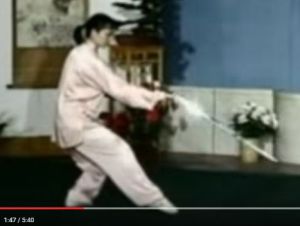
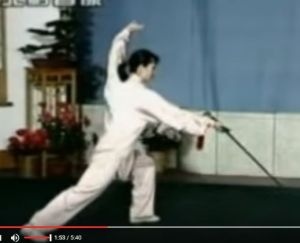
This completes the sequence for 56-Sword, following the demo by Fan Xue Ping. After xu bu dian jian, at about 4:30, she withdraws the sword, then steps up to bing bu ping ci (White Ape Presents the Fruit). From there she begins another retreating sequence.

56retreat

As she steps back, first with the right, she points the sword down (above). She retreats two more steps, left, right, each time pulling the sword back to her waist on the side to which she has stepped, left hand on the wrist.

56xiaci

Then she pivots on the right foot and does gong bu xia ci to the right front corner, as shown above. From there she does phoenix Spreads Wings, wheels the sword back on the left and chops down, as shown below.

56chopdown

She does another run of deng jiao, qian ci, tiao bu, ping ci. This is the third one in the form, and except for the direction she’s facing, I see no difference between them. From ping ci, she wheels the sword around on the left, dipping fairly low:

56dip

Then wheeling to the right, she dips with the right crossed in front of the left, as shown here:

56rcross

She then steps left and right, lifting the sword (liao jian). From there she pulls back to the position shown below.

56end

From there, she steps in a circle just as if to close 32-sword (Xieng zhuan ping me). But instead of the straight stab, she does bing bu ping ci and reaches under for the sword, as we do in closing Tai Chi Wudang Sword.

We’re done! I now know the sequence well enough to follow Long Feng and to practice on my own. However, I haven’t got complete lists of the names, poetic and descriptive, plus I would like to compare this form to Yang sword (which I don’t know very well). So I still have a lot to learn.

56-Sword: 4:00-4:30

I’ve reached Phoenix Spreads its Wings, or Che Bu Fan Ji, just before the four-minute mark in the demonstration video by Fan Xue Ping.

Phoenix Spreads its Wings

Phoenix Spreads its Wings

From the finishing position above, she shifts all the way onto the right, steps left and right, circling and lifting the sword—liao jian (below).

56liao

From there, she shifts back to the left, pulling the hilt of the sword in to the body and lifting the right knee. The she steps onto the right for Yaksha/Night Demon/Spirit (depending on your list) Searches the sea (below).

56necha

Another familiar sequence follows: Zhuan shen hui chou and Bing bu ping ci. From Yaksha, turn to face the opposite way, sword over the shoulder, then chop down and withdraw to left empty stance. The traditional name for Zhuan shen hui chou is (two moves actually) Rhonoceros Gazes at the Moon (Zhuan shen) and Shoot the Wild Goose (Hui chou).

Then step up to White Ape Offers the Fruit (feet together, level stab). She is now facing the front right corner. Another Phoenix Spreads Wings, leaves her facing the back left corner:

56phoenixbackleft

At 4:20 I encounter a completely new move. She shifts back and steps across with the right in front of the left. It’s a little jump, a falling step onto the right. Then steps left and presses down on the sword (below).

56jumpfence

Then she does it to the left: opens with the sword, shifts right, hops over with the left in front, then steps right and presses down, as below. Names may be Cross the Fence or Straddle and Block. I don’t know the modern descriptive names—I have those only for the names in common with 32-sword.

56jumpfenceR

From there, she shifts right and casts the sword overhead to Ding bu dian jian to the left front corner as shown below.

56fish

This brings us to 4:30. It’s enough sequence that I can follow Long Feng up to the new move—for which I need help! I don’t for a minute think I can learn the form from the video alone, but if I can get a handle on the sequence I can begin to learn by following Long Feng.

56-Sword: 3:00-4:00

The next full minute of the form consists of ten moves straight out of 32-sword, so maybe this is a good time to review. The movements all have both descriptive and traditional (or poetic) names. Which I’d like to hook up. My translations of the descriptive terms leave much to be desired. I don’t really care—why translate? Why not use the Chinese names?

The moves are:

Zuo/You/Zuo Gong Bu Lan (L, R, L bow stance block) = Dusting the Wind

Push Boat With Current

Push Boat With Current (Jin bu fan ci)

Jin Bu Fan Ci (advance and stab overhead) = Push Boat with Current

Comet Chases the Moon

Comet Chases the Moon (Fan shen hui pi)

Fan Shen Hui Pi (turn back circle chop) = Comet Chases the Moon

Pegasus Crosses the Sky (Xu bu dian jian)

Pegasus Crosses the Sky

Xu Bu Dian Jian (empty stance point sword) = Pegasus Crosses the Sky

Du Li Ping Tuo

Du Li Ping Tuo

Du Li Ping Tuo (stand on one leg hold up level) = Lifting the Curtain

I notice that a couple of transitions in this section are not what I’m used to. Fan Xue Ping stoops into xie bu ya jian (resting stance press the sword down) after Fan shen hui pi. Then, from Xu bu dian jian, she pulls the sword straight back up. I am accustomed to going straight from Fan shen hui pi to Xu bu dian jian, then wheeling the sword into xie bu ya jian. I am talking about this position being before or after pointing the sword in empty stance:

Xie Bu Ya Jian

Xie Bu Ya Jian

Gong Bu Gua Jian (bow stance wheel sword) = Wheeling the Sword Left and Right

Xu Bu Lun Pi (Wheeling Chop)

Xu Bu Lun Pi (Wheeling Chop)

Xu Bu Lun Pi (empty stance whirl and chop) = Right Wheeling chop

Phoenix Spreads its Wings

Phoenix Spreads its Wings

Che Bu Fan Ji (step back slash back) = Phoenix Spreads its Wings

56-Sword: 2:00-3:00

I left off at the two-minute mark of Fan Xue Ping’s exemplary demonstration video. Next is a series of three moves straight out of 32-sword: Du Li Lun Pi, Tui Bu Hui Chou, Du Li Shang Ci.

56-swordstand

She steps back with the left foot (facing away) and slashes left , palm-up, brings the feet together (bing bu) and slashes right, palm-down. Then pulls the sword in to the waist, like carrying the sword at the waist, ping dai. This is at 2:15 (above). She’s standing quite straight.

56-swordstab

She then does a complicated series of retreating and stabbing moves, facing all different directions, almost like four corners:

  1. One step straight back with the right, stabbing, then withdraws the sword to the waist. Tui bu ping ci? Step to left bow stance and stab–Zuo gong bu ping ci–to the back right corner (above).
  2. Turns around to her right 270 degrees: shift back, left toes in, step with right toe pointing to back left corner. With this turn, she turns the sword  over, from palm-up to palm-down, sweeping across (below), and then pulls it in to her waist, stepping in with the left.

56-swordsweep

This is followed by four retreating steps, starting with the left, a lot like block and sweep left and right, but retreating. Step left, pull the sword in to the left; step right, pull the sword into the right side. She finishes in position (below) to do a run of Lift Knee, Falling Step, Stab (Ti Xi Peng Jian, Tiao bu ping ci), which is also straight out of 32-sword.

52-swordtixi

Then she does Yang shen bao jian (circles the sword in front of her face and embraces it), turns back to her left in pu bu (below–doesn’t she look amazing?), and comes up to bing bu ping ci at the three-minute mark.

56-swordpubu

More than halfway through, with some familiar moves coming up. This is going faster than I expected!

56-sword continued

It appears that Michael Garofalo has lost his domain name! His website is such a great resource–I hope he’ll get it back up. I was counting on it for the traditional names for Yang sword (and for a lot of other things as well). [False alarm: Cloud Hands is fine. Whew!]

56-swordphoenix

I left off 56-sword at 1:30 in the excellent demo by Fan Xue Ping. She was in xu bu liao. What follows is: She slashes backhanded to the right, then steps in with the right foot and does Phoenix Spreads Wings (above). Repeat Xu Bu Liao.

56-swordxubuxiaci

Next, she steps back with the left foot and stabs downward to the left and circles the sword up, so the tip does a figure-8. She has shifted all her weight to the left and finishes this move stabbing down (xia ci) in xu bu (right empty stance–above).

56-swordblockdownright

The next move, repeated twice, is also unfamiliar. She steps right, blocking down with both hands on the hilt, as shown above (1:50), then steps left into what looks to me like zuo gong bu lan, except the sword is held lower. The first step is palm-down, the second is palm up. This brings us to 2:00 (below).

56-swordgongbulan

The form is a little more than five and a half minutes long. I’ll try to learn the whole sequence this winter.

Fan Form II: 1st Section

I’ve been going through Li De Yin’s instructional video for Fan Form II in Chinese, with Pan Huai’s help. So far, this involves learning a lot more Chinese–I wanted to know the names of the movements—but also, I’m learning how Professor Li breaks down the movements. Excellent form correction and detail!

Hai Di Fan Hua - Overturning Flowers from the Bottom of the Sea

Hai Di Fan Hua – Overturning Flowers from the Bottom of the Sea

So far I’ve only gotten through the first section, which consists of nine movements:

  1. Qi Shi
  2. Xu Bu Liao Shan
  3. Zhen Jiao Dou Shan
  4. Yun Shou Ba Shan
  5. Gong Bu Tui Shan
  6. Jia Shan Deng Jiao
  7. Du Li Pi Shan
  8. Hui Shen Beng Shan
  9. Ju Shan Chong Quan

The character for fan is this: 扇 and the word is Shan (sounds more like shen). The movements, like the movements of the contemporary sword forms, have two names—a descriptive name and a traditional name. The traditional names for the fan form are drawn mostly from other weapon forms.

The opening, Qi Shi, is the traditional White Ape Presents the Fruit– bái yuán xiàn guǒ. Stand with the fan held vertical in front, left hand shielding (not folded around) the right.

The traditional name for Xu Bu Liao Shan (Empty stance lift fan) is Jin Gang Liao Yi. This move resembles Jin Gang Dao Dui, except that the feet are close together. Liao Yi means to raise the hem, as of a skirt. The move is broken down by Professor Li as follows:

  • zhuan shen you lou (turn body and gather to the right)
  • ca bu ping tui (step the left foot forward and push [the fan to the right] level
  • gong bu zuo peng (bow stance ward-off left)
  • xu bu liao shan

Ca bu is new to me. It sounds a lot like cha bu, but it’s the step forward while shifted back (cha bu is cross step behind).

Third, Zhen Jiao Dou Shan (Stamp foot shake out fan). The traditional name, Hai Di Fan Hua (Overturn Flowers from sea bottom) describes the foam of a breaking wave.

  • Ju shan ti tui (raise fan lift leg)
  • Zhen jiao za shan (stamp the foot, pound the fan)
  • Zhuan yao bai bi (turn waist swing arms)
  • Ba quan dou shan (pull up fist shake out fan)

Fourth move: Yun Shou Ba Shan (Cloud hands pull fan). Traditional name, Cha bu yun shou (Cloud hands with cross step behind). The breakdown:

  • Kai bu you ba (open step pull right)
  • Cha bu Zuo ba (cross step pull left)
  • Kai bu you ba (open step pull right)
  • Cha bu Zuo ba (cross step pull left).

Move number 5 is Gong Bu Tui Shan (Bow Stance Push Fan). Traditional name is Lou xi au bu, the Yang brush knee push (or brush knee twist step).

  • Zhuan yao bai shan (turn waist swing fan)
  • Ti jiao fan shan (lift foot flip over fan)
  • Shang bu shou shan (step up collect/put away fan)
  • Gong bu tui shan (bow stance push fan)

Six: Jia Shan Deng Jiao (support fan heel kick). Jia is frame; jia shan is holding it up as if on a shelf. The traditional name, Tiao Lian Tui Chuang, is familiar from Yang sword—rolling up the screen.

  • Zhuan yao he shan (turn waist close fan)
  • Shang bu rao shan (step up spiral fan)
  • Ti tui ti shan (lift leg lift fan)
  • Beng jiao jia shan (collapse leg, support fan)

Seven: Du Li Pi Shan (stand on one leg chop/split fan) is a saber move, a chop as if to split logs with an axe. The traditional name, Na Zha Tan Hai (Na Zha goes to the sea bottom) invokes a well-known story. Na Zha is angry about his village not getting the rain it needs, so he goes to the sea bottom and hits the Long Wang (Dragon King), the rain god. The breakdown for number seven is:

  • Zhuan shen gua shan (turn body hang fan)
  • Gai bu ju shan (covering step raise fan)
  • Du li pi shan (stand on one leg chop fan)

Gai bu, the covering step, is a step across in front.

Hui Shen Beng Shan

Hui Shen Beng Shan

The eighth move is Hui Shen Beng Shan (turn back collapse fan). Collapse isn’t the right word; it’s a flick back to open the fan. The traditional name is entirely unfamiliar to me: Da Mang Fan Shen (big python turns back body).  It is clearly a snake move.

  • Kou bu chuan zhang (closing stance piercing palm—kou means fasten)
  • Tui bu ya zhang (step back press palm)
  • Zhuan shen chuan ci (turn body piercing stab)
  • Du li beng shan (stand on one leg flick fan back)

Last move in the first section: Ju Shan Chong Quan (Raise fan thrust fist). The traditional name is—surprise!—Wan Gong She Hu! Bend Bow shoot Tiger. Facing front. Professor Li does this with the fist rotated away from the body, as in Hit the Tiger.

  • Luo jiao bai bu (lower leg swinging step)
  • Kou bu fan shen (closing step turn body back)
  • Zhuan shen bai shan (turn body swing fan)
  • Ju shan chong quan
Bend Bow Shoot Tiger

Bend Bow Shoot Tiger

The pictures are all grabs from three wonderful demos by Professor Li’s daughter, Faye Li Yip.

The third video is particularly useful because of the slower pace. The lovely music seems to have been added afterwards. You can see her performing at speed, to Xi Yang Mei, in the first two.

Laojia Yilu Section 1

My class will be learning Laojia Yilu this coming year; we started last week. All of us already know the Chen 38 short form, so we’ve got a running start.

My class performing Laojia Erlu with Grandmaster Gohring, Dec. 2015

My class performing Laojia Erlu with Grandmaster Gohring, Dec. 2015

We count the first section as going up to the first Yan Shou Gong Quan (hidden hand punch). This section differs from the Chen 38 only in the addition of one new move after Lou Xi, which is then followed by a second Xie Xing/Lou Xi combination. So the sequence is:

  1. Jin Gang Dao Dui
  2. Lan Zha Yi
  3. Liu Feng Si Bi
  4. Dan Bian
  5. Jin Gang Dao Dui
  6. Bai He Liang Chi
  7. Xie Xing
  8. Lou Xi
  9. Shang San Bu (Step up three steps)
  10. Xie Xing
  11. Lou Xi
  12. Yan Shou Gong Quan
Shang San Bu

Shang San Bu, Grandmaster Gohring

At the end of the first Lou Xi, he rocks back on the left heel, steps up with the right. He shifts back, swinging the right arm across to the left, then pushes and shifts forward. The right hand is rotated so the fingers point to the left, palm away. The fingers of the left hand point up.

That’s it! Circle the hands to the left and step left into a second Xie Xing. Repeat Lou Xi. We have two videos of this section:

Laojia Erlu – Review

Laojia Erlu, also known as Pao Chui, is one of two Chen forms that I learned in class at Master Gohring’s Tai Chi and Kung Fu this year. My class will be performing it with now-Grandmaster Gohring in a few weeks, so I am pulling together all my posts on this form. Time to review!

The videos:

That last video, which is an hour long, is excellent, and it’s surprising how much you can understand the Chinese part if you know the Chinese names (see below) and how to count to about 8 in Chinese: yi, er (pronounced like are), san, si (suh), wo, liu (leo), qi (chee), ba.

BUT! Everything is also in English! The intro is long (history of Chen, credentials of Chen ZiQiang); instruction starts about 18 minutes in. BUT! I should also say that the form is slightly different from what we’re doing (which is what Chen Bing is doing).

List of names:

My posts working through the whole form with grabs from the Chen Bing video:

  1. First fast section
  2. Cloud Hands
  3. Firecrackers!
  4. The Yellow Dragon
  5. Sweeps
  6. Quan Pao Chui
  7. Last moves

All my posts on Pao Chui: Tag Laojia Erlu


Script for Ba Duan Jin

My practice group uses music with instructions to do the Eight Brocades. Pan Huai found the script and gave me both Pinyin and a translation (which I have amended slightly to follow English usage in martial arts as I know it). Here’s how it goes:

健身气功八段锦
jiàn shēn qì gōng bā duàn jǐn
Health Qi Gong Eight Section Brocade

预备式
yù bèi shì
Preparing form

Yu bei shi is an instruction for every form, so it’s a good bit of vocabulary to know. When you hear it, stand in a neutral position, Feet together, arms at your sides, and breathe deeply but naturally.

左脚开步;与肩同宽;屈膝下蹲;掌抱腹前
zuǒ jiǎo kāi bù ;yǔ jiān tóng kuān ;qū xī xià dūn ;zhǎng bào fù qián
Step left to shoulder width, bend the knees and sink down; hold the hand in front of the belly, palms facing in

Some of these words are already familiar: Zuo is left, Jiao is leg, Kai is open, bu is stance. Qu is bend, xi is knees. Zhang is palm. Bao is embrace.

中正安舒;呼吸自然;心神宁静;意守丹田
zhōng zhèng ān shū ;hū xī zì rán ;xīn shén níng jìng ;yì shǒu dān tián
Body centered and straight, relax; breathe naturally, calm your mind and facial expression, focus your mind on the Dan Tian

Hu xi is breathe; hu is exhale and xi is inhale.

两手托天理三焦
liǎng shǒu tuō tiān lǐ sān jiāo
Two Hands Reach up to the Heavens to regulate San Jiao

The first exercise i the set. San Jiao is the “triple burner” — a concept in Chinese medicine that refers to the generation of heat within the body. The instruction for this first movement is simple: lift the arms with fingers interlaced, then lower them to the sides. We do the movement six times, but the script ends on the last “Lift up,” after which the arms are lowered to the starting position for the next exercise (which is crossed hands).

上托、下落
shàng tuō 、xià luò
Lift up, Lower [the arms] down (6 repetitions)

左右开弓似射雕
zuǒ yòu kāi gōng sì shè diāo
Draw the Bow to Shoot the Eagle

Script for the second exercise. Gong is bow. Bing bu is feet together. We do this one three times on each side. Again, the last bing bu is omitted and instead you take the position for the next exercise  (feet together, sink down, right hand palm-down, left ready to lift).

撘腕、开弓、并步
dā wàn 、kāi gōng 、bìng bù
Cross the wrist, draw the bow, feet together (3 repetitions on each side)

调理脾胃须单举
diào lǐ pí wèi xū dān jǔ
Raise hand on each side to adjust the Spleen & Stomach

Instruction for the third exercise. Shang is upwards, xia is downwards. These words occur in a lot of instructions and forms; good to know. Again, 6 reps–three on each side–and the last xia luo is omitted. Move to position for the next exercise, which would be with both hands down, level with the ground, palms down.

上举、下落
shàng jǔ 、xià luò
Lift up, lower [the hand] down (3 repetitions on each side)

五劳七伤往后瞧
wǔ láo qī shāng wǎng hòu qiáo
Look back to [relieve? prevent?] Five Fatigues and Seven Illnesses

The name of this fourth exercise has been translated so many ways. As best I understand it, the looking backward, then turning forward, has an added connotation of forgetting, releasing, leaving behind. Shang means wound or injury, but here, may also refer to seven emotions: happy, angry, sad, worried, startled (nervous?), frightened, laughing. So maybe the idea is to look back, then leave it all behind. Put it all behind you? As a way of achieving peace and balance. I like this idea.

起身、后瞧、转正
qǐ shēn 、hòu qiáo 、zhuǎn zhèng
Stand up, turn head back, turn to front (3 repetitions on each side)

Zhuan (turn) is a good word to know, as is shen (body). Zhuan shen (turn body) is an instruction that occurs frequently in Tai Chi. We’re told to stand up because in the starting position the knees are bent; they should be bent upon returning to front. The last zhuan zheng is omitted and the starting position for the next movement is both palms facing in.

摇头摆尾去心火
yáo tóu bǎi wěi qù xīn huǒ
Sway the Head and Shake the Tail to get rid of the Xin-Huo

I’m a little mystified by Xin-Huo. Xin is heart and Huo is fire; Xin-Huo is heart-fire. But I wonder: is that heartburn???

上托、下按
shàng tuō 、xià àn
Lift up, press down

This last is the instruction for getting into position (stepping out to ma bu).

右倾、左旋、摇头、摆尾;左倾、右旋、摇头、摆尾
yòu qīng 、zuǒ xuán 、yáo tóu 、bǎi wěi ;zuǒ qīng 、yòu xuán 、yáo tóu 、bǎi wěi
Lean right, swing left, sway the head, shake the tail; Lean left, swing right, sway the head, shake the tail (3 repetitions)

I have to say I am not so sure what “shake the tail” means. The movement is more like roll the head and swing the tail (which you could use for the English instead). The following is the one-time instruction for lifting the arms and moving the feet back together:

上举
shàng jǔ
Lift up [the arms]

两手攀足固肾腰
Liǎng shǒu pān zú gù shèn yāo
Two Hands Hold the Feet to Strengthen the Kidneys and Waist

上举、下按、反穿、摩运、攀足
shàng jǔ 、xià àn 、fǎn chuān 、mó yùn 、pān zú
Lift up, press down, move the hands to the back, message legs (6 repetitions)

Add one last Shang Ju (Lift up) to straighten, then sink into the starting position for the next exercise (fists chambered at the waist).

攒拳怒目增气力
zǎn quán nù mù zēng qì lì
Clench the Fists and Glare Fiercely (or Angrily) to Improve Strength and Qi

Starting instruction:

抱拳
bào quán
Clench the fists

攒拳怒目、抓握、回收; 攒拳怒目、抓握、回收;
zǎn quán nù mù 、zhuā wò 、huí shōu ; zǎn quán nù mù 、zhuā wò 、huí shōu ;
Clench the Fists and Glare Fiercely, grab and clench the fist, pull the fist back (3 times left and right)

Omit the last hui shou to move into position (neutral standing position) for the last exercise. In the script for the one above, in English it would make more sense to say “punch with the [left or right] fist” rather than just clench.

背后七颠百病消
bèi hòu qī diān bǎi bìng xiāo
Bouncing (7 Times) on the Feet, Toes, Heel to Help Prevent Disease

提踵、颠足
tí zhǒng 、diān zú
Lift up heels, bounce on the feet (7 repetitions)

The script omits the last dian zu. Remain in that neutral standing position for:

收式
shōu shì
Close form

两手合于腹前
liǎng shǒu hé yú fù qián
Place your hands on the Dan Tian

体态安详;周身放松;呼吸均匀;气沉丹田
tǐ tài ān xiáng ;zhōu shēn fàng sōng ;hū xī jun1 yún ;qì chén dān tián
Relax the body, breathe evenly, Qi goes back to Dan Tian

Ba Duan Jin: Second Four

Continuing with the instructional video, which Pan Huai is interpreting from the Chinese. The second four exercises are described in an earlier post. We are adding details and corrections.

bdj5-1

Yao Tou Bai Wei (#5): Having just finished Wu Lau Qi Shang, he has both hands down at the sides, palms parallel to the ground, fingers pointing forward. Swing the arms up and step out to ma-bu-width, as shown in the picture above. He then presses down and braces the hands on the thighs.

bdj5-2

We notice that he does not lunge right and left; that is, he does not straighten the leg he is leaning away from. Instead he (mostly) leaves his hips in place to bend over, as shown above. When bending over, he is looking at the toe of the foot he’s leaning over. As he swings to the side, he looks at the heel of that same foot. See what that does to his head below.

bdj5-3

Looking from above you can see how he rolls his head at the end to come back up:

bdj5-4

Liang Shou Pan Jiao (#6): At the end of Yao Tou Bai Wei, he raises up to the starting position and closes the feet. He begins #6 by pressing down with the hand. At chest height, he turns them palm-up. Notice how high up he does this; he will draw the hands around to the back as high under the arms as he can:

bdj6-1

Then, starting as high up on the back as possible, he presses the fingers along the spine and firmly massages downward. He remains upright until the hand have traveled all the way down to the tail bone, pressing firmly on either side of the spine.

bdj6-2

Bending over he massages down the backs of the legs down to the feet. This part is a stretch for the backs of the legs. He then reaches forward and stretches the upper body upon rising.

bdj6-3

Wo Quan Nu Mu (#7): Sit in horse stance and extend the fist, turning at the waist. Look at the fist. You can see below that his shoulders are well turned aside, which means he is twisting both at the waist and at the neck.

bdj7-3

The hand movement is a little complicated. First open the fist, so the palm faces in (in the grab below, I was a bit late; he starts with the palm perpendicular to the ground):

bdj7-4

Rotate, so the palm faces all the way out:

bdj7-5

Circle the hand as if flat on a wall in front of you, until the fingers point down and the palm faces out.

bdj7-6

Then close the fingers over the thumb. This is quite a stretch in the forearm, wrist and fingers.

Bei Hou Qi Dian Bai Bing Xiao (#8): I have nothing special to add to this one except that you stand up as high on the toes as you can.