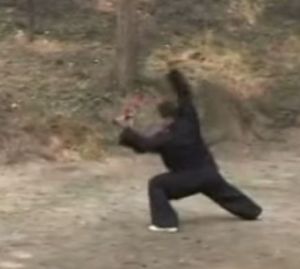
56-Sword: 4:00-4:30

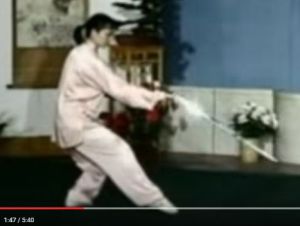
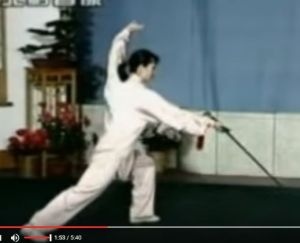
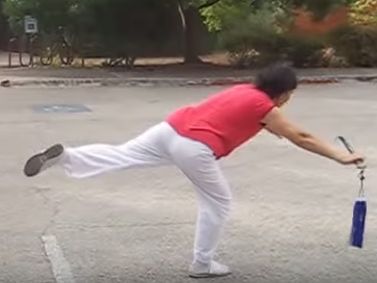
I’ve reached Phoenix Spreads its Wings, or Che Bu Fan Ji, just before the four-minute mark in the demonstration video by Fan Xue Ping.

Phoenix Spreads its Wings

Phoenix Spreads its Wings

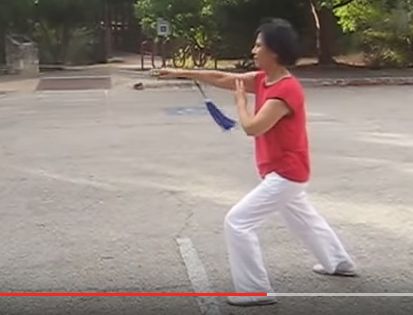
From the finishing position above, she shifts all the way onto the right, steps left and right, circling and lifting the sword—liao jian (below).

56liao

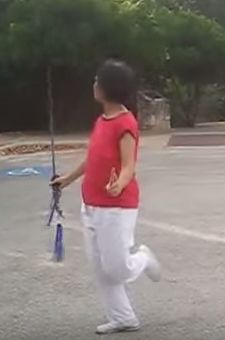
From there, she shifts back to the left, pulling the hilt of the sword in to the body and lifting the right knee. The she steps onto the right for Yaksha/Night Demon/Spirit (depending on your list) Searches the sea (below).

56necha

Another familiar sequence follows: Zhuan shen hui chou and Bing bu ping ci. From Yaksha, turn to face the opposite way, sword over the shoulder, then chop down and withdraw to left empty stance. The traditional name for Zhuan shen hui chou is (two moves actually) Rhonoceros Gazes at the Moon (Zhuan shen) and Shoot the Wild Goose (Hui chou).

Then step up to White Ape Offers the Fruit (feet together, level stab). She is now facing the front right corner. Another Phoenix Spreads Wings, leaves her facing the back left corner:

56phoenixbackleft

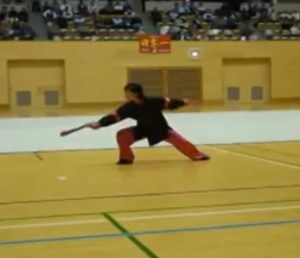
At 4:20 I encounter a completely new move. She shifts back and steps across with the right in front of the left. It’s a little jump, a falling step onto the right. Then steps left and presses down on the sword (below).

56jumpfence

Then she does it to the left: opens with the sword, shifts right, hops over with the left in front, then steps right and presses down, as below. Names may be Cross the Fence or Straddle and Block. I don’t know the modern descriptive names—I have those only for the names in common with 32-sword.

56jumpfenceR

From there, she shifts right and casts the sword overhead to Ding bu dian jian to the left front corner as shown below.

56fish

This brings us to 4:30. It’s enough sequence that I can follow Long Feng up to the new move—for which I need help! I don’t for a minute think I can learn the form from the video alone, but if I can get a handle on the sequence I can begin to learn by following Long Feng.

56-Sword: 3:00-4:00

The next full minute of the form consists of ten moves straight out of 32-sword, so maybe this is a good time to review. The movements all have both descriptive and traditional (or poetic) names. Which I’d like to hook up. My translations of the descriptive terms leave much to be desired. I don’t really care—why translate? Why not use the Chinese names?

The moves are:

Zuo/You/Zuo Gong Bu Lan (L, R, L bow stance block) = Dusting the Wind

Push Boat With Current

Push Boat With Current (Jin bu fan ci)

Jin Bu Fan Ci (advance and stab overhead) = Push Boat with Current

Comet Chases the Moon

Comet Chases the Moon (Fan shen hui pi)

Fan Shen Hui Pi (turn back circle chop) = Comet Chases the Moon

Pegasus Crosses the Sky (Xu bu dian jian)

Pegasus Crosses the Sky

Xu Bu Dian Jian (empty stance point sword) = Pegasus Crosses the Sky

Du Li Ping Tuo

Du Li Ping Tuo

Du Li Ping Tuo (stand on one leg hold up level) = Lifting the Curtain

I notice that a couple of transitions in this section are not what I’m used to. Fan Xue Ping stoops into xie bu ya jian (resting stance press the sword down) after Fan shen hui pi. Then, from Xu bu dian jian, she pulls the sword straight back up. I am accustomed to going straight from Fan shen hui pi to Xu bu dian jian, then wheeling the sword into xie bu ya jian. I am talking about this position being before or after pointing the sword in empty stance:

Xie Bu Ya Jian

Xie Bu Ya Jian

Gong Bu Gua Jian (bow stance wheel sword) = Wheeling the Sword Left and Right

Xu Bu Lun Pi (Wheeling Chop)

Xu Bu Lun Pi (Wheeling Chop)

Xu Bu Lun Pi (empty stance whirl and chop) = Right Wheeling chop

Phoenix Spreads its Wings

Phoenix Spreads its Wings

Che Bu Fan Ji (step back slash back) = Phoenix Spreads its Wings

56-Sword: 2:00-3:00

I left off at the two-minute mark of Fan Xue Ping’s exemplary demonstration video. Next is a series of three moves straight out of 32-sword: Du Li Lun Pi, Tui Bu Hui Chou, Du Li Shang Ci.

56-swordstand

She steps back with the left foot (facing away) and slashes left , palm-up, brings the feet together (bing bu) and slashes right, palm-down. Then pulls the sword in to the waist, like carrying the sword at the waist, ping dai. This is at 2:15 (above). She’s standing quite straight.

56-swordstab

She then does a complicated series of retreating and stabbing moves, facing all different directions, almost like four corners:

  1. One step straight back with the right, stabbing, then withdraws the sword to the waist. Tui bu ping ci? Step to left bow stance and stab–Zuo gong bu ping ci–to the back right corner (above).
  2. Turns around to her right 270 degrees: shift back, left toes in, step with right toe pointing to back left corner. With this turn, she turns the sword  over, from palm-up to palm-down, sweeping across (below), and then pulls it in to her waist, stepping in with the left.

56-swordsweep

This is followed by four retreating steps, starting with the left, a lot like block and sweep left and right, but retreating. Step left, pull the sword in to the left; step right, pull the sword into the right side. She finishes in position (below) to do a run of Lift Knee, Falling Step, Stab (Ti Xi Peng Jian, Tiao bu ping ci), which is also straight out of 32-sword.

52-swordtixi

Then she does Yang shen bao jian (circles the sword in front of her face and embraces it), turns back to her left in pu bu (below–doesn’t she look amazing?), and comes up to bing bu ping ci at the three-minute mark.

56-swordpubu

More than halfway through, with some familiar moves coming up. This is going faster than I expected!

56-sword continued

It appears that Michael Garofalo has lost his domain name! His website is such a great resource–I hope he’ll get it back up. I was counting on it for the traditional names for Yang sword (and for a lot of other things as well). [False alarm: Cloud Hands is fine. Whew!]

56-swordphoenix

I left off 56-sword at 1:30 in the excellent demo by Fan Xue Ping. She was in xu bu liao. What follows is: She slashes backhanded to the right, then steps in with the right foot and does Phoenix Spreads Wings (above). Repeat Xu Bu Liao.

56-swordxubuxiaci

Next, she steps back with the left foot and stabs downward to the left and circles the sword up, so the tip does a figure-8. She has shifted all her weight to the left and finishes this move stabbing down (xia ci) in xu bu (right empty stance–above).

56-swordblockdownright

The next move, repeated twice, is also unfamiliar. She steps right, blocking down with both hands on the hilt, as shown above (1:50), then steps left into what looks to me like zuo gong bu lan, except the sword is held lower. The first step is palm-down, the second is palm up. This brings us to 2:00 (below).

56-swordgongbulan

The form is a little more than five and a half minutes long. I’ll try to learn the whole sequence this winter.

Fan Form II: 1st Section

I’ve been going through Li De Yin’s instructional video for Fan Form II in Chinese, with Pan Huai’s help. So far, this involves learning a lot more Chinese–I wanted to know the names of the movements—but also, I’m learning how Professor Li breaks down the movements. Excellent form correction and detail!

Hai Di Fan Hua - Overturning Flowers from the Bottom of the Sea

Hai Di Fan Hua – Overturning Flowers from the Bottom of the Sea

So far I’ve only gotten through the first section, which consists of nine movements:

  1. Qi Shi
  2. Xu Bu Liao Shan
  3. Zhen Jiao Dou Shan
  4. Yun Shou Ba Shan
  5. Gong Bu Tui Shan
  6. Jia Shan Deng Jiao
  7. Du Li Pi Shan
  8. Hui Shen Beng Shan
  9. Ju Shan Chong Quan

The character for fan is this: 扇 and the word is Shan (sounds more like shen). The movements, like the movements of the contemporary sword forms, have two names—a descriptive name and a traditional name. The traditional names for the fan form are drawn mostly from other weapon forms.

The opening, Qi Shi, is the traditional White Ape Presents the Fruit– bái yuán xiàn guǒ. Stand with the fan held vertical in front, left hand shielding (not folded around) the right.

The traditional name for Xu Bu Liao Shan (Empty stance lift fan) is Jin Gang Liao Yi. This move resembles Jin Gang Dao Dui, except that the feet are close together. Liao Yi means to raise the hem, as of a skirt. The move is broken down by Professor Li as follows:

  • zhuan shen you lou (turn body and gather to the right)
  • ca bu ping tui (step the left foot forward and push [the fan to the right] level
  • gong bu zuo peng (bow stance ward-off left)
  • xu bu liao shan

Ca bu is new to me. It sounds a lot like cha bu, but it’s the step forward while shifted back (cha bu is cross step behind).

Third, Zhen Jiao Dou Shan (Stamp foot shake out fan). The traditional name, Hai Di Fan Hua (Overturn Flowers from sea bottom) describes the foam of a breaking wave.

  • Ju shan ti tui (raise fan lift leg)
  • Zhen jiao za shan (stamp the foot, pound the fan)
  • Zhuan yao bai bi (turn waist swing arms)
  • Ba quan dou shan (pull up fist shake out fan)

Fourth move: Yun Shou Ba Shan (Cloud hands pull fan). Traditional name, Cha bu yun shou (Cloud hands with cross step behind). The breakdown:

  • Kai bu you ba (open step pull right)
  • Cha bu Zuo ba (cross step pull left)
  • Kai bu you ba (open step pull right)
  • Cha bu Zuo ba (cross step pull left).

Move number 5 is Gong Bu Tui Shan (Bow Stance Push Fan). Traditional name is Lou xi au bu, the Yang brush knee push (or brush knee twist step).

  • Zhuan yao bai shan (turn waist swing fan)
  • Ti jiao fan shan (lift foot flip over fan)
  • Shang bu shou shan (step up collect/put away fan)
  • Gong bu tui shan (bow stance push fan)

Six: Jia Shan Deng Jiao (support fan heel kick). Jia is frame; jia shan is holding it up as if on a shelf. The traditional name, Tiao Lian Tui Chuang, is familiar from Yang sword—rolling up the screen.

  • Zhuan yao he shan (turn waist close fan)
  • Shang bu rao shan (step up spiral fan)
  • Ti tui ti shan (lift leg lift fan)
  • Beng jiao jia shan (collapse leg, support fan)

Seven: Du Li Pi Shan (stand on one leg chop/split fan) is a saber move, a chop as if to split logs with an axe. The traditional name, Na Zha Tan Hai (Na Zha goes to the sea bottom) invokes a well-known story. Na Zha is angry about his village not getting the rain it needs, so he goes to the sea bottom and hits the Long Wang (Dragon King), the rain god. The breakdown for number seven is:

  • Zhuan shen gua shan (turn body hang fan)
  • Gai bu ju shan (covering step raise fan)
  • Du li pi shan (stand on one leg chop fan)

Gai bu, the covering step, is a step across in front.
Hui Shen Beng Shan

Hui Shen Beng Shan

The eighth move is Hui Shen Beng Shan (turn back collapse fan). Collapse isn’t the right word; it’s a flick back to open the fan. The traditional name is entirely unfamiliar to me: Da Mang Fan Shen (big python turns back body).  It is clearly a snake move.

  • Kou bu chuan zhang (closing stance piercing palm—kou means fasten)
  • Tui bu ya zhang (step back press palm)
  • Zhuan shen chuan ci (turn body piercing stab)
  • Du li beng shan (stand on one leg flick fan back)

Last move in the first section: Ju Shan Chong Quan (Raise fan thrust fist). The traditional name is—surprise!—Wan Gong She Hu! Bend Bow shoot Tiger. Facing front. Professor Li does this with the fist rotated away from the body, as in Hit the Tiger.

  • Luo jiao bai bu (lower leg swinging step)
  • Kou bu fan shen (closing step turn body back)
  • Zhuan shen bai shan (turn body swing fan)
  • Ju shan chong quan
Bend Bow Shoot Tiger

Bend Bow Shoot Tiger

The pictures are all grabs from three wonderful demos by Professor Li’s daughter, Faye Li Yip.

The third video is particularly useful because of the slower pace. The lovely music seems to have been added afterwards. You can see her performing at speed, to Xi Yang Mei, in the first two.

Laojia Yilu Section 1

My class will be learning Laojia Yilu this coming year; we started last week. All of us already know the Chen 38 short form, so we’ve got a running start.

My class performing Laojia Erlu with Grandmaster Gohring, Dec. 2015

My class performing Laojia Erlu with Grandmaster Gohring, Dec. 2015

We count the first section as going up to the first Yan Shou Gong Quan (hidden hand punch). This section differs from the Chen 38 only in the addition of one new move after Lou Xi, which is then followed by a second Xie Xing/Lou Xi combination. So the sequence is:

  1. Jin Gang Dao Dui
  2. Lan Zha Yi
  3. Liu Feng Si Bi
  4. Dan Bian
  5. Jin Gang Dao Dui
  6. Bai He Liang Chi
  7. Xie Xing
  8. Lou Xi
  9. Shang San Bu (Step up three steps)
  10. Xie Xing
  11. Lou Xi
  12. Yan Shou Gong Quan
Shang San Bu

Shang San Bu, Grandmaster Gohring

At the end of the first Lou Xi, he rocks back on the left heel, steps up with the right. He shifts back, swinging the right arm across to the left, then pushes and shifts forward. The right hand is rotated so the fingers point to the left, palm away. The fingers of the left hand point up.

That’s it! Circle the hands to the left and step left into a second Xie Xing. Repeat Lou Xi. We have two videos of this section:

Laojia Erlu – Review

Laojia Erlu, also known as Pao Chui, is one of two Chen forms that I learned in class at Master Gohring’s Tai Chi and Kung Fu this year. My class will be performing it with now-Grandmaster Gohring in a few weeks, so I am pulling together all my posts on this form. Time to review!

The videos:

That last video, which is an hour long, is excellent, and it’s surprising how much you can understand the Chinese part if you know the Chinese names (see below) and how to count to about 8 in Chinese: yi, er (pronounced like are), san, si (suh), wo, liu (leo), qi (chee), ba.

BUT! Everything is also in English! The intro is long (history of Chen, credentials of Chen ZiQiang); instruction starts about 18 minutes in. BUT! I should also say that the form is slightly different from what we’re doing (which is what Chen Bing is doing).

List of names:

My posts working through the whole form with grabs from the Chen Bing video:

  1. First fast section
  2. Cloud Hands
  3. Firecrackers!
  4. The Yellow Dragon
  5. Sweeps
  6. Quan Pao Chui
  7. Last moves

All my posts on Pao Chui: Tag Laojia Erlu


56-Sword

Long Feng is satisfied that I know both Wudang Tai Chi Sword and Yi Jian Mei, and has started teaching me 56-sword. I think I need a lot of practice before I will be able to do either of those two forms as well as I’d like, but I am excited to start learning the sequence for 56–wo shi liu shi. That was my goal for the coming year.

Excellent video of 56-sword; Qi Shi.

Excellent video of 56-sword; Qi Shi.

To start with, here’s an excellent video, which I think will turn out to be the same thing Long Feng is doing. So many of the movements are also found in the other two forms and 32-sword as well! Other movements are reminiscent of the traditional long form, with which I have only a small acquaintance.

Looking at the opening, the first thing she does (in the picture above) is turn to her right and, as in lan que wei, does press and push. Then she continues with Three Rigs Around the Moon. So Qi Shi is like 32-sword, except for that press and push. What I see so far is:

  1. Qi Shi
  2. Ding Bu Dian Jian
  3. Du Li Fan Ci
  4. Pu Bu Heng Sao
  5. You Zuo Ping Dai

Then she transitions as if to do Fen Jiao Ling Jian (Wudang) but instead of kicking, she does this:

65xubu

Looks like Xu Bu Liao. Then she turns to face the back and continues with a series just like Wudang Taiji Jian:

7. Pu Bu Chuan Jian

8. Deng Jiao Qian Ci

9. Tiao Bu Ping Ci

10. Zhuan Shen Ping Ci

She then does what looks like Phoenix Spreads Wings, or what in 32-sword is called Che Bu Fan Liao and then again Zuo Xu Bu Liao. The move after that is unrecognizable to me (except it somewhat resembles the last move in Yi Jian Mei!). This is enough to get me started. I need to find a real list of names.

Clearly, knowing the forms I’ve already learned, this will go a lot faster. That’s already the first minute and a half. To be continued!

Finishing Yi Jian Mei

All that’s left are the four instrumental lines in the middle of the song and the closing. That middle section begins from this position.

LFYJMchorus5

Line 1: Step with the left foot around to face stage right, then step out toward the front with the right to face front again. The arms close and cross. Swing the sword backhand out to the right.

Line 2: Turn the sword over and draws a big backward C as if winding up for zuo gong bu lan. Facing stage right, step right and strike the odd pose shown below. The hands are positioned as if to push the blade—but you would cut yourself! So don’t actually touch the blade with the left hand.

lastyjm2

Line 3: Turns around to the left while straightening, and set the left foot down facing the opposite way. Stab forward, left hand touching the upper arm, gong bu, as shown.

lastyjm3

Then step forward on the right while wheeling the sword in front (hilt circles clockwise) to point the sword, and look, to the back, left arm extended as shown.

lastyjm4

Step forward on the left, closing the arms so the wrists cross. Left foot is turned out to face left near corner. Step around so the right foot also points to the left front corner and lifts the left foot from the knee. Collapse the sword as shown below.

lastyjm5

Line 4: Step left, cross step right, left (travelling to stage right), then walk in a circle right-left-right. Pivot the left foot and xie bu to prepare to resume at verse 3 in this position:

LFYJMV2-4

While traveling left, draw big clockwise circles with the sword. At the start of the walking-in-a-circle part, circle the sword to go palm up and lead with the hilt. Swing it around for finish in xie bu.

On the very first step left, Long Feng rises to make a little hop onto the right cross-step. The lift coincides with the lift of the sword. It’s a cute little step.

Shou Shi begins from the position shown at the top of this post (after the long repeat). Close the arms and take the hilt in the left hand. Extend the left arm and set the sword fingers at the hip.

Swing the left across in front while twisting the wrist as if to hold a tray. At the same time, lift the left knee and pulse up with the right. Looks like this:

lastyjm6

Then take four steps, LRLR in a circle to face front, left xu bu. Spiral the sword down on the left on the last two steps..

Step back with the left, bring the right back to the left, knees bent, feet shoulder width. Make another circle with the right hand at the same time. Lower the right hand and straighten the knees. Feet together. That’s it!

Chen ZiQiang Videos

Chen ZiQiang is the son of Chen Xiaoxing and nephew of Chen Xiaowang. He’s also the great grandson of Chen Fake. (In case you’re wondering, as I was, that’s pronounced Fah-kuh.) Kungfumagazine.com has a good article (from 2006) on Chen ZiQiang: What it Takes to be a Taiji Master in Chen Village.

Chen ZiQiang step-by step Pao Chui

Chen ZiQiang step-by step Pao Chui on YouTube

A lot of video has been posted, and continues to be posted (he is young and active), on YouTube. As recently as May 2015, an hour-long tutorial on Laojia Erlu was posted. He demonstrates each move multiple times, slowly, with names in both Chinese and English.

The intro is long, with history of Chen Taiji (interesting!) and Chen ZiQiang’s lineage and credentials. The actual breakdown begins around the 18-minute mark. The English translations of names vary from what I’ve seen elsewhere, but the Chinese names are the same. It’s my first opportunity to learn how to pronounce them correctly.

Chen ZiQiang Double Saber Demo

Chen ZiQiang Double Saber Demo

I learned about Chen ZiQiang when Grandmaster Gohring (my teacher) sent around the link to Chen ZiQiang’s demo of the double sabers, which we are working on in class. Other Chen ZiQiang video links to study:

The Chen sword demo is another step-by-step tutorial. Laojia Yilu and saber are just demos. For those who like to do push-hands, YouTube has a whole slew of Chen ZiQiang Tui Shou video.