Unknown's avatar

About elizabethbuhmann

Author of Mystery Novels--Lay Death at Her Door, Blue Lake, Accidents of Life, and Freewheeling--plus a new detective series, Murder on the Gulf Coast.

Pao Chui Part 4

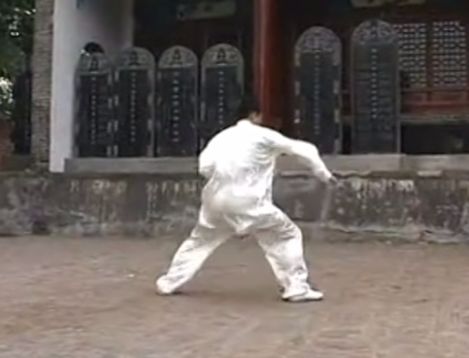
From Yan Shou Gong Quan, Chen Bing makes a quarter-turn to the right, moving his right foot. Then he steps to a wider stance with the right, reaches with the left hand, grabs and pulls while hammering with the right. Below you see him grab with left:

reachleft

Hammer with right:

hammerright

He then advances with a skipping left-right and repeats the grab-hammer, which is called Duo Er Gong, double forearm punches.

Next, he steps forward with the left throwing three quick punches, left, right, left. This move is called Zuo Er Gong You Er Gong.

Hui Tou Dang Men Pao is a turning move. After the last punch left, he picks up his left foot and monkey hops around, left-right-left and hits back in the direction he came from with both forearms. He then mirrors that move, right-left-right coming back, with the Dang Men Pao to his left:

dangmenpao

At 3:00, he picks up his right foot and does an elbow block at the waist. He follows this with another right elbow strike, this one not blocked by the left hand. He then skips left-right and does another grab-and-hammer.

It’s not clear how to parse the names with the movements in this section. Yao Lan Zhou is a repeated move, the elbow block at the waist, which I recognize (from just before Da Gong Quan Xiao Gong Quan). I think Wo Di Da Zhuo Pao must be the blows at the end of the turning move, Hui Tou Dang Men Pao. Then Shun Lan Zhou is the second elbow strike (without the left hand) and the last hammer is Wo Di Pao.

Anyway, the final turning move before the Buddha Stamp is surely Hui Tou Jing Lan Ji Ru. He turns right-left-right, throws a right elbow and we’re done. JinGang Dao Dui, Shou Shi.

Laojia Erlu Names

Chen Xiao Xing will offer a workshop on Silkreeling and Laojia Yilu in Chicago in April at the University of Chicago.

I’m learning the names of the movements of Laojia Erlu using the Chicagotaiji.com list. Many are familiar from the Chen 38, but I’m a little confused by others. The opening is clear (I list them here for practice):

  1. Youbei Shi
  2. Jin Gang Dao Dui
  3. Lan Zha Yi
  4. Liu Feng Si Bi
  5. Danbian
  6. Hu Xin Quan
  7. Xie Xing
  8. Hui Tou Jin Gang Dao Dui
  9. Pie Shen Quan

Three more moves are listed before #13 Yan Shou Gong Quan ends the first section:

  • Zhi Dang (Pointing to the Crotch)
  • Zhan Shou (Chopping Hand)
  • Fan Hua Wu Xiou (Overturning Flowers and Waving Sleeves)

I’m not 100% sure how to parse this section. The fajin (arms thrown out) after Pie Shen Quan is (I am guessing) part of Zhi Dang, the cross step and punch down (similar to Zhi Dang Chui in the 108 and the Chen 38). Zhan Shou would then be the partial turn before Fan Hua Wu Xiou, the 180- leap to face forward. (That move is a 180 when it repeats later in the form.)

Yao Lan Zhou (Lan is block, and Zhou is Elbow) is the elbow strike. Da Gong Quan Xiao Gong Quan is the turning cloud hands-type move.

Yu Nu Chuan Shuo is a familiar name (Fair Lady Works the Shuttles). The move bears no resemblance to the other movements by the same name, but actually, the four rapid bamboo steps do resemble shuttle action on a loom.

Dao Qi Long is Riding the Dragon Backwards (the three bamboo steps back)–Long is Dragon. Another Yan Shou Gong Quan shows we’re in the right place.

  • Guo Bian Pao – Firecrackers
  • Shou Tou Shi – Beast Head Pose (xu bu, right fist by temple)
  • Pi Jia Zi – Wearing the Frame (the fajin that follows)

Fan Hua Wu Xiou (Overturning Flowers and Waving Sleeves) repeats. Yan Shou Gong Quan closes the second section.

  • Fu Hu is Subduing the Tiger (Hu is tiger) (the low squat somewhat like Hit the Tiger).
  • Mo Mei Gong is Wipe the Brow Palms (the turning palm strike).

Huang Long San Jiao Shui (Yellow Dragon Stirs the Water Three Times) is the set of one-handed cloud hand-type moves. Long is dragon, Water is Shui, San is Three.

Chong is the thrust kick. (You and Zuo are Right and Left respectively). Yet another kick word! To go with deng jiao, fen jiao, bai lian and pai jiao.

Then Yan Shou Gong Quan (which is like punctuation, or a stepping stone in this form) occurs before and after the leg sweep (Sao Tang Tui). Tui is leg here (it can have other meanings). In the traditional 108, the cross form kick is Shi Zi Tui; compare to Shi Zi Shou, cross hands.

Quan Pao Chui (see the post before this one) is the last new move before the third section ends with Yan Shou Gong Quan. The fourth section has a number of names I haven’t learned yet, so I’m not quite done with this language project!

Quan Pao Chui

The leg sweeps in the third section of Laojia Erlu occur at 2:40-2:45 of the Chen Bing video. The strike with concealed fist (Yan Shou Gong Quan) is followed by Quan Pau Chui, translated as “The Whole Cannon Fist” on the Chicagojaiji.com list of names I’m using.

quanpaochui

The Yan Shou Gong Quan after the sweeps faces to our left in the video. He resets (right left) in the same position (maybe advancing a little bit) and does Quan Pao Chui to the left. It’s a double hammer-fisted blow to the left, both fists palm-up. Master Gohring describes the Quan Pao Chui as picking up a bucket of water and throwing it to the left. That works for me!

Master Bing then resets (left right) facing away and does Quan Pao Chui to the right, which what he is doing in the screen grab above at about 2:47. Reset (right left) facing to screen left and repeat Yan Shou Gong Quan. This is the end of the third section of the form. We’re at 2:50.

The fourth section has ten moves, including the final Jin Gang Dao Dui and Shou Shi. That last Buddha stamp is at 3:07 (the video ends at 3:20), so between 2:50 and 3:07 — 17 seconds — we’ll do eight moves we haven’t learned yet. They are:

  • Duo Er Gong – Double Forearm punches
  • Zuo Er Gong You Er Gong – Left and right forearm punches
  • Hui Tou Dang Men Pao – Turning around forearm punches
  • Wo Di Da Zhuo Pao – Punches under the armpits
  • Yao Lan Zhou – Dragging the waist and hitting with the elbow
  • Shun Lan Zhou – Hitting with the elbow
  • Wo Di Pao – Side lower punch
  • Hui Tou Jing Lan Ji Ru – Turning around elbows

That fourth section up to the last Buddha stamp is all fajin. It’s like a fireworks show, where you get to the end and they set off a long volley for a climax.

Saber Videos

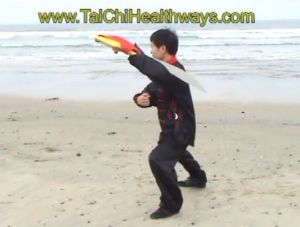
I’m looking at YouTube, searching for video (other than our own school’s) on the Yang saber form that I will be performing for Chinese New Year. No luck, really, but I’ve found some interesting material. The closest thing to our form is this one by Peter Tam Hoy (see my October post on this form). But the most interesting discovery today is an instructional video from TaiChiHealthways.

daodahu


Mostly, he is working on the double jump kick. I have always thought the “punch” after the kick was just that: Jin bu ban lan chui. But I knew it was called Hit the Tiger Form. Light bulb moment for me! He is not punching, he is doing Hit the Tiger Left–Zuo Da Hu Shi!

Other Yang forms are all so different, but it’s helpful to see how the various performers move. Amin Wu (whom I admire no end) does an unfamiliar Yang saber form:

wudao

This might be a modern form–it is called 36-form saber. And I couldn’t help noticing that she has also done a video of a short, unfamiliar fan form–36-fan. Lovely:

wunfan36

Possibly the best thing I found, though, is a video on Chen Saber, also from TaiCHiHealthways.com, which includes instruction and names of movements.

chendao

Like the Yang saber video, it doesn’t cover the whole form, but what it does cover is great. The two videos from TaiChiHealthways are samples–Master Tsao offers a huge variety of instructional DVDs, covering most of the forms I have studied and/or plan to study, both traditional and modern. Wow. Might have to get one.

Fan Form II

Grandmaster Li Deyin created two fan forms in the early 2000s. Both are performed to the song called Xi Yang Mei (Beautiful Sunset). The first form, usually simply called Kung Fu Fan, has 52 movements. It is the easier of the two forms and lends itself very well to group performances. It’s hugely popular.

The second form, usually called Tai Chi Kung Fu Fan Form 2, is “a dynamic routine with various moves from Chen, Yang, Wu, and Sun Tai Chi and Chinese kung fu.” From the instructional DVD by Professor Deyin himself:

“This fan routine, created by professor Li, is based on the framework of the first Taiji Kung Fu Fan.  By putting a series of more complicated but graceful taiji movements together with numerous powerful and dynamic movements from other martial arts styles, it provides an excellent opportunity for enthusiasts to achieve better physical fitness, greater flexibility and increase self confidence.”

The form is in six sections, as follows. Moves are named and described by me–these are not official names, just nicknames that I find helpful. Wherever possible, I have used names that are familiar from other forms.

Section 1: slow, with 4 lines of music that are repeated.

  1. Prepare Jin Gang Dao Dui
  2. Jin Gang Dao Dui and stand on right leg (crane) SNAP
  3. Cloud hands L-R-L-R
  4. Chen-style Lou Xi Au Bu
  5. Left Deng Jiao (closed fan)
  6. Step left, stand on right leg SNAP down
  7. Step  left (close fan), stand on right SNAP at waist
  8. Turn around, You Da Hu

Section 2: Fast. Four lines of music are repeated.

  1. Strike left and down on the right
  2. Buddha Stamp and SNAP overhead
  3. Feet apart, fan in front, twirl fan, step R cross behind
  4. Zhuan Shen Gong Bu (fan extended)
  5. Step left, You Fen Jiao (fan closed)
  6. Straightforward push fan (like push knife)
  7. Throw fan to SNAP down
  8. Turn left, Zuo Xu Bu, SNAP to body

Section 3: Faster.

  1. Open arms (close fan), 3/4 turn SNAP horizontal
  2. L-R-L stabbing closed fan
  3. Swing fan in figure 8, Xie Bu SNAP at waist
  4. You Gong Bu, fan behind back, push w/ left
  5. Close fan, step around 180, fan on shoulder, punch left
  6. Ma Bu push
  7. Step and turn R-L-R, Xie Bu (wheel fan)
  8. Unwind, extend, kick back w/L and SNAP

Rest 4 counts:

  • step down, arms extended
  • turn around, arms extended
  • hold closed fan in front
  • wait a beat

Section 4: Repeats section 2.

Section 5: Fast, staccato, then slows to cymbal crash.

  1. Step L-R, point closed fan down
  2. Step L-R SNAP down
  3. Stamp R, close fan SNAP backwards
  4. Punch L-R-L, You Gong Bu
  5. Zhuan Shen (close fan) Zuo Deng Jiao
  6. Jump to Yuo Xu Bu and SNAP down
  7. Turn around and swing the open fan behind
  8. Face from raise closed fan overhead.

Cymbals crash three times:

  • Crash at the end of Section 5
  • Step to Zuo Gong Bu and SNAP under fist on crash
  • Step back (close fan) to left cross behind SNAP high R on crash

Section 6: Slow.

  1. Zuo Ye Ma Fen Zong
  2. You Ye Ma Fen Zong
  3. Open the fan back, hold edges and push
  4. Sink back to Pu Bu
  5. Tui Bu Kua Hu
  6. Zhuan Shen Bai Lian
  7. Dang Tou Pao SNAP to Ti Shou
  8. Bai He Liang Chi

Shou Shi: as in 32-sword, but finish with closed fan held forward in both hands.

Pao Chui – Sweeps

The leg sweeps begin right after the punch at 2:40 in my go-to video of Chen Bing. He sweeps first with the left leg, then with the right, then sets up for another punch at 2:44.

sweep

The footwork: He turns the left foot in, turns onto the right and sweeps the left leg around. He’s now facing away, so he’s made a 3/4 turn. He pivots on the left and sweeps the right leg around. That’s another 3/4 turn, for a total 1 and 1/2 turns. He rises on both feet, then sets up for the punch right-left.

After he turns the left foot in, he drops down to a low squat on the right and touches down with both hands while sweeping the extended left leg around (above). He shifts into a left squat, hands still on the ground, while he sweeps the right foot around (below).

sweep2

Happily, Master Gohring, who by the way is now Grand Master Gohring (8th degree!), is offering us an upright modified version of this move. The footwork is pretty much the same: left-right-left, left-right-left (and then right left for the punch). The sweep is just a swing of the leg.

Between the speed, the deep squats, and the turning, there’s significant potential for knee injury on this move (in my opinion), especially for older students like me. I for one will probably experiment with the sweep shown above, but I doubt I’ll try it at full speed any time soon. I am happy about the modified option!

Pao Chui (con’t)

After the wrap crackers (Guo Bian Pao, on the Chicago list), we do the “beast head pose” (Shou tou shi). The freeze frame below occurs at 2:14 in the Bing video that I am using.

Beast Head Pose (Shou Tou Shi)

Beast Head Pose (Shou Tou Shi) at 2:14

From the last wrap cracker, at 2:12, step back with the right while circling the right fist down, back and around. The left fist circles down, back and around following the right fist. Finish in left cat stance with the left fist inside the left knee and the right fist by the right temple.

Step onto the left (he doesn’t appear to pick it up first), skip once (right-left), and fajin, hammering back and down with the right fist and at head-level with the left at 2:15:

fajin215

He then drops his arms and makes a huge leap, turning 180 degrees, landing with the right fist punching down. He immediately ball–changes right-left for Yan Shou Gong Quan. The slow motion feature (see Jan 22 post) is a life-saver! I wish I had discovered it a long time ago!

From the list of names I’m using (Chicagitaiji laojia erlu list of names), it appears we are at the end of the second section. Pi Jia Ji (Wearing a Frame) must be the fajin; Fan Hua Fu Xiou is the 180-degree leap. It’s the same leap that immediately preceded Yan Shou Gong Quan at the end of the first section.

The next section begins with Subduing the Tiger (Fu Hu) at 2:20. I note that he does step back a step with the right; I find that I have to, even though I try to widen my stance for the cannon fist. The right hand pulls back, palm up, then circles up. Both hands spiral into a hit-the-tiger position.

Subdue the Tiger (Fu Hu) at 2:20

Subdue the Tiger (Fu Hu) at 2:20

Rise for a palm strike. The right arm circles out, the left arm circles under it, and the strike is to the right near corner.

palmstrike

We get a break. Two sets of three one-handed cloud hands-type moves follow, and these are comparatively slow. From the Palm Strike (Mo Mei Gong?), he faces away, feet together, left hand at the waist, and backhands to the right while stepping sideways to the left, cloud hands-style. Then he cross-steps behind with the right as the arm circles down, so the right hand sort of follows the right foot.

After three steps to the left, the final cross-step is a ball-change 180-degree turn to face front. I think it’s actually the same turn as the one in the middle of the firecrackers. The right hand goes to the waist and the left backhands, cloud hands-style with a step to the left. In this direction, the left hand follows the left foot for three steps.

That series is called Yellow Dragon Stirs the Water Three Times–Huang Long San Jiao Shui. The next two moves are Zuo Chong and You Chong, left and right thrust kicks. At the point when his feet are together after the third step, he steps back to his right, circles the arms out and scoops to gather for the kick:

zuochong

He pivots on the left foot to face away for the right kick. He lands with a ball change right-left for Yan Shou Gong Quan and we are ready for the dreaded sweeps. We are at 2:40, and we’re halfway through the third section (of four).

Pao Chui – Firecrackers!

Wrapping Firecrackers, Guo Bian Pao, takes less than 10 seconds. From the Yan Shou Gong Quan (punch) at 2:05 (Bing video), Master Bing turns around to the right and makes two fajin moves to his left. Then he turns 180 and does two more.

firecracker

That first turn: he picks up his right foot, pivoting on the left foot, and does a ball-change, right-for-left. It’s a 270-degree turn. His arms close on the turn, then he does a double back-fist. Picks up the right foot, does a ball-change to the left, landing right-left, and does another double back fist.

The second turn: picks up the right foot, pivoting on the left to the right, and does a ball-change right-left. Pow. Pick up the right, ball change right-left. Pow. So it’s actually sort of simple (in slow motion! In theory!) — he does the same thing four times, with two turns. Easy, right?

Pao Chui Part 2 (cont.)

We left off with Waving Hands (da gong quan xiao gong quan) and four quick bamboo steps. On the last step, we pivot on the right foot to the right, to face back in the other direction. Circle the right arm out and around on the pivot, so the right hand is at the left shoulder. The left arm follows, circling across the body and down to the side.

The position after the 180 turn

Position after the turn

The frame above is at the 2:02 mark in the video by Master Chen Bing.  Master Bing has a website, by the way, www.chenbing.org. You can study with his student in Los Angeles, if you can’t get to Master Bing’s school in Chen Village.

After the turn, advance three more bamboo steps, turn around and punch. As best I can tell, the four bamboo steps to the right are Yu Nu Chuan Shuo–Fair Lady Works the Shuttle– and the three steps back to the left are Dao Qi Long–Riding the Dragon Backwards.

The four bamboo steps right are led with the right foot; the three bamboo steps back to the left are led with the left foot. The turn for the punch is to the right on the ball of the left foot. He sets his feet for the punch right-left. The turn is propelled (partly) by the switch of the hands from the position in the picture above to the position for the punch (right hand chambered, left reaching out, as in the picture below).

You can click on the settings icon (looks like a gear) in the lower right-hand corner of the video screen and set the speed of the video to .25 for slow motion playback. You can see the footwork from 1:58 to 2:03 for the bamboo steps and turns in this section of the form. Below, he has just pivoted on the left foot, after riding the dragon backwards, and and landed right-left to set up for the punch.

Landing right-left for the punch.

Landing right-left for the punch.

The punch is Yan Shou Gong Quan. (I am going by the list of names on the Chicago website; the Absolute Tai Chi list is different, which is confusing.)

Next: Wrapping Firecrackers. Guo Bian Pao. We’ve advanced about 7 seconds, and we’re only about halfway through the second section of the form.

Pao Chui – Cloud Hands

The Chicago school (Chenjigou Taijiquan, USA Chicago, which appears to be pretty closely tied to the major proponents of the Chen style in Chen village) divides the form into four sections, with the first section ending in Yan Shou Gong Quan. This is just before where I left off.

punch

The second section begins with the 180-degree turn and the elbow strike (hit the left palm with the elbow, by the way). What follows is a turning version of Cloud Hands. The footwork:

  • Step around with the right to face front.
  • Cross step behind with the left.
  • Step out to the right and pivot on the right heel to face away.
  • Step out with the left.
  • Cross step behind with the right.

In this frame (below), Master Bing is about to face away. The left foot was planted across and behind the right; he is stepping out and pivoting on the right heel.

Pivoting on the right heel to face away

Pivoting on the right heel to face away

At the end, step out to the left and prepare to take four bamboo steps back in the opposite direction (see below).

lookback

I call this Cloud Hands, but it’s not Yun Shou. It’s Da Gong Quan Xiao Gong Quan. The translation offered is simply waving hands. To me, it looks like “big fist work, little fist work”–never mind! I am mystified about quite a few names, at this point. I see chopping hands, overturning flowers and waving sleeves in between Zhi Dang and Yan Shou Gong Quan. Hmmm!!!!

Anyway, the waving hands pretty much follow the left foot when he’s facing forward and the right foot when he’s facing back. That is, when he steps out to the right, his hands are to the left of his body; when he cross-steps behind with the left, the hands are waving to the right of the body. When he swings 180, he’s pivoting on the right heel and his hands swing to the right of his body as he step left. When he cross-steps behind with the right foot, his hands are waving to the left.

Advance with bamboo step right

Advance with bamboo step right.

Step back onto the left foot, touch-step with the right, hands crossed at the chest, right hand in front. Advance four quick bamboo steps, leading with the right (above). We have barely begun the second section, and we are at the two-minute mark, so apparently, we are going to cram the rest of the form into one minute twenty seconds!