Unknown's avatar

About elizabethbuhmann

Author of Mystery Novels--Lay Death at Her Door, Blue Lake, Accidents of Life, and Freewheeling--plus a new detective series, Murder on the Gulf Coast.

Pao Chui – Cloud Hands

The Chicago school (Chenjigou Taijiquan, USA Chicago, which appears to be pretty closely tied to the major proponents of the Chen style in Chen village) divides the form into four sections, with the first section ending in Yan Shou Gong Quan. This is just before where I left off.

punch

The second section begins with the 180-degree turn and the elbow strike (hit the left palm with the elbow, by the way). What follows is a turning version of Cloud Hands. The footwork:

  • Step around with the right to face front.
  • Cross step behind with the left.
  • Step out to the right and pivot on the right heel to face away.
  • Step out with the left.
  • Cross step behind with the right.

In this frame (below), Master Bing is about to face away. The left foot was planted across and behind the right; he is stepping out and pivoting on the right heel.

Pivoting on the right heel to face away

Pivoting on the right heel to face away

At the end, step out to the left and prepare to take four bamboo steps back in the opposite direction (see below).

lookback

I call this Cloud Hands, but it’s not Yun Shou. It’s Da Gong Quan Xiao Gong Quan. The translation offered is simply waving hands. To me, it looks like “big fist work, little fist work”–never mind! I am mystified about quite a few names, at this point. I see chopping hands, overturning flowers and waving sleeves in between Zhi Dang and Yan Shou Gong Quan. Hmmm!!!!

Anyway, the waving hands pretty much follow the left foot when he’s facing forward and the right foot when he’s facing back. That is, when he steps out to the right, his hands are to the left of his body; when he cross-steps behind with the left, the hands are waving to the right of the body. When he swings 180, he’s pivoting on the right heel and his hands swing to the right of his body as he step left. When he cross-steps behind with the right foot, his hands are waving to the left.

Advance with bamboo step right

Advance with bamboo step right.

Step back onto the left foot, touch-step with the right, hands crossed at the chest, right hand in front. Advance four quick bamboo steps, leading with the right (above). We have barely begun the second section, and we are at the two-minute mark, so apparently, we are going to cram the rest of the form into one minute twenty seconds!

Miyamoto Musashi

Love this video. Miyamoto Musashi was a legendary Samurai swordsman, but here he’s using a short staff–what we call the flute.

musashi

And here’s a cool documentary on the Samurai by Mark Dacascos (about an hour and forty-five minutes long, on YouTube).

samuraidoc

My interest is Tai Chi, which is Chinese, whereas the Samurai are Japanese. And although Tai Chi is a martial art, my interest is more in the art than the marital part, more about health than fighting. But this is pretty exciting stuff.

Also, in the short clip, I recognize some of the moves we practice in flute form, including two-handed poke at the end of the form, which he is about to execute below.
poke

If you haven’t read Shinju, by Laura Jo Rowland, I recommend it. It’s a satisfying nail-biter of a detective story, set in 17th century Tokyo. The main character, Sano Ichiro, is a Samurai and the most admirable protagonist ever. Here’s a lovely old Japanese woodblock of Musashi from Wikipedia:

Miyamoto Musashi (Wikipedia image)

Samurai Miyamoto Musashi

Pao Chui (1)

The form opens with Jin Gang Dao Dui, Lan Zha Yi, Liu Feng Si Bi, and Danbian. All four movements are (deceptively) simple versions, compared to what we did in the Chen 38. In the Bing video, these four moves bring us to 1:23 (out of 3:20).

Chen Bing: Protect the Heart

Chen Bing: Protect the Heart

Hu Xin Quan (Protect the Heart) has three parts: (1) a 180-degree leap followed by a right back fist; (2) advance left and grab for an elbow-strike; and (3) a right knee-up onto the left leg, left hand up.

xiexing

From the du li, he lands (right, left) in position for Xie Xing, with left foot in advance of the right. He pushes from left to right with the left hand, and from right to left with the right hand, before opening up to the final position of Oblique Form at 1:32.

Begin Hui Tou Jin Gang Dao Dui (Hui Tou () is turn around): He chambers up as if to punch, strikes with the palm, then strikes back with the elbow, before turning all the way around to the right for the second Buddha stamp at 1:37. He pivots on the right heel, steps around with, then pivots on, his left foot, sweeping the right around and up for the stamp. From the point shown below, it’s a lot like Hui Tou Jin Gang Dao Dui in the 38.

Turn around Buddha stamp

Turn around Buddha stamp – Chen Bing

There is no pause between this move and the next, which is Pie Shen Quan, which we call Draping the Fist and/or Lean the Back (different names for the same move). From the Chen 38, we know this one as a twisting move with fists pulling right (fist) to left, left (fist) to right, and right fist to the left, ending in the leaning position shown below.

Lean the back - Chen Bing

Lean the back – Chen Bing

This form has an unfamiliar (to me) detail at the beginning: He steps out to the right, opens up and crosses his hands before beginning the “drape” with the left hand over to the right, then with the right hand over to the left. Despite the “quan” in the name, there’s no fist until the final leaning position. The hands are open, palms up.

This immediately follows the second Buddha stamp.

This position follows the second Buddha stamp, just before draping the fist and leaning the back.

From Lean the Back, he winds up in a Hit the Tiger-type position, then opens the arms diagonally:

hitfredHe then steps left (or maybe pivots on the left heel), then steps right to left cross behind and punches down. He jumps 360-degrees (turning to his left), punching to groin (Zhi Dang).

zhidang

He finishes the jump here (above). You can tell he just landed because his jacket has flown up. From here, he does a ball change to switch the feet so the left is in advance. Chamber the right fist and punch.

punch

Step around 180 degrees to the left with the right foot, pivoting on the left, advance left and throw the right elbow. We are at 1:50 in the video, and we are ready to slow down. Whew!

elbowI usually figure that 30 seconds of new material is a reasonable bite-size, but this 30 seconds has me reeling. Tough class. Without this video, recorded in Chenjiagou in 2001, I would be L-O-S-T. This last grab says it: Can I do this?!?

midair

Chen Double Saber

In addition to Pao Chui, my class will be learning the Chen tai chi double saber form. It’s fairly short, less than three minutes. Here’s a walk-through by Master Gohring of the opening moves.

Opening moves, double saber

Opening moves, double saber

Here’s a demo by Grand Master Chen Zhenglei. The form we are doing in class is slightly different, since Master Gohring learned it from Grandmaster Cheng Jincai, whose Chen Taiji differs from the prevailing style practiced in China today.

CZdao

A fourth degree student at our school performed double saber at our last black sash graduation. This video of Mr. Guidry differs slightly from what we learned in class; he has added some flourishes.

Lao Jia Erlu

Old Frame Chen Tai Chi, second routine, is my official new project for 2015 (though between us, what I really want and plan to learn is more sword). Here’s Chen Bing–impressive.

bingerlu

I found two great websites with information about the Chen forms:

Absolute Tai Chi offers an excellent Syllabus page with links to videos and lists of the names of the movements for the major Chen forms. The Chicago school Curriculum page offers these resources, too. Both schools seem to follow the teachings of Chen Xiaowang, whose videos I’ve been using.

I was excited to see that both curricula include sword and broadsword (Dao). The latter is the same one we learned–with names in Chinese. The sword form is the same but, wow, different. And names for the sword, which we’ve never had. More to come on both of these!

Chen Xiao Xing: Lao Jia Er Lu

Chen Xiao Xing: Lao Jia Er Lu

In addition the Chicago website includes the Chen 38, though not the same one taught by Cheng Jincai. Differences here are substantial, based on the names; I haven’t looked into the video resources on that one yet.

Anyway, this is enough Tai Chi to occupy me for the next few years. And we’re starting with Laojia Erlu. I note that the London school cautions against excessive practice of Erlu alone because it can be wearing on the body.

So of course the two lists of movements for Laojia Erlu are slightly different. However, they both start off with the same movements up to the second Buddha Stamp, and these opening movements are all familiar from the Chen 38.

The first four (disregarding Yubei and Qishi) are also the opening to the 38, but each movement is styled quite differently–seemingly more simply. The London and Chicago lists for Erlu then agree up to a second Buddha Stamp.

  • Jin Gang Dao Dui
  • Lan Zha Yi
  • Liu Feng Si Bi
  • Dan Bian
  • Hu Xin Quan
  • Xie Xing
  • Jin Gang Dao Dui

That’s the first minute and a half of a three and a half minute form, but it’s only eight of more than forty movements. In other words, it start out slow and gets very fast!

Chen Forms

The Chen taiji forms have been handed down through centuries by the Chen family. Laojia, or old frame, is said to have been practiced since the time of Chen Changxing, the 14th generation master who taught in the first half of the 19th century. Yang Luchan was his student.

Laojia consists of two routines, the first (Yilu) being longer and consisting of large, slow movements with occasional outbursts of intense energy (fajin). Laojia Yilu runs about 20 minutes. Here’s a video by Chen Xiaowang, grandson of Chen Fake.

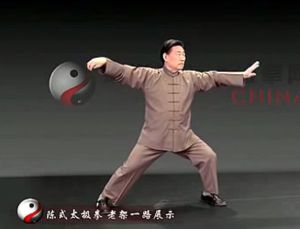
Chen Xiaowang Laojia Yilu

Chen Xiaowang demonstrates Laojia Yilu

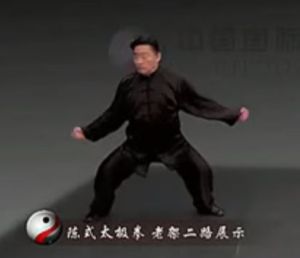
Laojia Erlu, also known as Pao Chui, or Cannon Fist is a little more than four minutes long and contains substantially more fajin.

Chen Xiaowang demonstrates Laojia Erlu

Chen Xiaowang demonstrates Laojia Erlu

The New Frame Chen routines, called Xinjia, are attributed to Chen Fake and were largely promulgated by his son, Chen Zhaokui. The new forms are Xinjia Yilu and Erlu. This is Xinjia Yilu–less than five minutes, but it’s just part one:

Chen Xiaoxing at Chenjiagou Temple 2006

Chen Xiaoxing at Chenjiagou Temple 2006

Chen Xiaowang demonstrates both parts one and two:

That’s just one option; many videos are available on YouTube for all of these forms. Here is Xinjia Erlu, also called Cannon Fist (less than four minutes):

Chen Xiaowang demonstrates Xinjia Erlu

Chen Xiaowang demonstrates Xinjia Erlu

The Chen forms and style are characterized by the silk-reeling movement called chan si jin and explosions of power (fajin). For the patient and devoted student, Chen Xiaowang explains silk-reeling in Chinese with subtitles in the following 45-minute video, which I have not yet watched. But I will.

Chen Xiaowang explains silk-reeling

Chen Xiaowang explains silk-reeling (subtitles)

Chinese for the Sword

In trying to learn the descriptive names for 32-sword, I’ve added some new vocabulary. Of course, jian is sword. A number of the new words describe stances.

Sifu Amin Wu demonstrates 32-sword

Sifu Amin Wu demonstrates 32-sword

  • Gong Bu – Bow stance
  • Ma Bu – Horse stance
  • Xu Bu – Empty stance (aka cat stance)
  • Pu Bu – Half-squat (I think; squat with one leg extended)
  • Xie Bu – Cross stance
  • Bing Bu – Feet together

Then there are words for moving this way and that, which I’ve also encountered in empty-hand forms:

  • Jin Bu – Advance (a step)
  • Tui Bu – Step back
  • Xia Bu – Step down
  • Shang Bu – Step up

More specific to sword play:

  • Ci – Stab
  • Dian – Point
  • Sao – Sweep
  • Dai – Carry
  • Pi – Chop
  • Lun – Wheel or whirl
  • Chou – Withdraw
  • Liao – Lift
  • Lan – Block

Here’s a good dictionary, by the way: MDBG English to Chinese.

Names for 32-Sword

Names of movements can be either poetic or descriptive, and in the case of 32-sword, there are two completely different lists of the same routine.

photo (15)

The list I gave in an earlier post on 32-sword is useful because so many of the movements also occur in the traditional and the standardized long sword forms. However, I’m trying to learn the descriptive list–in Chinese–because these are the names that my Chinese friends use. They are also the names called out in the music we use.

Here’s a nice web page: Tai Chi Central offers both lists in English. But I need Chinese. And not just any Chinese version (such as I might generate with a dictionary), but the one my friends use.

Luckily, they’ve given me this beautiful written transcript (above). Working out the correct Pinyin from these characters has been a most entertaining exercise! I’m almost there.

Below, the English is not word for word; I’ve rendered it a little more idiomatic. The Tai Chi Central page helped with this.

  1. 并 步 点 剑 Bing bu dian jian – Feet together point sword
  2. 独立反刺 Du li fan ci – Stand on one leg stab overhead
  3. 仆 步 ? 扫 Pu bu hen sao – Half-squat and sweep
  4. 向 右 平 带 Xiang you ping dai – Carry level on the right
  5. 向 左 平 带 Xiang Zuo ping dai – Carry level on the left
  6. 独立抡劈 Du li lun pi – stand on one leg whirl chop
  7. 退 步 回 抽 Tui bu hui chou – Step back circle withdraw
  8. 独立上 刺 Du li shang ci – Stand on one leg stab up
  9. 虚 步 下 戳 Xu bu xia chuo – Empty stance downwards cut
  10. 左 弓 步 刺 Zuo gong bu ci – Left bow stance stab
  11. 转 身 斜 带 Zhuan shen xie dai – Turn body carry across
  12. ? 身 斜 带 Shuo (?) shen xie dai – Carry across body (?)
  13. 提 膝 捧 剑 Ti xi peng jian – Lift knee hold sword both hands
  14. 跳 步 平 刺 Tiao bu ping ci – Falling step level stab
  15. 左虚 步 撩 Zuo xu bu liao – Left cat stance lift
  16. 右 弓 步 撩 You gong bu liao – Right bow stance lift
  17. 转 身 回 抽 Zhuan shen hui chou – Turn body circle withdraw
  18. 并 步 平 刺 Bing bu ping ci – Feet together level stab
  19. 左 弓 步 拦 Zuo gong bu lan – Left bow stance parry
  20. 右弓 步 拦 You gong bu lan – Right bow stance parry
  21. 左 弓 步 拦 Zuo gong bu lan – Left bow stance parry
  22. 進 步反刺 Jin bu fan ci – Advance step stab overhead
  23. 反 身回 劈 Fan shen hui pi – Turn back circle chop
  24. 虚 步 点 剑 Xu bu dian jian – Empty stance point sword
  25. 独立平 托 Du li ping tuo – Stand on one leg lift hilt
  26. 弓 步 掛 剑 Gong bu gua jian – Bow stance wheel sword back
  27. 虚 步 抡 劈 Xu bu lun pi – Whirl and chop to empty stance
  28. 撤 步 反 击 Che bu fan ji – Withdraw step and slash right
  29. 進 步 平 刺 Jin bu ping ci – Step forward level stab
  30. 丁 步 回 抽 Ding bu hui chou – Fourth step circle withdraw
  31. ? 转 平? Xieng zhuan ping me – Turn level…what???? Step around, carrying level*
  32. 弓 步 直 刺 Gong bu zhi ci – Bow stance straight stab

This is all a little backwards, in that the names aren’t helping me learn the form; it’s because I know the form that I can figure out the names! But if I can understand the names in Chinese, I can follow the music. Right?

*This is what you do; cannot make sense of the characters or the Pinyin!

49-Step Wudang Sword (6)

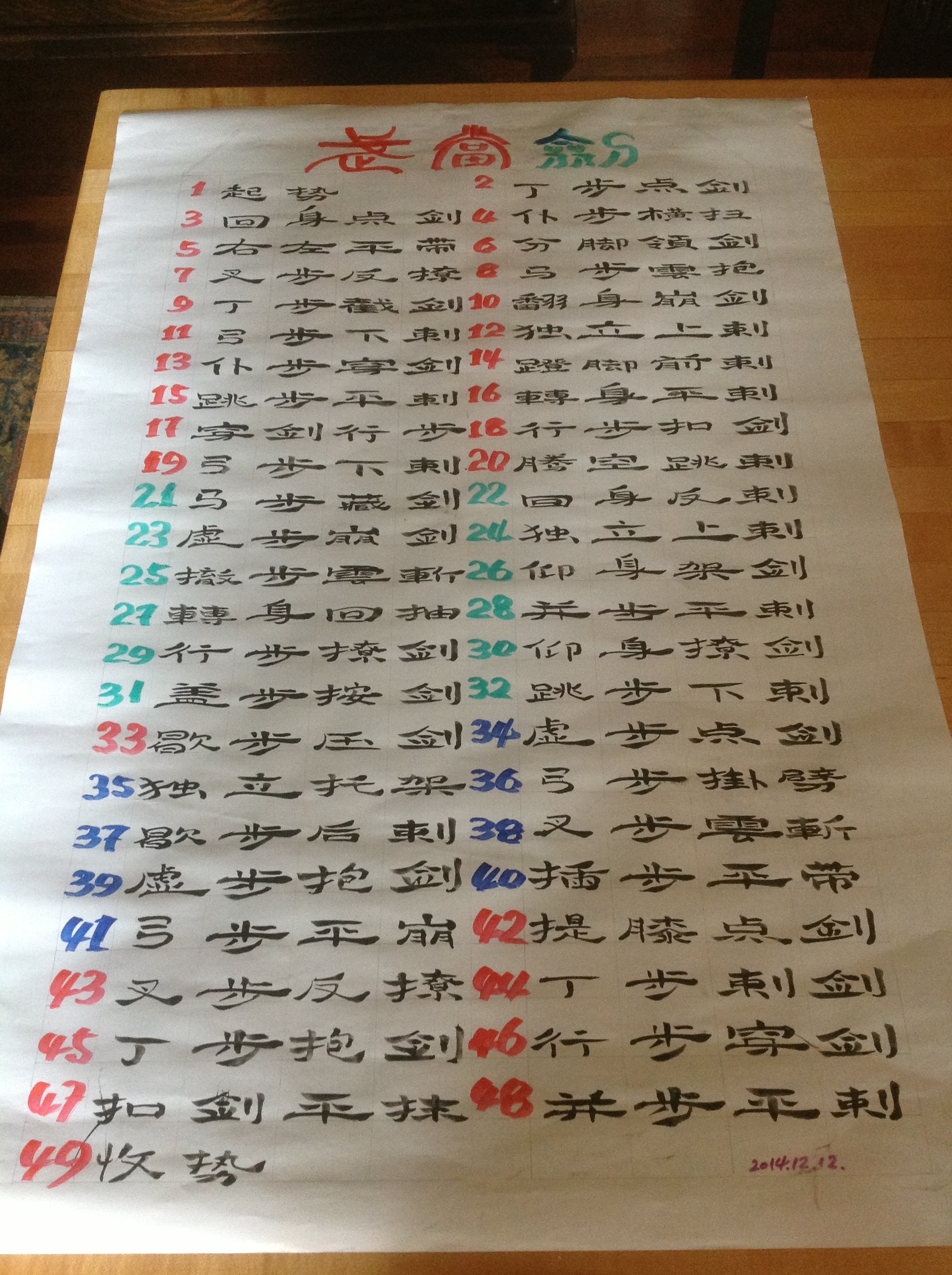
Look at this! One of the people in my weekend practice group has written out the 49 steps of this form for me in beautiful calligraphy. Don’t tell me: Now I have to learn to read Chinese characters.

The 49 steps in Standardized Wudang Sword form

The 49 steps in Wudang Sword

Step 1 is Qi Shi and Step 49 is Shou Shi. Beyond that I can see Du Li in three places–why not more? He also gave me a list of the steps in 32-sword, so that helps in decoding. There are many thousands of Chinese characters, so this is no mean riddle.

I’ve also found another video of 49-step Wudang. It looks like the same place, the same person (but with a different name?) and a different (somewhat less annoying) sound track: Wudang Sword by Master Leng Xian Feng.

We left off at the second sit, with the sword pointing to the left, arms closed, right foot crossed behind the left. Step back out to the right, slashing out to the right and circling the blade around in front of the face. Cross step in back with the left, pointing the sword to the right, left arm over the head. Poor quality screen grab nevertheless shows the position at the three-minute mark:

photo (14)

Footwork on the next move is step out to the left with the left, step to right cat stance, step out to the right, and step across behind with the left. Some shifting of weight happens with the slashing of the sword, as follows: slash to the left, circle in front of the face, and hold palm up with both hands in front at the cat stance. Then slash right, left, right. Finish in position as above, but sword low, left hand high.

Shift onto the left foot and lift the right knee and the hilt of the sword, step right and cut, palm up, to the right, left arm down. Pivot to the left on the left foot, chop overhead and down, right knee up. Step forward with the right (but you’re traveling to stage left) and wheel the sword back, left hand high.

Step left, sweeping to front with the sword, close with the right foot and point the sword. Step left again, sweeping the sword to the left, and close with the right, both hands on the sword.

Run in a circle, starting with the right foot, six steps and then back with the right, to left cat stance. The arms circle once during the six steps, then the sword circles, then the arms open when you step back, same position as if you were about to finish 32-sword.

To close the form (!!!) step forward left, close with the right (as in the Compass), then catch the hilt in the left hand, palm up, hand pointing back at you. Step forward left, right, then left to shoulder width. While taking these steps, circle the sword back to resting position and circle the right hand up. Straighten up and lower the right hand, as if ending the 32-sword. We’re done.

photo (12)

49-Step Wudang Sword (5)

From the sit at 2:30 (Liang Video), rise on the right leg, step left and cast overhead to right cat stance, circle sword counterclockwise and step back with the right to a low cross stance. Then stand on the right leg, sword pointed down. This sequence is also in 32-sword: Lifting the Curtain and Wheeling the Sword Left to what in Yang sword we call Minor Literary Star.

What I am calling Cut Nose Off Face

What I am calling Cut Nose Off Face

Here, it gets complicated: The sword circles clockwise, leading with the point, then figure-eights to the right, then stabs under the right arm. He spins right out of this somewhat awkward position and wheels the sword back on the right, arm up.

Finally, he leaps (left, right) to right cross in back, facing away, casting the sword overhead to the left. The sword follows through, circles up, as he spins to the right, on the left foot. He finishes by stepping out to right bow, left hand up, sword stabbing.

Step back with the right and sit. Step back out to right bow with a left-to-right slash, rock back and circle the sword in front (cutting off nose!), slash right and step across in back with the left foot.

Wheeling the Sword (Right)

Wheeling the Sword (Right)

Finishes at 3:00 facing front, right foot crossed behind the left, sword pointing back to the right, left hand over the head. Whew. This section is difficult, but there’s only half a minute left.