Tai chi Sword: Taijijian 太极剑

The Tai Chi solo sword form is the first step in learning to fight with a sword. If you have read my series on the Sword of Li Jinglin, you will be familiar with the process. After acquiring a basic competence in taijiquan (bare-hand Tai Chi), you incorporate the sword in your practice by adding the jianfa—swordfighting techniques.

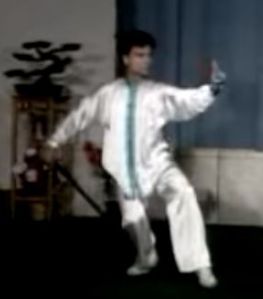
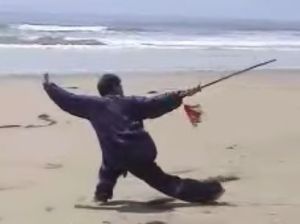
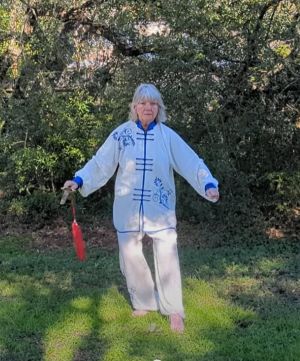
me and sword: cha bu xia ci
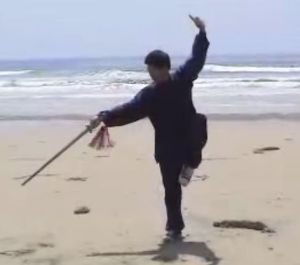
Tai Chi 24-sword, Xia ci – Downward stab

The sword form is not a pantomime of a swordfight. It is the practice of one form of swordplay after another. The form is designed so these moves flow from one to the next. So, for example, in 32-sword, I practice the jianfa called 带 Dài, first to the right, then to the left.

Dai is a technique for countering a stab by an opponent directly in front of me. [Dai translates as “carry” but the English word is neither descriptive nor helpful.] To start, I am shifted left, so I first practice Dai to the right. Now my weight is on my right. I again practice what I could do in response to a stab from an opponent directly in front of me: I do Dai to the left.

At a comparable point in the sequence, Traditional Yang sword uses 拦扫 Lán Sǎo (block and sweep) to the right and then to the left. Lan Sao and Dai are two quite different movements, different jianfa altogether, but either one could answer a stab, and the principle is the same: you practice the move first on one side, then on the other.

demonstration of lansao (block and sweep).
Lansao (Block and sweep)

There are some basic assumptions that I make when practicing sword. One, I assume that I am facing a single opponent who is also wielding a sword. That is not to say that you cannot fight multiple attackers (good luck with that!) or that a sword cannot counter a different weapon, like a staff. These are interesting and valid variations on the basic moves. But these are advanced variations. As a default, when practicing a sword form, I assume I am fighting one other swordsman.

Another assumption: My opponent is in front of me. At a number of points in any sword form, I practice what to do in response to an attack from the side, the back, an angle, etc. That is, I practice what to do if my opponent is *not* in front of me. The answer is, in every case, that I first turn, so that he is front of me. Then I answer.

Bow stance, stabbing with a sword
Bow Stance, Level Stab; Bluegreen Dragon Emerges from the Water

For example, consider a move common to both Yang Sword (Qing Long Ch Shui—the Bluegreen Dragon Emerges from the Water) and 32-sword (Gong Bu Ping Ci—Bow Stance, Level Stab). In both forms, from the previous move, I am facing due East, and I am attacked from the left corner (NE). I first turn, then fall back and send out my own sword in front of me to contact my opponent’s weapon. Then I draw his sword to my right and counterattack.

In any case where you are attacked from anywhere but head-on, you never just throw your sword out toward your apponent. You first turn your body. Then answer.

This is corollary to a more basic principle in swordfighting, that my first priority is defense. Don’t let my opponent cut me! Then, if I can cut him, that’s good. But first and foremost, I want to stay alive.

In practice, this means that I keep my sword in front of me at all times. It could be the blade, it could be the tip, it could even be the hilt. But I need to at all times use my sword first to defend myself.

Correct position in preparation for ti xi peng jian
Can you see that the tip of the sword is on the blue line on the front of my uniform?

A good illustration of this principle is Ti Xi Peng Jian (Lift the Knee and Cup the Sword) in 32-sword. A comparable move in Yang sword is Ye Ma Tiao Jian (Wild Horse Jumps over the Stream). These two moves are quite different in the two forms, but the point here applies to both.

Sitting back in preparation to start these moves, you do not open up. Pei Yi taught me this. The tip of the sword should be in front of you, on the centerline of your body. Compare the two pictures (above and below): correct vs. incorrect position.
Incorrect: sword is not in front of the body.
In swinging my sword wide, I open myself to attack.

With the tip of the sword on the line from my center to that of the opponent in front of me, I am doing two things at once: I am defending myself and I am aiming my sword at my target. In the second picture, I am doing neither.

I should probably repeat my usual disclaimer: I am not a Tai Chi master! I am a diligent student who has been fortunate to study with more than one excellent Chinese master. I’m just lately doing sword quite a bit after a long-ish spell of not doing sword much at all, so I am thinking a lot about what I have learned, or at least come to think I know, over the years.

Go to Home and scroll down to the Sword section for links to previous posts on sword.

Yang-style 28-step Tai Chi Fan

This relatively new Tai Chi fan form, created in 2014, is elegant and short. It has many intricate and enjoyable movements, but no physically challenging moves, so it is appropriate for people of all abilities. It’s not very difficult to learn, so it would be a great one to start with, if you want to learn Tai Chi fan.

Above, Yang Li demonstrates the whole routine (beautifully!) in the first session of a video teaching series that used to be on a YouTube station called China Wushu. The series now resides on the Chinese Wushu Association YouTube station. The series:

Here’s the full playlist.

The name of the form is 杨氏28式太极扇:Yáng shì 28-shì tàijíshàn (Yang-style 28-step Tai Chi Fan). In my group, we call ited èr shì bā shàn (28 fan) for short. As you can see from Professor Yang’s demo, this form makes a very nice solo performance. It makes a good ensemble piece too, for group practice or a performance by three or five persons.

Here is a list of the 28 movements: PDF. Here’s my demo:

Huawu Fan Review

This has come to be my favorite fan form, partly because this time around I found and used the teaching videos of Master Zeng Nailiang himself, creator of the form. Read about him here: Kung Fu Magazine-Professor Zeng Nailiang.

To me the most beautiful demonstration of this form is that of Sing May Chen (Irvine World Tai Chi Day 2015). In this grab she is doing 飞凤回首 – Fēi fèng huíshǒu (Flying Phoenix Turns Head):

Here are the links to Master Zeng’s four-part tutorial, totalling about 45 minutes of instruction. I especially appreciate his emphasis on the martial aspects of the form and the use of the fan as a weapon. That is Master Zeng’s daughter demonstrating the moves at the beginning of each segment.

  1. Movements 1-8 (9:55)
  2. Movements 9-20 (11:25)
  3. Movements 20-32 (11:52)
  4. Movements 33-42 (9:26)

The name of the form is 华武太極扇  (Huáwǔ tàijíshàn). Huawu means “Flowery Martial” Tai Chi Fan, and here is a list of the 42 movements (PDF). For more about Huawu Fan and links to more video demonstrations, see my earlier posts: Huawu Fan (tagged).

Styles of Tai Chi

Chen WangTing (1580-1660), from Chen village in Henan Province, was the founder of Chen-style Tai Chi, the oldest documented style. Laojia Yilu (Old Frame, First Way) is the Chen-style long form from which, arguably, all other forms and styles have been derived. A statue of Chen WangTing stands in the center of the courtyard to the Tai Chi Museum in Chen Village. [Read about Laojia Yilu.]

Chen WangTing statue

Statue of Chen WangTing (my photo, 2019)

Yang Luchen (1799-1872) learned Chen-style Tai Chi during the time of Chen Changxing, the 6th generation master after Chen WangTing. Yang was the first non-family member to learn the art, and according to legend, he did so by subterfuge, taking a job in Chen village and watching lessons in secret.

Eventually, Yang was discovered and surprised the master with his ability. Yang stayed on and studied with Chen Changxing for a total of ten years. When Yang left Chen village, he was sworn to secrecy about the Chen routines and soon developed his own Yang style of Tai Chi.

[See Moving Forms for Yang-style Tai Chi forms and links to comparisons of Chen and Yang styles]

Two of Yang Luchan’s most notable disciples were named Wu. Looks and sounds like the same name to us, but they are written differently (武 and 吳) and sound different to Chinese ears. These two disciples were Wu Yuxiang (1812-1880) and Wu Quanyou (1834-1932), and each founded his own style of Tai Chi.

Wu Quanyu studied with both Yang Luchan and Yang’s second son, Yang Banhou. Wu Quanyou’s style is today called Wu-style. The Wu long form closely tracks the Yang-style long form but is characterized by more of a grappling style, different footwork, different hands, and a distinctive leaning posture.

Wu Yuxiang first learned Yang Tai Chi from Yang Luchan. Then Yang introduced him to Chen Qingping, 7th generation Chen master. Chen Qingping practiced a small-frame version of Chen-style Tai Chi that was influenced by an ancient martial art called Zhaobao.

Wu Yuxiang eventually developed a distinctive style that incorporated elements of both Yang and Zhaobao-Chen. One of the best-known followers of his style was Hao Weizhen (1842-1920). Wu Yuxiang’s style of Tai Chi has come to be known as Wu Hao in the West, to resolve confusion between the two Wu names.

Cover of bookWu Hao is still practiced today but is not as well-known as Chen, Yang and Wu. This is partly because, at the turn of the twentieth century, Hao met Sun Lutang (1860-1933), a fighter of formidable reputation. Sun did not practice Tai Chi. Sun’s arts were Xingyi and Baguazhang.

Sun learned Wu Hao Tai Chi from Hao and then developed his own style, a fusion of Wu Hao Tai Chi, Xingyi, and Baguazhang. The Sun style, thanks to Sun’s reputation and wide influence as a teacher, went on to become quite popular. You could say that Wu Hao was eclipsed by the Sun. [See also Sun-style Tai Chi]

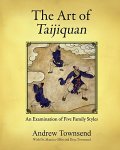
Today, the four most popular styles—Chen, Yang, Wu, and Sun—are represented in combined forms like 32, 42 (the modern competition style), and 48. A more detailed history and comparison of the styles described in this post, can be found in a book by Andrew Townsend, The Art of Taijiquan, An Examination of Five Family Styles.

Dragon Section

The eighth and last section of the Tiger-Crane set. Here’s an excellent video (includes Drunken section, too), shown from behind so you can follow, with names.

hunterdragon

And the names of the moves are:

Pull sweep push sweep
Fist like an arrow
Pull sweep push sweep
Monkey steals the peaches
Dragon thrusts its claws
Sweep the sea and push the mountain
Dragon stretches its claws
Hook a star with the fist
Tiger pushes the mountain
Flying arrow fist
Dragon lands on the sand
A pair of butterflies
Turning stance to swiftly strike
Unicorn stepping
Butterfly palms
Continuous butterfly palms
Crescent moon hand and foot
Crouching tiger hidden dragon
Fierce tiger claws the sand
Draw bow to shoot arrow
Single dragon leaps from sea

Followed by the Five Animal Salute. End of form!

Drunken Fist

We’re up to the next-to-last section of the Tiger-Crane Set. It’s short, and Master Gohring’s videos combine it with the Dragon Section that comes after it. Here’s a good video of both sections, with names; the Drunken part is less than a minute.

drunkenchew

The names of the moves are as follows:

  • Eight drunken gods
  • Old man exits cave
  • One finger asks the question
  • First star punching method
  • Second star punching method
  • Two fists punching downward
  • Immediately punching upward
  • Fist like an arrow

Crane Section

This is the sixth of eight sections in the Tiger-Crane 108. Video:

crane

Names are:

Hard and soft crane walking
Descending arm hand and waist
One finger asks the question
Crane wing punching
Fist through the sleeve

[Repeat on the other side:]
Hard and soft crane walking
Descending arm hand and waist
One finger asks the question
Crane wing punching
Fist through the sleeve

Crane pecking
Reviving crane

Flying crane
Hungry crane stands on one leg
Hungry crane captures shrimp

[repeat on the other side:]
Flying crane
Hungry crane stands on one leg
Hungry crane captures shrimp

Crane head punching
Crane head punching

Dragon swings its tail
Monk summons corpse
Tame the tiger shoot the tiger

Footwork and Stances

步法 (bu fa) means footwork. I’ve been working on building a comprehensive list of names of steps and stances. I use the Chinese names, because translations of the everyday meanings of the Chinese words are mostly not applicable; these are terms of art. I do offer some English equivalents, especially where the English expression is well established.

弓步 gong bu (bow stance) is the long stride in which the leading foot points straight ahead and the back foot is at a 45-degree angle. How long, low, and wide the stride is varies with the individual and the style of tai chi. In the modern forms that I have studied, long and low is good, as long as you don’t have to lunge or lurch to move around, and about 8 inches in width is desirable. The weight is 60-70% on the leading foot.

Amin Wu is doing 24-form, in which gong bu is the basic forward step.

Amin Wu is doing 24-form, in which gong bu is the basic forward step.

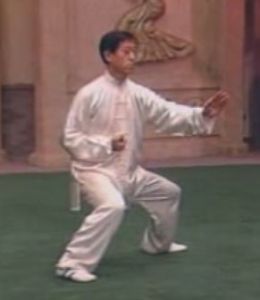
In 虚步 xu bu (empty stance), the weight is entirely (or at least 90%) on one foot. The other can be in front with the ball of the foot or the heel touching and bearing a slight amount of weight. A variation is 点步, dian bu, in which the foot is pointed.

Xu Bu Xia Chuo from 32-sword

Xu Bu Xia Chuo from 32-sword

歇步 xie bu (resting stance) is a low position with the legs folded. The front foot points straight ahead and bears most of the weight. The knee of the back foot is turned in and rests on the back of the front leg. The heel of the back foot is off the ground. Xie bu can be specified as di (low), which means all the way down so the back knee is on or near the ground.

Master Faye Li Yip does Xie bu in Fan Form.

Master Faye Li Yip does Xie bu in Fan Form.

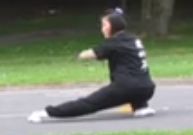
仆步 pu bu is a low stance in which the body is turned sideways and one leg is folded into a low squat while the other is extended. This stance is also called fu hu (tame the tiger), and is most famously exemplified in the taiji movement called Snake Creeps Down. Both feet face front, parallel, and the heel of the bent leg should be on the ground. The upper body should be upright.

Master Faye does Pu Bu Chuan Jian in Wudang Taiji Combined sword form.

Master Faye does Pu Bu Chuan Jian in Wudang Taiji Combined sword form.

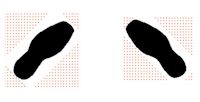
扣步 kou bu is a pigeon-toed stance used when turning the body around.

Pigeon-toed, kou bu

Pigeon-toed, kou bu

马步 ma bu (horse stance, or horse-riding stance) is a wide stance with thighs parallel to the ground. Weight is equally distributed in plain ma bu, but the stance may be staggered left or right. It can also be easily shifted into left or right bow stance. In a general list of fighting stances, this one should probably have come first, but it is not so common or basic in taiji as in kung fu.

Ma Bu, Chen Zhenglei

Ma Bu, Chen Zhenglei

擦步 ca bu is the forward step in Chen style taiji, in which the heel skids forward (ca means brush or clean or polish).

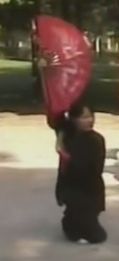
Professor Li's wife does ca bu at the opening of Fan II.

Professor Li’s wife does ca bu at the opening of Fan II.

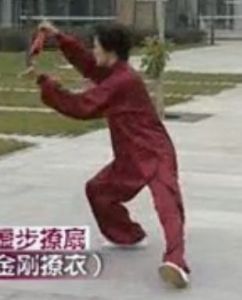
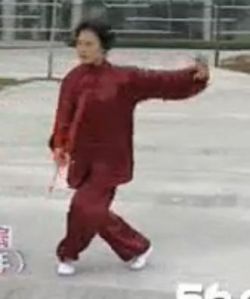
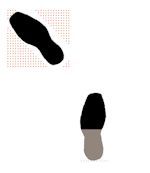
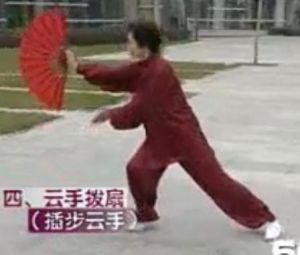
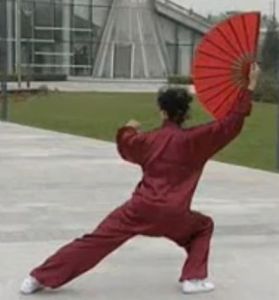
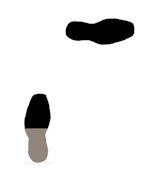
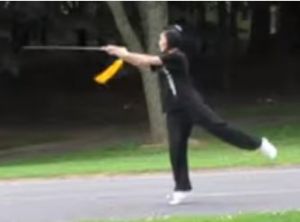
叉步 cha bu is a cross-step behind. When stepping into xie bu, one foot is set down behind the other, but just behind. In cha bu, the back foot crosses well behind.

Cha Bu Yun Shou, Fan II

Cha Bu Yun Shou, Fan II

Jesse Tsao, Cha Bu Fan Liao

Jesse Tsao, Cha Bu Fan Liao

盖步 gai bu is the opposite of cha bu: it is a cross-step in front.

Gai Bu, stepping across in front.

Gai Bu, stepping across in front.

并步 bing bu means feet together.

丁步 ding bu means feet are together, but the weight is on one foot, while the heel of the other foot is lifted. The empty foot may point forward or to the side.

开步 kai bu is a step to the side; kai means open. In Cloud Hands, the sidestep is kai bu.

Kai Bu Yun Shou (Fan II)

Kai Bu Yun Shou (Fan II)

撤步 che bu is a side-facing bow stance.

Che Bu, bow stance with hips turned sideways

Che Bu, bow stance with hips turned sideways

in 摆步 bai bu (swing step), the leading foot is set down on the heel and then swings outward 90-degrees. The heel of the back foot releases with the shift of weight, and the hips turn.

Bai Bu, swing step 90-degrees outward, releasing the heel of the back foot.

Bai Bu, swing step 90-degrees outward, releasing the heel of the back foot.

独立 du li [bu] is standing on one leg. The standing foot is at 45 degrees with respect to the body, as is the knee, which should be lifted waist-high, with the free foot pulled in toward the center of the body for balance.

du-li

跳步 tiao bu is a jump. This generally refers to the move traditionally called Horse Jumps Over the Stream.

tiao-bu

進步 jin bu is an advancing step.

退步 tui bu is a retreating step.

半步 ban bu is a half-step, where the back foot follows the front foot half-way, as for example, to set up Bai He Liang Chi (White Crane Spreads Wings) or Shou Hui Pipa (Playing the Guitar).

上步 shang bu means step up one step with the back leg, as in Shang Bu Qi Xing (Step Up Seven Stars).

行 步 xing bu is a walking step, usually in a circle as in Bagua Walking.

This list is not exhaustive–I keep coming across new steps! I haven’t found all the names of the shifted horse stances or the special empty step for Bai He Liang Chi (in which you set the toe in front, between the opponent’s legs, in preparation for a snap kick) or the staggered horse stance that you jump to in the fan forms (I do know there’s a special name for that, too). But this is most of them.

See also Wikipedia on Wushu Stances. Also, Jesse Tsao covers basic Taiji stances in his Tai Chi Fundamentals DVD, which is also available as Amazon Stremming Video. This book, Complete Taiji Dao, also covers many of the stances described in this post.

Tiger Section

The Tiger section of the Tiger-Crane 108 is all footwork, and travels to four corners like the Yang Fair Lady Works Shuttles. Here’s the video, with names:

Snake section leads into Butterfly Scatters and Black Tiger Claw Method. Then Tiger Exits Cave points to the right front corner. Tiger Captures Sheep points to the right rear corner. Repeat.

Then Tiger Combats Wolf points to the left rear corner. Tiger Exits Cave (same move as before but mirror image) points to the left front corner. Repeat Tiger Combats Wolf.

Tiger Ascends and Descends Mountain are left and right symmetrical moves, as are the two Return Horse to the Stable. Here’s the full list of names:

  • Butterfly Scatters
  • Black Tiger Claw Method
  • Tiger Exits the Cave
  • Tiger Captures Sheep
  • Tiger Exits the Cave
  • Tiger Captures  Sheep
  • Tiger Combats Wolf
  • Tiger Exits the Cave
  • Tiger Combats Wolf
  • Tiger Ascends the Mountain
  • Fierce Tiger Descends the Mountain
  • Return Horse to the Stable
  • Return Horse to the Stable

Snake Section

The Snake Section is the fourth part of the Hung Gar Tiger Crane set. Videos:

snake

And the names are:

  • Wipe the Sleeve
  • Snake Spits Poison
  • Rising Falling Block
  • Lift and Press
  • Snake Points to Heaven
  • Double Falling Back Fist
  • Fist Going Through the Sky
  • Continually Piercing the Sky
  • Staggered Horse Stance, Fist Like an Arrow

Repeat other side. Then:

  • Snake Pierces the Eye
  • Cat Stance Chopping Down
  • Turn Around and Slice bamboo
  • Snake Strikes from the earth

We are going to stop here for a while and return to Laojia Yilu, but there are two more sections remaining to this form. We’ll learn them before the end of the year.