Tai Chi and Wushu: What’s the difference?

On the question, What is Tai Chi? Here is a recent, in-depth and wonderful interview with Grand Master Aiping Cheng: https://cinaoggi.it/2026/07/05/intervista-con-aiping-cheng-allenatrice-e-giudice-di-tai-chi-e-wushu-di-fama-internazionale/

Master Aiping is unusual in the Tai Chi pantheon in being not only a great Tai Chi master but also a leading Wushu artist. Here is a short but stunning demonstration of Aiping doing a straight sword routine.

After reading the interview, and seeing this video, I found myself pondering the difference between Tai Chi and Wushu. So I asked Aiping that question, and she sent me this answer:

What is the difference between Wushu(武术) and Tai Chi?

Grand Master Aiping Cheng: “Wushu(武术) is the collective term for all Chinese martial arts, including empty-hand systems, weapon forms, and combat events. More precisely, your question is really about the difference between the external martial arts (外家拳) and the internal martial arts (内家拳), because Tai Chi is simply one style within the broader system of Chinese Wushu.
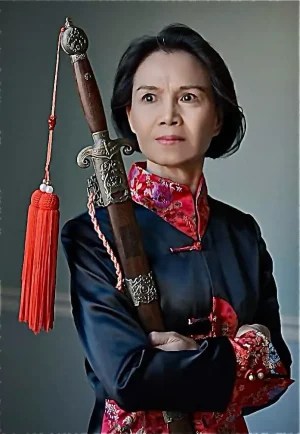
Grandmaster Aiping Cheng with sword

“Chinese Wushu has a history spanning thousands of years, giving rise to numerous styles and schools. Traditionally, these systems have been broadly categorized as internal and external martial arts.

“However, the distinction between “internal” and “external” is neither absolute nor a matter of superiority or inferiority. Rather, they represent two different paths of cultivation that evolved throughout the long history of Chinese martial arts.

“The internal arts are represented by Tai Chi (太极), Xingyiquan(形意), and Baguazhang(八卦), while the external arts include Shaolin Kung Fu(少林功夫)and many other traditional systems. Although their methods of training differ in emphasis, both are founded on martial application, aim at self-cultivation, and are rooted in Chinese culture. Together, they form the rich and complete heritage of Chinese martial arts.”

Different Cultural Expressions, the Same Spiritual Pursuit

Grand Master Aiping Cheng: “External martial arts place greater emphasis on the martial spirit. They stress strength, speed, courage, and decisiveness. Through rigorous fundamental training, practitioners develop physical fitness and practical fighting ability, embodying the spirit of strength, perseverance, and continual self-improvement.

“Internal martial arts place greater emphasis on inner cultivation. Drawing upon the Confucian ideal of harmony and the Daoist philosophy of following nature, they emphasize the balance of yin and yang, the integration of hardness and softness, and using stillness to control movement. Physical training and mental cultivation are developed together as one.

“One emphasizes the martial, while the other emphasizes the Way (Dao道). One focuses more on external capability, the other on inner refinement. Yet both ultimately pursue the same martial ideal: to cultivate virtue through martial practice and to realize the Dao through martial skill.

“True martial arts are not merely about learning how to defeat others; more importantly, they teach us how to improve ourselves.”

Two Different Paths of Training

Grand Master Aiping Cheng: “External martial arts generally follow the approach of ‘from the outside inward.’ Training begins with the body. Fundamental skills, kicking techniques, footwork, strength, speed, explosive power, flexibility, and offensive and defensive techniques all form essential parts of practice.

“Through constant repetition, movements become more precise, the body becomes stronger, and coordination and combat ability gradually develop. As a result, external martial arts are often characterized by powerful, fast movements, distinct rhythms, and striking visual impact.

“Internal martial arts, by contrast, follow the path of ‘from the inside outward.’ Training begins by correcting body structure and developing a relaxed, rooted, and stable posture. Through breathing, intention, weight transfer, and whole-body coordination, movements gradually become unified internally and externally, with the upper and lower body moving as one.

“Tai Chi emphasizes ‘guiding qi with the mind, and moving the body with qi.’ Xingyiquan emphasizes ‘the harmony of mind and intention, intention and qi, qi and power.’ Baguazhang emphasizes continuous walking, turning, and transformation, with the body changing in harmony with the steps. Although their methods differ, all of them stress developing an integrated movement system from the inside outward.

“Therefore, although the movements of the internal arts often appear slow and gentle, they require every part of the body to work together in complete coordination, achieving the principle that ‘when one part moves, every part moves.’

“These two methods—one progressing from the outside inward, the other from the inside outward—may seem different, yet both follow the same martial principle of gradual, systematic progression from the simple to the profound.”

From Form, to Strength, to Jin(劲) – The Three Levels of Chinese Martial Arts Training

Grand Master Aiping Cheng: “Whether one practices the internal or external arts, a complete martial arts education ultimately consists of three progressive levels:

  • Form (形): establishing correct structure, posture, movement, and technical precision.
  • Strength (力),  developing physical power, endurance, speed, coordination, and functional ability.
  • Jin劲(Refined Power): transforming physical strength into integrated, efficient power through whole-body coordination, timing, relaxation, and intent.

“These three stages are not separate, but build upon one another. Form provides the foundation, strength supplies the capacity, and jin represents the highest level of martial expression.”

Conclusion

Grand Master Aiping Cheng: “The internal and external martial arts represent two distinct paths that emerged during the historical development of Chinese Wushu.

“One emphasizes the cultivation of physical capability; the other focuses on developing whole-body integration and internal coordination. One progresses from the outside inward; the other from the inside outward.

“Yet regardless of which path one chooses, genuine martial arts training cannot be separated from the proper development of form(形) the accumulation of strength(力) and the refinement of jin(劲).

“When form becomes natural, strength becomes unified throughout the body, and jin is fully integrated into both body and mind, martial arts transcend mere technique. They become a means of self-cultivation rather than simply competition; a cultural tradition rather than merely physical exercise; and ultimately a lifelong path toward self-understanding and the refinement of character.

“This enduring philosophy is precisely why Chinese martial arts have flourished for thousands of years, and why they continue to transcend geographical and cultural boundaries, inspiring practitioners around the world today.

-Aiping

7/24/26

Visit her website: https://aipingcheng.com/

Tai chi Sword: Taijijian 太极剑

The Tai Chi solo sword form is the first step in learning to fight with a sword. If you have read my series on the Sword of Li Jinglin, you will be familiar with the process. After acquiring a basic competence in taijiquan (bare-hand Tai Chi), you incorporate the sword in your practice by adding the jianfa—swordfighting techniques.

me and sword: cha bu xia ci
Tai Chi 24-sword, Xia ci – Downward stab

The sword form is not a pantomime of a swordfight. It is the practice of one form of swordplay after another. The form is designed so these moves flow from one to the next. So, for example, in 32-sword, I practice the jianfa called 带 Dài, first to the right, then to the left.

Dai is a technique for countering a stab by an opponent directly in front of me. [Dai translates as “carry” but the English word is neither descriptive nor helpful.] To start, I am shifted left, so I first practice Dai to the right. Now my weight is on my right. I again practice what I could do in response to a stab from an opponent directly in front of me: I do Dai to the left.

At a comparable point in the sequence, Traditional Yang sword uses 拦扫 Lán Sǎo (block and sweep) to the right and then to the left. Lan Sao and Dai are two quite different movements, different jianfa altogether, but either one could answer a stab, and the principle is the same: you practice the move first on one side, then on the other.

demonstration of lansao (block and sweep).
Lansao (Block and sweep)

There are some basic assumptions that I make when practicing sword. One, I assume that I am facing a single opponent who is also wielding a sword. That is not to say that you cannot fight multiple attackers (good luck with that!) or that a sword cannot counter a different weapon, like a staff. These are interesting and valid variations on the basic moves. But these are advanced variations. As a default, when practicing a sword form, I assume I am fighting one other swordsman.

Another assumption: My opponent is in front of me. At a number of points in any sword form, I practice what to do in response to an attack from the side, the back, an angle, etc. That is, I practice what to do if my opponent is *not* in front of me. The answer is, in every case, that I first turn, so that he is front of me. Then I answer.

Bow stance, stabbing with a sword
Bow Stance, Level Stab; Bluegreen Dragon Emerges from the Water

For example, consider a move common to both Yang Sword (Qing Long Ch Shui—the Bluegreen Dragon Emerges from the Water) and 32-sword (Gong Bu Ping Ci—Bow Stance, Level Stab). In both forms, from the previous move, I am facing due East, and I am attacked from the left corner (NE). I first turn, then fall back and send out my own sword in front of me to contact my opponent’s weapon. Then I draw his sword to my right and counterattack.

In any case where you are attacked from anywhere but head-on, you never just throw your sword out toward your apponent. You first turn your body. Then answer.

This is corollary to a more basic principle in swordfighting, that my first priority is defense. Don’t let my opponent cut me! Then, if I can cut him, that’s good. But first and foremost, I want to stay alive.

In practice, this means that I keep my sword in front of me at all times. It could be the blade, it could be the tip, it could even be the hilt. But I need to at all times use my sword first to defend myself.

Correct position in preparation for ti xi peng jian
Can you see that the tip of the sword is on the blue line on the front of my uniform?

A good illustration of this principle is Ti Xi Peng Jian (Lift the Knee and Cup the Sword) in 32-sword. A comparable move in Yang sword is Ye Ma Tiao Jian (Wild Horse Jumps over the Stream). These two moves are quite different in the two forms, but the point here applies to both.

Sitting back in preparation to start these moves, you do not open up. Pei Yi taught me this. The tip of the sword should be in front of you, on the centerline of your body. Compare the two pictures (above and below): correct vs. incorrect position.

Incorrect: sword is not in front of the body.
In swinging my sword wide, I open myself to attack.

With the tip of the sword on the line from my center to that of the opponent in front of me, I am doing two things at once: I am defending myself and I am aiming my sword at my target. In the second picture, I am doing neither.

I should probably repeat my usual disclaimer: I am not a Tai Chi master! I am a diligent student who has been fortunate to study with more than one excellent Chinese master. I’m just lately doing sword quite a bit after a long-ish spell of not doing sword much at all, so I am thinking a lot about what I have learned, or at least come to think I know, over the years.

Go to Home and scroll down to the Sword section for links to previous posts on sword.

When and Where?

One of my favorite Chinese Tai Chi friends has recently returned to Austin, and I have begun practicing with her again. Wonderful! She speaks no English. No problem! I speak Taijiese.

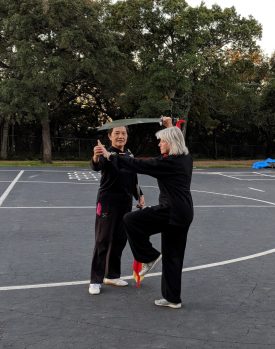
two people practicing tai chi in a park

Taijiese is not conversational Chinese, which I do not know. It is pidgin Chinese, if you will. “Pidgin” is “a simplified form of English for communication between groups that don’t share a common language.”

Except where pidgin is traditionally made up of simple English words, Taijiese is based on Chinese. Key words and minimal grammar, combined with pantomime and lots of nodding and smiling, can get simple ideas across the language barrier.

One of the things my friend and I need to communicate on any given day is when and where we will practice next. For this, it helps to know:

明天  Míngtiān Tomorrow

And the days of the week. There are several ways of naming the days of the week, but the people I know mostly use:

礼拜  Lǐbài   Week

The days of the week are numbered, starting with Monday.

礼拜一              Lǐbài Yī   Monday – literally “week [day] one”

礼拜二              Lǐbài Èr   Tuesday

礼拜三              Lǐbài Sān   Wednesday

礼拜四              Lǐbài sì   Thursday

礼拜五              Lǐbài Wǔ   Friday

礼拜六              Lǐbài Liù Saturday

Sunday is different. Again, there are several expressions for Sunday, but I know:

礼拜天      Lǐbàitiān   Sunday

Next is useful too:

下个  Xiàgè   Next

Next week

下个礼拜    Xiàgè Lǐbài   Next week

下个礼拜一 Xiàgè Lǐbài Yī     Next Monday

We need one more word:

见        Jiàn   See you

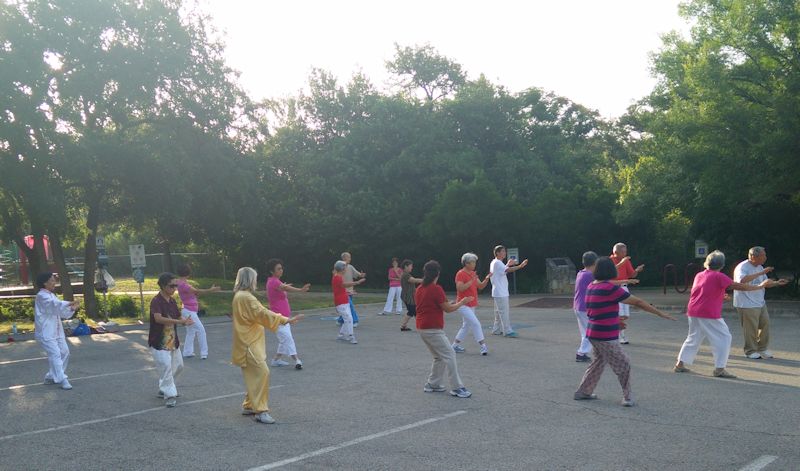
Practicing tai chi with a group in a park

For a number of years, I used to practice with a group every weekend. At the end of practice on Saturday, I would say:

明天见            Míngtiān jiàn   See you tomorrow!

At the end of practice on Sunday, I would say,

下个礼拜六见      Xiàgè Lǐbài Liù Jiàn!   See you next Saturday!

For anything more complicated than that, we might have to open our calendars.

We also need to agree about times. For this we need only the numbers and the word for hour, o’clock.

点    Diǎn  O’clock

八点  Bā diǎn   Eight o’clock

半    Bàn   Half

八点半 Bā diǎn bàn     Eight-thirty 8:30

八点一刻    Bā diǎn yī kè   Quarter past 8 (literally eight o’clock one quarter) 8:15

To say we’ll meet “here,” I just point at the ground. We both nod. That works. But there is a school where we sometimes practice:

学校  Xuéxiào    School

公园  Gōngyuán    Park

For coming to practice, we use:

来    Lái   Come

你来  Nǐ lái?  Are you coming?

This last is probably not very elegant sounding in Chinese—you come? Like Tarzan. But it works.

你来明天    Nǐ lái míngtiān?  Are you coming tomorrow?

Rising inflection and raised eyebrows make it a question.

We answer such questions with head shakes or “Yeah!”

This is helpful:

能    Néng    Indicates can

不能  Bùnéng     can’t (literally no can)

So the other day, as my friend and I were winding up after an hour, we agreed:

回家  Huí jiā    Return home (go home)

That’s enough to indicate that we are done for the day. I wasn’t going to be able to meet her the next day, so I said,

明天我不能来      Míngtiān wǒ bùnéng lái   I can’t come tomorrow

She said okay.

I then said, in an interrogative voice,

你能来礼拜四              Nǐ néng lái lǐbài sì?   Can you come Thursday?

She said, “Yeah!”

I said,

九点半      Jiǔ diǎn bàn?   Nine-thirty?

Yeah!

When I left, I said,

礼拜四见        Lǐbài sì jiàn!    See you Thursday!

Yang-style 28-step Tai Chi Fan

This relatively new Tai Chi fan form, created in 2014, is elegant and short. It has many intricate and enjoyable movements, but no physically challenging moves, so it is appropriate for people of all abilities. It’s not very difficult to learn, so it would be a great one to start with, if you want to learn Tai Chi fan.

Above, Yang Li demonstrates the whole routine (beautifully!) in the first session of a video teaching series that used to be on a YouTube station called China Wushu. The series now resides on the Chinese Wushu Association YouTube station. The series:

Here’s the full playlist.

The name of the form is 杨氏28式太极扇:Yáng shì 28-shì tàijíshàn (Yang-style 28-step Tai Chi Fan). In my group, we call ited èr shì bā shàn (28 fan) for short. As you can see from Professor Yang’s demo, this form makes a very nice solo performance. It makes a good ensemble piece too, for group practice or a performance by three or five persons.

Here is a list of the 28 movements: PDF. Here’s my demo:

More Wu-style Tai Chi

In my last post, on the Wu 45, I didn’t include the list of movements. Here it is.

吴式太极拳45式竞赛套路 (Wu-style Tai Chi 45-step competition routine) [PDF]

The Wu 45 is the competition form, so it’s pretty demanding. For beginners, a very short routine—just 13 movements, no kicks, no low form—makes for an easy introduction to some of the most important movements. When I practice this one, I add Cloud Hands after Fair Lady Works the Shuttle, before Single Whip.

  1. Qishi (beginning)
  2. Lanquewei (grasp the bird’s tail)
  3. You zuo lou xi au bu (R/L brush knee push)
  4. Jin bu ban lan chui (step forward, block, parry, punch)
  5. You zuo ye ma fen zong (R/L part the wild horse’s mane)
  6. You zuo dao juan gong (R/L go back whirling arms)
  7. Hai di zhen (needle at sea bottom)
  8. Shan tong bei (flash the back)
  9. Zhuan shen pie shen chui (turn around strike with back fist)
  10. Jin bu zai chui (step up and punch down)
  11. You zuo yunuchuan suo (R/L fair lady works the shuttle)
  12. Danbien (single whip)
  13. Shou shi (close form)
Amin Wu demonstrates the Wu-13

Master Wu also teaches Wu 24, which is very much like Wu 13 but adds opposites sides of needle at sea bottom and flash the back, plus both directions of cloud hands. She offers instructional videos on this form as well.

Wu-Style Tai Chi (3)

The modern competition form in Wu-style is the Wu 45. Like other competition routines, it incorporates the opening of the traditional form, plus many of the most important moves of the old form, but it is more left/right balanced and contains no repetition. Also like other competition routines, the Wu 45 is about six minutes long.

宗維洁 Zōng Wéi jié (1969- Beijing) is a six-time national champion in Wu-style Tai Chi competition.

Here is a list of the 45 movements (PDF).

Alas! The excellent China Wushu YouTube station no longer exists! In fall and winter of 2022-2023, I used the teaching series by Zong Wei Jie to learn the Wu 45. I have hunted down most of the videos on other YouTube stations, but I cannot find the introductory piece anywhere. In it, one of Zong’s students gives an amazing performance of the whole routine.

Here is a demo of the whole routine by Zong herself. Video quality is not the best:

Of the introductory videos on the elements of Wu style, I have located only one:

Video 4: Bufa (footwork)

I have found links to all the segments teaching the routine:

Amin Wu (吳阿敏 Wú Ā Mǐn) (About Master Wu) is another great Wu-style Tai Chi Master. Like Zong, she studied under Master Li Bingci (李秉慈 Lǐ Bǐng cí). She offers a video teaching series on Wu 45, available on Vimeo for only $20. I have used many teaching videos by Master Wu over the years (Yang, Sun, and Wu!)—they are all excellent.

Master Amin Wu teaching Wu-style 45-step Tai Chi

And here is a demonstration of the whole routine by Master Amin Wu:

Traditional Wu-style Long Form

[See my previous post introducing Wu-style Tai Chi] Each of the major styles of Tai Chi has a traditional long form, and all of the long forms follow the same deep logic. The Wu-style long form tracks the Yang 108 quite closely, so if you know the 108, the sequence of the Wu is easy to learn.

Outstanding video instruction on this form is available from Master Amin Wu. Here is a video of the whole form, demonstrated by Master Wu.

Her instructional series, very reasonably priced at just $20, consists of eighteen segments of about 12-15 minutes each. Purchase the series on Vimeo.

The instruction is in Chinese, but Master Wu’s demonstrations are so clear and detailed that you don’t need to understand what she’s saying. I have transcribed her list of the movements, totaling 93, to arrive at this list:

吴式传统93式太极拳 (Wu-shi Chuantong 93-shi Taiji – Wu-style Traditional 93-step Tai Chi) (PDF)

One note on the names: the instructional word 措 (cuò) is new to me. It’s used with 掌 (zhǎng) palm in moves 87 and 90. None of the usual definitions makes much sense–“to handle/manage/put in order/arrange/administer/execute/take action on/plan.” What you do is much like 抹 (mǒ), smear. I translated as “apply.” It’s a term of art; you just have to copy what she does. [But see George’s comment below!]

Instructional videos by Jesse Tsao are available in English from Taichihealthways.com.* I have studied these as well. Master Tsao grew up (from the age of six!) practicing Wu-style Tai Chi at the temple in Penglei. He teaches the long form in two hour-long videos priced at $24 each, also a bargain given the quality and detail of the instruction.

*At this writing, Jesse is revamping his website, but you can still get the videos here.

Here’s another demonstration of the full long form, by Master Fayi Chang: