Author of Mystery Novels--Lay Death at Her Door, Blue Lake, Accidents of Life, and Freewheeling--plus a new detective series, Murder on the Gulf Coast.
Li Jinglin (1885–1931) was a military leader during China’s Warlord Era. The Qing Dynasty, China’s last, was overthrown in 1912, and regional armies controlled the country for a couple of decades after that. The political history of that period is kalaidescopic and tumultuous, and Li Jinglin was active throughout the rise and fall of the various factions.
Li Jinglin
An accomplished and influential grandmaster of martial arts, Li is best known to those of us who study Tai Chi as China’s greatest swordsman. Li was schooled in the martial arts from childhood and learned sword as a young man from the great Wudang Grandmaster Song Wei Yi. Li became the 10th generation lineage holder of Wudang Dan Pai Sword.
Li also studied the sword of Yang Luchan by way of Yang’s sons and collaborated with masters of many other sword traditions, testing and selecting the most effective swordfighting techniques. Among Li’s closest associates were Yang Chengfu, Li Yulin (same surname, no relation), and Sun Lutang. Li Tianji, son of Li Yulin, was trained according to Li Jinglin’s teachings and later created the modern 32-step Yang-style sword form.
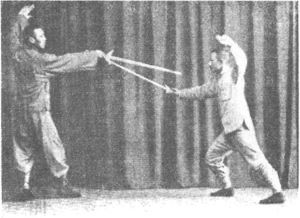
Li’s Wudang master, Song Wei Yi, was the first to create a manual for Wudang Dan Pai Sword. This manual was published in 1923 in Beijing and widely promoted and amplified by Li Jinglin. A disciple of Li Jinglin, Huang Yuanxiu, published a new, illustrated edition of the manual, Essentials of the Wudang Sword Art, in Shanghai in 1931, the year of Li’s death. The various sword techniques are demonstrated by Huang and another Li disciple, Chu Guitang, in photographs.
Huang and Chu demonstrate
The Wudang Sword Treatise, while based on the art of Song Wei Yi, represents the culmination of Li Jinglin’s wide-ranging lifelong practice. Paul Brennan provides a translation of this work, along with the photographs:
At the beginning of the treatise, in his own calligraphy, Li Jinglin writes:
“The key in sword practice is that your body moves like a swimming dragon, never coming to a halt. After practicing over a long period, your body will unite with your sword, then your sword will merge with your spirit. There will be no sword anywhere, and everywhere there will be a sword.”
This has come to be my favorite fan form, partly because this time around I found and used the teaching videos of Master Zeng Nailiang himself, creator of the form. Read about him here: Kung Fu Magazine-Professor Zeng Nailiang.
To me the most beautiful demonstration of this form is that of Sing May Chen (Irvine World Tai Chi Day 2015). In this grab she is doing 飞凤回首 – Fēi fèng huíshǒu (Flying Phoenix Turns Head):
Here are the links to Master Zeng’s four-part tutorial, totalling about 45 minutes of instruction. I especially appreciate his emphasis on the martial aspects of the form and the use of the fan as a weapon. That is Master Zeng’s daughter demonstrating the moves at the beginning of each segment.
The name of the form is 华武太極扇 (Huáwǔ tàijíshàn). Huawu means “Flowery Martial” Tai Chi Fan, and here is a list of the 42 movements (PDF). For more about Huawu Fan and links to more video demonstrations, see my earlier posts: Huawu Fan (tagged).
After a year and a half of isolation, my long-time neighborhood weekend practice group has resumed its routine, and I am so glad.
Yang Li demonstrates 28-Fan
At a nearby park, we start with about a half-hour of basics: baduanjin (the eight brocades qigong), 24, 42, 32-sword, and kungfu fan. What we do after that varies. Right now, we are learning a new fan form: 28-step fan.
The name of the form is 杨氏28式太极扇:Yáng shì 28-shì tàijíshàn (Yang-style 28-step Tai Chi Fan). We call it èr shì bā shàn (28 fan) for short. The form is relatively new, created in 2014, and is quite popular in China. It has many intricate and enjoyable movements, but it has no level-of-difficulty moves, so it is appropriate for people of all abilities. It makes a good ensemble piece too, for group practice or performance.
China Wushu is a great YouTube station with tutorials for many forms, including 28-fan. A very beautiful demonstration by Yang Li (pictured above) begins at 1:20 in the introduction to a series of teaching videos. The whole series:
This famous fan form was created in the early two thousands by Li Deyin as part of the pageantry that surrounded the 2008 Beijing Olympics. It is the second of two fan forms that Li composed for that occasion. The first was Kung Fu Fan. Both routines immediately became very popular.
This form is called Xi Yang Mei (Beautiful Sunset), or 56-Fan, or Fan II (第二套 dì èr tào, “the second way”). It is one of the most sophisticated and spectacular modern forms, first performed in Beijing by Li’s daughter, Faye Li Yip. Here she gives an amazing performance:
Xi Yang Mei is eclectic in style. Its movements are drawn from Tai Chi (both Yang and Chen), Bagua, Long Fist, Bajiquan (never heard of it! I had to look it up), sword, staff and spear, Northern and Southern Fist, even Beijing Opera. Like the music that accompanies it, Kung Fu Fan, it is a celebration of the Chinese martial arts.
Li has made more than one instructional video for this form. A new one, posted in 2020, is the first I’ve seen that has English subtitles. While I prefer to listen for the Chinese instructions (see the PDF below), it is very helpful to have English translations of the discussions where Li explains important points and also identifies the provenance of the various movements.
The tutorial is in three parts, each about thirty minutes long:
Xi Yang Mei is a good bit more difficult than Kung Fu Fan. Also, while Kung Fu Fan is a great ensemble piece, Xi Yang Mei is more suitable for a solo performance. You do see groups of three performing Xi Yang Mei—I have performed it with two other people myself—but it’s a lot easier to field a group for Kung Fu Fan.
Xi Yang Mei is an endlessly absorbing form to study and practice. I first learned it from my friend and teacher Hu Pei Yi, and I have studied Li’s various tutorials over the years, but even so, watching this latest set of videos, I see a whole slew of corrections for myself:
Obviously, I have a long way to go yet! I can only admire the elite performances in Li’s video—I particularly like to watch Fang Mishou (on the left in the opening demonstration), who is Li’s wife and an accomplished Tai Chi master in her own right.
One especially interesting point: Talking about this form as an exercise for older practitioners, Li says that it elevates the heart rate to about 120 beats per minute, and a maximum of 150 beats per minute in its most demanding parts. Perfect.
Last year, my doctor, who knows I do Tai Chi every day, asked me about whether my practice was sufficiently aerobic. He was no doubt picturing slow, Yang-style Tai Chi (which involves more exertion than most people realize, if they haven’t tried it). Next time I see him, I’ll tell him about the heart rate for Xi Yang Mei.
The Sun 73 is a modern form designed for competition. As such, it is between 6:00 and 6:30 in length and eliminates the repetition in the traditional long form. Also, as is usually the case with modern forms, it is more left-right balanced than the old form.
My current teacher here in Austin, Grandmaster Aiping Cheng, learned from Sun Lutang’s daughter, Sun Jian Yun. Years ago, the Chinese government made a video of Aiping performing the Sun competition form, and this is the standard for judging the form. Unfortunately, the copy on YouTube is incomplete (only the first three minutes) and not the best video quality.
The name of the form is 孙式七十三式太极拳竞赛套路, Sūn shì Qī Shí Sān Shì Tàijíquán Jìngsài Tàolù, which translates as Sun-style 73-Step Tai Chi Competition Form. Below, Gao Jiamin demonstrates the Sun 73 with Li Deyin providing the names of the movements.
The 98 and the 73 start out the same—the whole first section is the same, in fact. But then in the second section of the 73, several of the movements occur on the unfamiliar side: Lanzhayi is on the left, single whip is on the right, and cloud hands travels to the right.
In section three, ban lan chui is on the opposite side from usual. The four corners of Fair Lady Works the Shuttle (section five) are in a different order in the 73; the order in the 98 is the same as in the Yang 108: SW/SE/NE/NW. In the Sun 73 the corners are SW/NE/NW/SE.
Finally, here is Gao Jiamin in back view:
As usual, I got Jesse Tsao’s instructional video from Taichihealthways.com. Between that and Li’s videos above, I learned the form well enough to schedule some private lessons (outside, masked) with Aiping. I actually learned the 73 first, and found it pretty easy to move up to the 98 from there.
The Sun-style long form that Sun Lutang describes, move by move, in his book, Taijiquan, consists of 98 movements and echoes the overall structure of both the Chen and Yang long forms. It’s quite a bit shorter, however; it only takes about seven and a half minutes.
Here is a video of the Sun 98, with names, demonstrated first by Liu Jingshan (刘金山), then by Sun Lutang’s daughter, Sun Jian Yun.
Sun Jian Yun dedicated her life to preserving her father’s teachings. Li Yulin, father of Li Tianji and grandfather of Li Deyin, was a close disciple of Sun Lutang, and all three (father, son, grandson) have carried on the tradition as well.
My list of the movements in the Sun long form is derived from the book and the names given in the first video above. Where the two lists diverge, I have followed the video; footnotes in the book indicate that Sun’s form continued to evolve after he published the book.
My daily backyard practice in 2021 begins with the Sun 98. I learned the elements of Sun style from Grandmaster Aiping Cheng in 2020, and learned the 98 using Grandmaster Jesse Tsao’s instructional video (available on Taichihealthways.com).
I love the gentleness and accessibility of this style of tai chi; it’s perfect for an ordinary (and older) practitioner like me. These days, a modern competition form in Sun style, the Sun 73, seems to be more widely practiced than the old form. See: Sun-style Tai Chi (3)
Sun Lutang (1860-1933), founder of Sun-style Tai Chi, was a martial artist of formidable reputation. Aspiring fighters came from all over Asia to challenge him and study with him. Sun’s arts were Xingyi and Baguazhang. He learned Bagua from Cheng Tinghua and Xingyi from Guo Yun Shen, both dominant masters in their time.
To get an idea of what Sun practiced in his fighting career, here’s a great video of Master Xia Boya demonstrating Sun-style Baguazhang and Xingyi. As a bonus, at the end he performs 32-sword (“Li Tianji’s Sword”). It’s the most beautiful demonstrations of that form that I have ever seen.
In 1914, when Sun was in his fifties, he met Hao Weizheng, who taught Sun what is now called Wu/Hao Tai Chi. In these later years, Sun abandoned fighting, focusing instead on healthful exercise and longevity. When young men came to him to learn to fight, he told them to find another teacher!
As Sun incorporated Wu/Hao into his practice, he developed his own style of tai chi, one that contained elements of Bagua and Xingyi as well. In this next video, a 4th generation disciple of Sun Lutang practices Xingyi. You can clearly see some of the distinctive elements of Sun-style Tai Chi, such as the back-weighted 30/70 stance called 三七势 Sān Qī Shì (literally “three seven form”).
The Sun style is characterized by lively and distinctive footwork involving 跟步 Gēn bù (the following step), neat turns, and a signature opening and closing of hands (kai shou he shou) that follows every major movement in the form.
开手 Kāi shǒu Open hands
合手 Hé shǒu Close hands
Sun tai chi is also comparatively upright and small frame, with no extreme low form, so although it has all the benefit of other styles, it is particularly accessible for people of all abilities, and is especially favored by the elderly.
Here’s a great video from a Sun-style martial arts conference, in which you can see Sun-style Bagua, Xingyi, and Tai Chi:
Despite having little opportunity for education in his early life, Sun became a distinguished scholar through sheer intelligence and hard work. He wrote several important books, including one on Xingyi (published in 1914) and one on Bagua (1916).
The book pictured here was written in 1924. This volume is available in translation by Tim Cartmell and it includes a very interesting biography of Sun by Dan Miller, based on interviews (also translated by Cartmell) with Sun’s daughter, Sun Jian Yun.
The biography contains a tantalizing anecdote about a mysterious letter that was delivered to Sun’s home upon his death, and a maddening story about how his diary, containing a detailed record of his entire career and teaching, was lost.
The book is illustrated by photographs of Sun himself demonstrating the movements of his form. In the photo shown here, Sun demonstrates sanqishi when performing the Sun-style Shantongbei (flash through back).
Almost from the beginning of my Tai Chi studies, I have relied on the instructional videos that are available from Taichihealthways.com. Now there is a book, and it is amazing.
Almost from the beginning of my Tai Chi studies, I have relied on the instructional videos that are available from Taichihealthways.com. Now there is a book, and it is amazing.
Grandmaster Jesse Tsao is the real deal: Chinese born and trained from childhood, he has spent his life studying and teaching Tai Chi. He is a master of all four major styles—Chen, Yang, Wu, and Sun—and is a former collegiate wushu champion. He is an elite athlete and martial artist, but also a scholar, with a PhD in traditional Tai Chi from the prestigious Shanghai University of Sport. His book includes ample reference to the Tai Chi classics and clear explanations of the most complex issues.
Master Tsao is also a teacher with a large international following, not just because of his knowledge and achievements, but also because he is a kind, helpful, and generous mentor to students at all levels of ability and accomplishment. He is so unassuming and approachable that everyone who studies with him just calls him Jesse.
I’ve traveled to China with Jesse twice, an unforgettable experience with lots of Tai Chi along the way. This picture was taken in the Wudang mountains.
The new book, Practical Tai Chi Training: A 9-Stage Method for Mastery, (available from Amazon) represents a lifetime of study and collaboration with some of the most illustrious Tai Chi masters of our time. The book contains ample detail about external matters such as posture, footwork, and style, but its ultimate focus is on the internal nature and wholistic benefits of Tai Chi — benefits to mind, body, and spirit.
Clearly written and well-illustrated, this reference volume is absolutely comprehensive, a must-have for your Tai Chi library. If you have a question about Tai Chi, the answer is in these pages.
General Qi Jiquang was one of the most famous and successful military leaders in China’s long history. He came from a military family and assumed a hereditary post in Penglai, Shandong Province, at the age of 17.
The temple overlooking the sea at Penglai
Despite his youth, Qi quickly distinguished himself as an exceptional strategist and leader. Qi is best known for eradicating the threat of Japanese Pirates along the coast, but he was also famous for defending Beijing from Mongol invaders and directing the fortification of the Great Wall.
The Great Wall
In 2018, I traveled to China with a group led by Master Jesse Tsao. In Penglai, we visited General’s Qi’s residence.
General Qi Jiguang’s House and GardenThe garden at General Qi’s houseStatues of children playing in front of the houseThe general’s horse is saddled and ready to go.
The Yang-style 24-step Tai Chi routine is the most widely practiced form in the world. It is said to be simplified in the sense that it is short—much shorter than the traditional Yang-style long form on which it is based—and some movements have been modified to make them a little easier for beginners to learn. Here is a brilliant demonstration of 24 by Gao Jiamin:
The name of the form is 二十四式简化太极拳 (Èr Shí Sì Shì Jiǎnhuà Tàijíquán): 24-style Simplified Tai Chi. Here is a PDF list of the 24 movements.
Many people practice this form with little or no training, and it’s the only Tai Chi they know. Others learn 24 as an introduction to Tai Chi, train to a higher level of performance, and then move on to learn longer and more advanced forms.
Among this latter group, many continue practicing 24 routinely as a review of fundamentals. Twenty-four may be simplified, but it’s not easy! With heel kicks and xiashi duli (low form to standing on one leg) on both sides, it is as physically challenging as Yang Tai Chi gets.
History of the form
Twenty-four dates from the 1950s. At that time, the prevailing Tai Chi practice was the long form of Yang Chengfu. That form is a brilliant exercise, but it is very long—85 to 108 moves, depending how you count it. The problem is not so much that it takes a long time to perform (25-30 minutes) but that it takes such a very long time to learn. Most people never get there.
Recognizing that tai chi was a remarkably good exercise for health and longevity, the Chinese government’s sports commission sponsored the development of a shorter, more accessible form for beginners, in hopes that more people would learn and practice tai chi.
Yang Chengfu was long gone, having died in 1936. A number of well-known masters were consulted or involved in this development project. Li Tianji—son of Li Yulin—was a leading creative force behind the new form, and it was Li who wrote and illustrated Simplified Taijiquan, the first textbook on 24, which was eventually distributed to physical education departments throughout China.
In any case, the resulting form has only 24 movements derived from the traditional long form and little or no repetition. The long form contains 50-odd unique movements, so 24 has not quite half as many moves. It can be learned in a matter of weeks or months, not years. A person who has learned 24 can then move up to the 108 fairly quickly, having already learned the fundamentals of Yang-style Tai Chi and nearly half of the moves in the long form.
Instructions
Instructional material for 24 abounds. Arguably the most authoritative is this instructional video by Li Deyin, nephew of Li Tianji and for many years one of China’s most influential teachers, as well as its number one tournament judge. He has produced a number of instructional videos on 24. This one is almost two hours long, very complete.
This video is in Chinese. Li does a lot of talking, but if you are patient, you can learn from watching. He’s very clear, shows everything from multiple angles, and goes into great detail. After a brief introduction, a full demo starts at 3:15, back view of the first part at 9:00, and instruction begins at about 17:00.
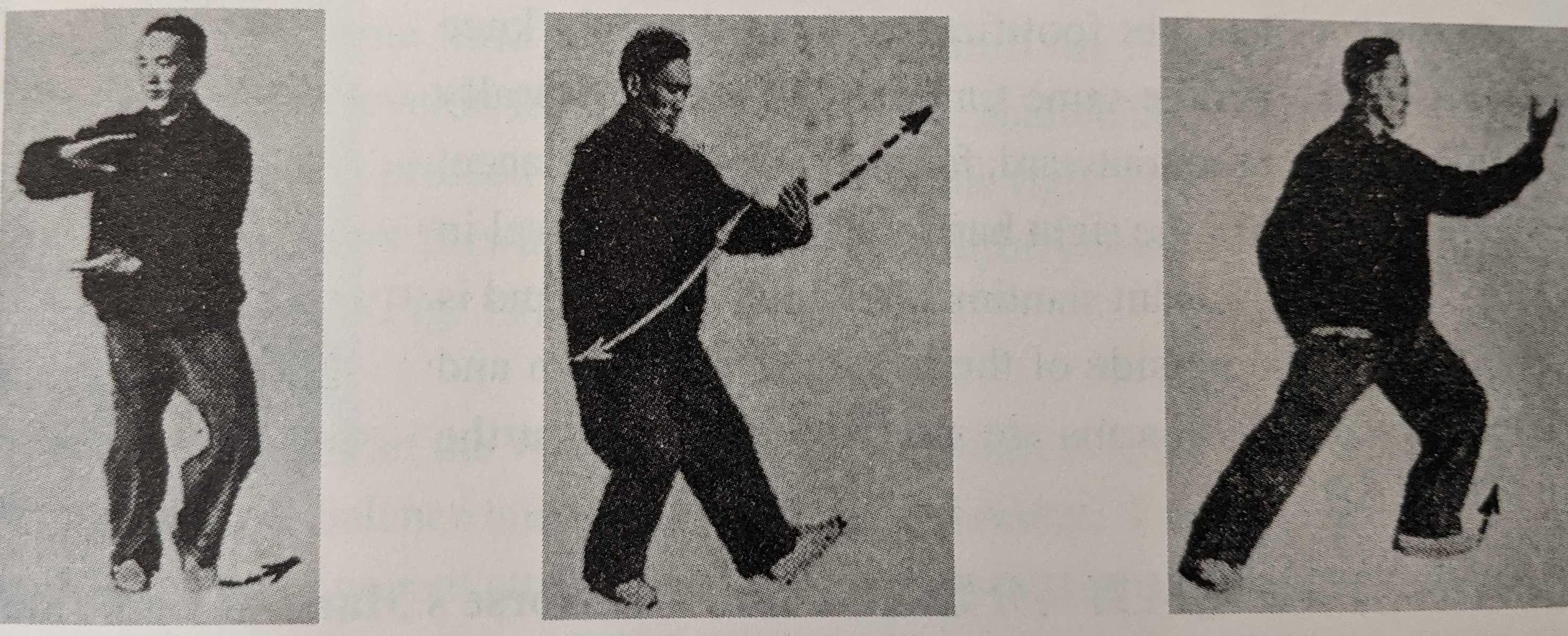
Li Tianji demonstrating how to do the moves in 24 (from the book by Li Deyin).
Although the 24 moves are derived from the 108, they are not all exactly the same. In fact, 24 is revolutionary in some respects. For one thing, the traditional forms tend to be one-sided; a lot of moves are only ever practiced on one side.
Twenty-four, by contrast, is more left-right balanced. Grasp the Bird’s Tail is practiced on both sides in 24, and Snake Creeps Down is performed on both sides as well, which makes the Golden Rooster Standing on Right Leg considerably more difficult than it is in the 108. This left-right balance turned out to be a trend; nowadays, in contemporary forms, we practice almost everything on both sides.
The retreating move in 24 is simpler than the traditional Repulse Monkeys. Some people call the backward-stepping move in 24 Repulse Monkeys, but it is a different move and has a different name in Chinese. Repulse Monkeys is 倒攆猴 Dào niǎn hóu, and the move in 24 is 倒卷肱 Dào juǎn gōng (Go back whirling forearms).
The upper body movement in these two steps is pretty much the same, but the footwork is different. Many beginners have a hard time learning the footwork for Repulse Monkeys. Dao Juan Gong is a more basic 退步 tuìbù (step back)—step straight back, from empty stance on one side to empty stance on the other.
In practice
I love 24 and practice regularly to keep my fundamentals up to speed. My only comment would be that 24 requires a warm-up. The 108 starts so gradually that by the time you get to the more demanding moves, you are ready for them. When you do 24, you are doing heel kicks and squats within two minutes. Of course, you could take it easy, but I like to practice 24 after I am thoroughly warm so I can perform each move as well as I can. Ba Duan Jin (the Eight Brocades) serves very well as a warm-up for 24.
My backyard 24 below is considerably less impressive than the world-class performance by Gao Jiamin above. This is more like what most of us do: