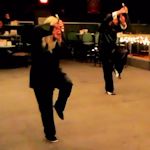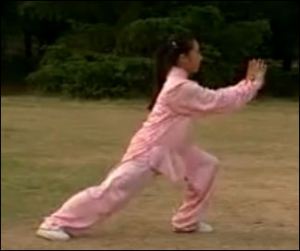
Flute Form

This short, energetic form is required for the first degree black sash. Master Gohring’s YouTube play list includes a full walk-through (about two minutes), a full-speed demo (about half a minute), and several more clips of instruction and demonstration. It’s almost impossible to learn a form entirely from video (for me anyway), but you can certainly polish and/or resurrect your form with these video tools.
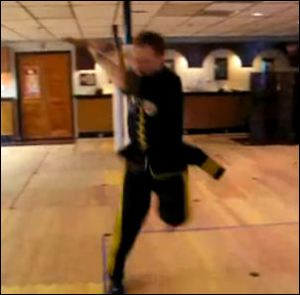
The full-speed demo above is faster than most of us can manage. For me, this form takes about one minute. The movements don’t have names, so these are just my notes on the sequence:

  1. Strike left, left hand only
  2. Hit left with two-hands on
  3. Pull in and kick right
  4. Turn left, hit/stamp down
  5. Shove, Row
  6. Pivot left and right, hitting over, over, under under
  7. Row, Shove
  8. Helicopter (360 turn with ball-change to hit)
  9. Block up (skip), hit under arm
  10. Row, shove
  11. Turn 180/hit
  12. Block up (skip), hit under arm
  13. Row, shove
  14. Turn 180/hit
  15. Step right/hit back
  16. Turn 180/hit

Switch to one hand and advance, striking:

  • High, high, low, low, high, high, low, low

Close form:

  • Turn to left, brace wrist
  • Pivot 270 on right
  • Open arms, thrust with two hands
  • Step back left, left hand
  • Circle and bow

The pivots in step number 6 above are on the heel of the leading foot and the ball of the trailing foot, 180 degrees per step. For the striking advance before the closing, step forward left and close with the right.

Chen 38: Additional Instruction

Master Gohring has recorded an introduction to Chen style Tai Chi in several parts.

stamp

In addition, he’s made video demonstrations of a number of movements and sections within the Chen 38.

One last video: Mr. Figg leads the Chen 38 up through Fist Under Elbow.

When I Google the Chen 38, what comes up most often (apart from our own videos above) is the (or a) competition set. Here is a video of the competition set that Master Gohring teaches: American Chen Tai Chi Competition Form. Our Yang competition set is just a subset of the regular Yang moves, but the Chen competition set is quite different from the 38…and looks formidably difficult to me!

The Chen 38

Grandmaster Cheng Jincai is a student of 18th generation Chen Master Chen Zhaokui. From Cheng Jincai, Master Gohring learned the Chen 38, which is currently one of the main requirements for the second degree black sash in either Tai Chi or Kung Fu at Master Gohring’s martial arts academy.

Cheng Jincai

Grand Master Cheng Jincai – Chen 38

The Chen 38 takes between ten and fifteen minutes to perform; for the test, we should take no less than twelve minutes. The stance should be low, with thighs roughly parallel to the ground, but not everyone is able to achieve this.

Videos

Master Gohring demonstrates the Chen 38 in two parts with English names. In background audio (sometimes hard to make out) Cheng Jincai provides Chinese names and breathing.

Master Gohring Chen 38

Chen 38: Part One | Part Two

Two more videos of the whole form:

In addition, Master Gohring has made several instructional videos for the opening section and for certain specific movements later in the form. I’ll list these in a separate post: Chen 38: Additional Instruction.

Names of the movements

The following list of names was provided by Master Gohring, who teaches the Chen 38 at his black sash Academy in Austin (where I have studied since 2010). These are the names used by Grandmaster Cheng Jincai.

The form may begin as usual with Yu Bei Shi (Preparing Form) and/or Qishi (Commencement),but the first movement is the Buddha Stamp..

  1. Jin Gang Dao Dui – Indra Pounds with Tilt Hammer (Buddha Stamp)
  2. Lan Zha Yi – Lazy About Tying the Robe
  3. Liu Feng Si Bi – Six Sealing Four Closing
  4. Dan Bian – Single Whip
  5. Jin Gang Dao Dui – 2nd Buddha Stamp
  6. Bai He Liang Chi – White Crane Spreads Wings
  7. Xie Xing – Oblique Form
  8. Lou Xi Au Bu – Brush Knee Twist Step
  9. Yan Shou Gong Quan – Hidden Hand Punch
  10. Jin Gang Dao Dui – 3rd Buddha Stamp
  11. Pie Shen Quan – Lean with Back (Draping the Fist)
  12. Qing Long Chu Shui – Blue Green Dragon Emerges from the Sea
  13. Shuang Tui Shou – Double Push Hands
  14. Zhou Di Kan Quan – Fist Under Elbow
  15. Dao Juan Gong – Whirling Wind Arms
  16. Bai He Liang Chi – White Crane Spreads Wings
  17. Xie Xing – Oblique Form
  18. Shan Tong Bei – Flash the Back
  19. Yan Shou Gong Quan – Hidden Hand Punch
  20. Liu Feng Si Bi – Six Sealing Four Closing
  21. Dan Bian – Single Whip
  22. Yun Shou – Cloud Hands
  23. Gao Tan Ma – High Pat on Horse
  24. Shi Zi Bai Lian – Cross Form Kick
  25. Zhi Dang Chui – Punch Downward
  26. Yuan Hou Xian Guo – Ape Picks Up the Fruit
  27. Dan Bian – Single Whip
  28. Hu Xin Quan – Shield Heart with Fist (Protect the Heart)
  29. Xie Xing – Oblique Form
  30. Hui Tou Jin Gang Dao Dui – Turning Back and 3rd Buddha Stamp
  31. Lan Zha Yi – Lazy About Tying the Robe
  32. Liu Feng Si Bi – Six Sealing Four Closing
  33. Dan Bian – Single Whip
  34. Shuang Bai Lian – Sweep Leg with Both Hands
  35. Shang Bu Qi Xing – Step Up Seven Stars
  36. Xia Bu Kua Hu – Step Down to Ride the Tiger
  37. Bai Lian Dang Tou Pao – Sweep Leg and Cannon Forward
  38. Jin Gang Dao Dui – 4th Buddha Stamp

88-Step Taiji Quan

Long Feng surprised me one day by showing me Ba Shi Ba — 88 form. The surprise was that 88 turned out to be the traditional long form that I know as the Yang 108. And sure enough, if you look it up, 88 is supposedly the traditional long form.

Li Deyin Instructional Video on Youtube

Li Deyin Instructional Video on Youtube

What I call the Yang 108 and what Long Feng knows as the 88 are unmistakably the same form, but the differences are numerous. One movement is missing entirely–the shoulder strike–and some movements are almost unrecognizable, most notably Embrace Tiger Return to Mountain (Bao Hu Gui Shan).

In addition, nearly every single movement is styled a little (or a lot) differently, more like the modern Beijing-style forms that I’ve been learning from Long Feng. I take it that 88 is the traditional Yang long form as performed and taught in China today. Modern Tai Chi is highly standardized. It’s taught in universities in China and is a college sport.

Although it sounds like 88 would have twenty fewer movements, it’s not actually any shorter except for lacking the shoulder strike. The difference is in how the movements are counted. I haven’t studied the details, but I’ve watched (and followed) the whole 88, and it is the complete 108 (sans Kao). Lan Que Wei alone could account for the difference, depending on whether you counted each Peng, Lu, Ji and An separately.

The picture above links to an instructional video by Li Deyin, who has been an enormously influential Tai Chi Master and instructor in Beijing for many years. He created 42 and 48 forms, and is considered an authority on 88. The performer is one of his students.

I would love to learn to do the long form this way, but I am afraid of confusing myself in advance of my test. Maybe this spring.

Kung Fu Fan

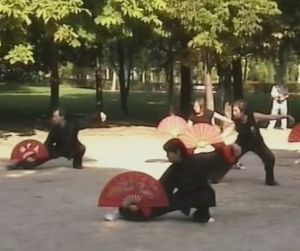
Also called 52-step fan,  Fan Form I, or Taiji Gong Fu Shan, this form was created by Master Li Deyin in 2001. Here is a wonderful video of his daughter Faye Li Yip performing (pictured below).

Fan Form


As usual, Michael Garofalo provides a wealth of information on Cloud Hands, including a PDF of the movement names, which for the most part, mean little to me (except for Slant Flying, White Crane and a couple of others) and links to numerous video perfomances.

The form, like the song (Beauty of Sunset, Xi Yang Mei) has six parts. Part one is slow, Part two faster, Part Three faster yet, ending with a little tattoo. Part four is a repeat of part two. Part five is quite fast and staccato, culminating with crash and drumroll. Part six is slow and Yang-y.

Here are my notes from Pommelhouse, using names as Long Feng taught me:

Part 1 of 6:

  • Opening
  • Slant Flying
  • White Crane Spreads Wings
  • Hornet’s Hole (step L,R)
  • Rebels to Sea (pivot on R, step L)
  • White Crane Stands on Left Leg
  • Force Split Chinese Mountain (R, L, R)
  • Civet Rat (snake L, R, L, flip fan)
  • Sit Horse Flower (snake R, horse stance)

Part 2 of 6:

  • Part the Wild Horse’s Mane (feet stay put)
  • Chuyan Volley (White Crane w/feet together, fist)
  • Hornet’s Hole
  • Tiger’s Prey (step back R, forward L, push)
  • Mantis Stalks Cicada (kick stand)
  • Lema Back (step around R,L twirl fan)
  • Turning Tibet Fan (snake)
  • Sit Horse Flower

Part 3 of 6:

  • Ding Push Hill (push fan R)
  • Dragon Back (poke fan L)
  • Whiplash Horse (wind up turn L snap back)
  • Flew Swagger (snap stand R, cat L)
  • Arms Hold On (sink fan front)
  • Windward Liaoyi (stand tall fan points down)
  • Inverted Flower Wuziu (step R, point L, cross L sink)
  • Xiang Yu Yang Fan (fan front)
  • Hold Fan Interlude (starting position)

Part 4 of 6:

    Repeat Part 2!

Part 5 of 6:

  • Strike back with both elbows
  • Horse Shaking Fist (strike w/ two backfists)
  • Hop right cat stance
  • Kick with Right
  • Dragon intersect (R, ball-change L, kick back)
  • Lady Shuttle (stand w/ fan in front)
  • Tiannvsanhua (fan flutters over head)
  • Overlord Palm (close fan sit snap) Line Step Interlude (walk in circle)

Part 6 of 6:

  • Seven Star Hand (kick stand left)
  • Ward off right
  • Pull back and press
  • Su Bei Jian (fan behind back, push)
  • Brush Knee Twist Step
  • Single Whip
  • Bow to Shoot Tiger (snake pose)
  • Bai He Liang Chi
  • Close Form

The creation of the Taiji Kungfu Fan Form was completed in January 2001 in Beijing.  The first public demonstration of this new creation took place on February 18, 2001, by 2008 senior Taiji enthusiasts at Tiananmen Square in Beijing.

 – Faye Li Yip

Yang-style Short Form

Also known as the 37-step form, the short form was created by Cheng Man Chin, who studied with Yang Cheng Fu. Patience Tai Chi offers an interesting account of the history.

37 form

Cheng Man Ching: Yang Short Form

Here’s a video of Cheng Man Chin himself doing 37 form. The movements are styled much like what we do at Master Gohring’s school–but not exactly. One of my Chinese friends is showing me this one at the park on the weekends, and he does it somewhat differently yet. Minor variations in form are endless! I have gotten over being confused by it. For this one, I will try to mimic Cheng Man Ching’s style, since we have this example of the master himself.

The 37 movements are listed below as I’ve identified them, by the names familiar to me; the list on the Patience site is  probably more authentic. From this list, anyone who knows the 108 ought to be able to put together the short form.

  1. Commencement
  2. Grasp the Bird’s Tail
  3. Single Whip
  4. White Crane Spreads Wings
  5. Brush Knee Push
  6. Playing Guitar (plus a second brush knee push)
  7. Step Forward Deflect Downward Intercept and Punch
  8. Withdraw and Push
  9. Cross Hands
  10. Embrace Tiger Return to Mountain
  11. Grasp the Bird’s Tail
  12. Diagonal Single Whip
  13. Fist Under Elbow
  14. Repulse Monkeys
  15. Slant Flying [skip White Crane thru single whip]
  16. Cloud Hands
  17. Single Whip
  18. Snake Creeps Down/Golden Rooster (Right and Left)
  19. Separate Right Foot
  20. Separate Left Foot
  21. Turn and Strike with Heel Left
  22. Brush Knee Push (Left and Right)
  23. Step Forward, Deflect Downward, Intercept and Punch
  24. Grasp the Bird’s Tail
  25. Single Whip
  26. Four Corners
  27. Grasp the Bird’s Tail
  28. Single Whip
  29. Snake Creeps Down
  30. Step Up Seven Stars
  31. Ride the Tiger to the Mountain
  32. Sweep the Lotus
  33. Bend Bow Shoot Tiger
  34. Step Forward Deflect Downward, Intercept and Punch
  35. Withdraw and Push
  36. Cross Hands
  37. Feet Together

The form is only about five minutes long, but contains most of the unique movements of the 108 and much less repetition. The major kicking section is altogether missing. So are Part the Wild Horse’s Mane and Needle at Sea Bottom.

Ba Fa

Ba Fa means Eight Energies. It’s also the name of a short Chen-style form consisting of only 16 movements corresponding to the eight energies: blocking, pulling, pushing, pressing, grabbing, breaking, elbowing and shouldering.

Ba Fa

Master Gohring demonstrates Ba Fa

Video by Master Gohring shows Ba Fa from the back at a walk-through pace. Movements are as follows:

Left:

  • Block (step left, fingers pointing right)
  • Pull Back (shift back left, close with right foot, step forward right)
  • Push (shift back to right cat stance, step forward right to push)
  • Press (open to left, press down, step back up left to shoulder width)

Right:

  • Block (step back right, fingers point to left)
  • Pull Back (shift back right, close with left, step forward left)
  • Push(shift back to left cat, step forward left to push)
  • Press (open to right, press down, step up right feet together)

Left:

  • Grab (Step left)
  • Break (block up left, pull back and down left)
  • Elbow (step left, right)
  • Shoulder (Step left, right, walk back)

Right:

  • Grab (step right)
  • Break (block up right, pull back and down right)
  • Elbow (step right, left)
  • Shoulder (step right, left, walk back)

Chen Sword

This form is required for the second degree black sash. The sword is double-edged and flexible, so it snaps when jabbed sharply. It’s the first sword form I learned; I now recognize some of the same movements in the Yang sword forms I’ve been studying.

Chem sword form

2010 Black Sash Graduation

The 2010 Black Sash Graduation video shows the form as we do it, which is the way Master Cheng Jincai teaches it. Here’s a video of Cheng Jincai performing Chen sword at the Legends of Kung Fu tournament. My Chen class performed it at the 2013 Graduation (I’m in the back in gold silks).

I don’t know the names of the movements, though I did find a list of movements on a site for the Dragon River School. I have my own notes describing the sequence; I’ll have to compare the two lists and see if I can make any sense of it. I’m not even sure that list is for the same form.

  1. Opening Form. Step left, sword across chest; shift left, turn right toes in, shift back, pivot on left heel, right arm forward; Step right, circle the arms and present sword; shift back, right toes in, open all the way around to left, return back around to right, sink, switch hands.
  2. Stand on right leg and SNAP DOWN.
  3. Step left and stab level.
  4. Slashing. Cut Right, left, right, left and turn.
  5. Step left and stab level.
  6. Over-the-head stab down behind.
  7. Stamp, step left and stab level.
  8. Slant Flying.
  9. Rhinoceros Gazes at the Moon.
  10. SNAP horizontal.
  11. Slashing. Cut left, right, left.
  12. Sink and Pull Back.
  13. Stamp right.
  14. Stand on right leg and SNAP DOWN.
  15. Stab Up. Cut left and right, left knee, stab upward.
  16. Slashing. Cut left, right, left, turn right, left, right, open.
  17. Stab Up. Knee, step right, left, skip, stab upward.
  18. Stab horizontal. Pull around to left, sink and pull back, step up and stab horizontal.
  19. Twirl Sword. Step left, twirl right; step right, twirl left, turn and face front.
  20. Lunge. Step back with right foot, wipe blade and brush knee, stab overhead and catch right wrist with left hand.
  21. Over-the-head stab down behind.
  22. Fish: Turn back to front, cast overhead to cat stance, step up and horizontal stab.
  23. Slant Flying.
  24. Stab Up Left. Cut left, left knee, stab behind and up to left.
  25. Fish: Open and step right, left, right cat stance stab down.
  26. SNAP vertical. Open to right, recoil and snap open to side, sword up.
  27. SNAP. Turn to front, scoop on right, stamp, stand on right leg and snap down.
  28. Over the Shoulder. Step left throw sword up and over the right shoulder, right cat stance.
  29. Over the Shoulder. Step right and left throw sword forward, around and down in front, right cat stance.
  30. Slant Flying. Facing front.
  31. Recoil, hilt right, step right, left, right, fajin.
  32. Cut right and left, recoil, step right, left, right, fajin.
  33. Fish: Open step right, left, right cat stance
  34. Circle sword and catch.
  35. Slashing. Cut left, right, left, and open, right knee, step right and stab upward.
  36. Fajin. Turn back and stab down.
  37. Slant Flying.
  38. SNAP. Coil, step right, left, right, and SNAP horizontal.
  39. Over-the-Head stab behind.
  40. Horizontal SNAP. Facing front.
  41. Slashing. Left, Right turning, right, right, sink and pull, step up and stab horizontal.
  42. Close Form. Change hands, step left, slip sword, feet together, left hand circles down.

One more video, of Master Chen Zhenglei, is recognizably the same form, styled differently and with a different opening. I like it! And another variation has the opening that looks a bit like a Buddha Stamp, plus a bit more Fajin.

Yang Sword

I am in love with the double-edged sword. This is the third sword form I’ve learned, after Chen sword and 32-sword. It is NOT required for either the first or second degree black sash test at Master Gohring’s school. Like other traditional forms, this one is somewhat time-obscured.

Sword

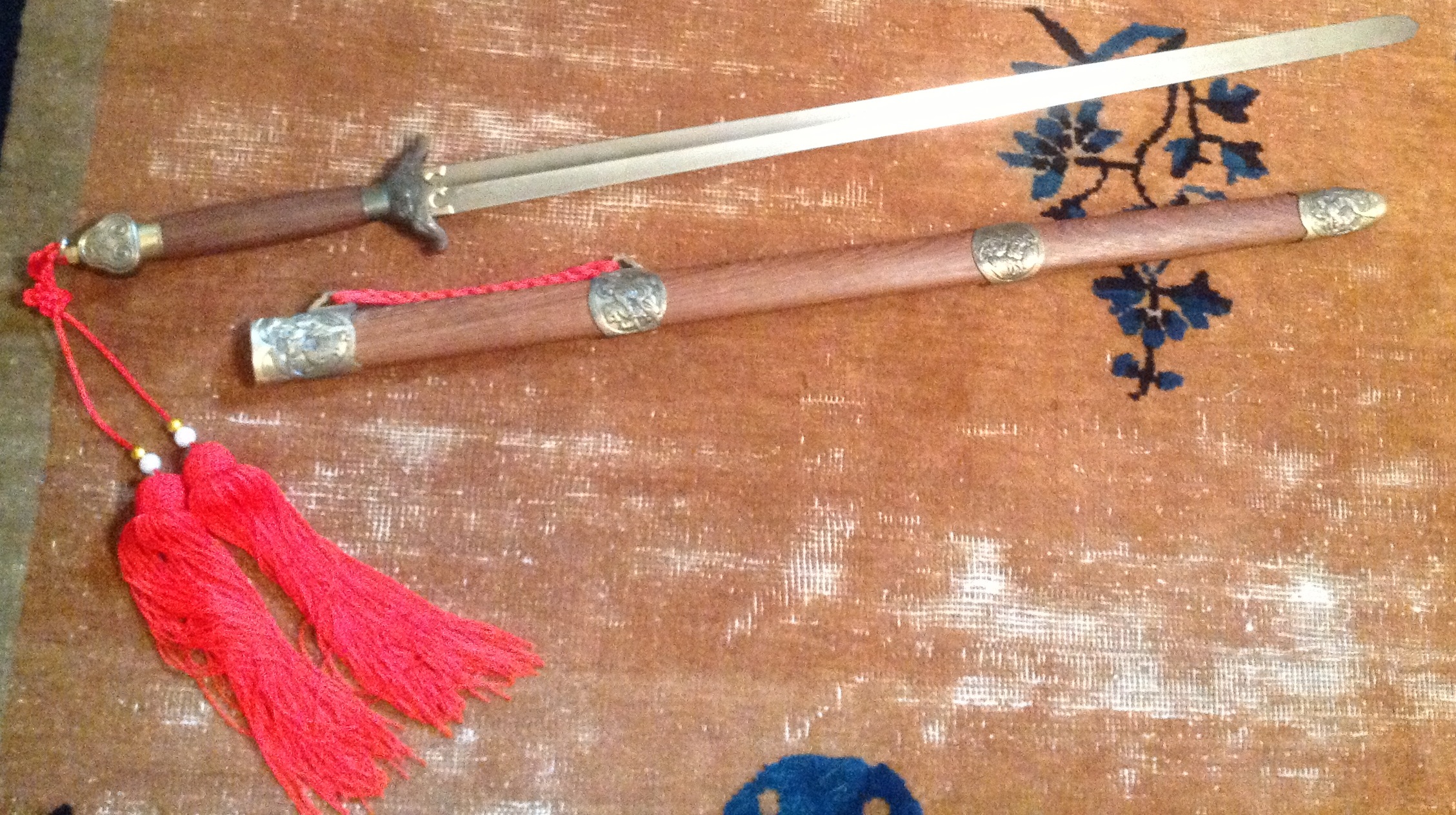
My sword is from KungFuDirect.com

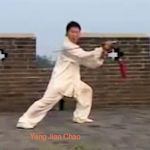
I’ve found six videos, two from Master Gohring’s school and four by other masters. (1) This video of class with names seems a little brisk in pace to me; it takes only about three minutes. That’s barely enough time to say all those long names! (2) This student demo was performed at Master Gohring’s 2013 Black Sash Graduation (4 minutes). The form runs a bit longer when performed by (3) Sifu Peter Tam Hoy, (4) Yang Jian Chao, (5) Li Guang Qi, and (6) Yang Jun.

1. Yang sword class  2. Yang sword demo 3. Peter Tam Hoy

4. Yang Jian Chao 5. Li Guang Qi 6. Yang Jun

The form looks quite different from one video to the next! I think it might be characteristic of traditional forms, which are by nature handed down from one teacher to another, that they vary this much.

Michael Garofalo lists the same movements we learn in class, along with numerous alternative translations that he has come across in his rather extensive research. Here’s the list of names.

  1. Step forward moving sword and hand together
  2. Divinity points the way
  3. Three rings around the moon (L,R)
  4. Major literary star
  5. Swallow beats the water (times three)
  6. Block and sweep from the left
  7. Block and sweep from the right
  8. Minor literary star
  9. Bee enters the cave
  10. Alert cat catches the mouse
  11. Dragonfly strikes the water
  12. Swallow returns to the nest
  13. Phoenix spreads both wings (slant flying)
  14. Whirling wind counterclockwise
  15. Minor literary star
  16. Whirling wind counterclockwise
  17. The attitude of catching a fish
  18. Divide the grass in search of a snake (times three)
  19. Embrace the moon
  20. The bird returns to the forest
  21. The black dragon wags its tail
  22. The wind rolls the lotus leaf
  23. The lion shakes its head
  24. The tiger holds its head
  25. The horse leaps over the stream
  26. Turn your body to stop the horse
  27. The compass
  28. Wave tassels against the wind
  29. Push boat with current
  30. Shooting star chases the moon
  31. The running horse goes wild
  32. Rolling up the screen
  33. The wheel spins left and right
  34. The swallow holds mud in its beak
  35. The roc spreads its wings
  36. Scooping the moon from the bottom of the sea
  37. Embracing the moon, the spirit searches the sea
  38. The rhino gazes at the moon
  39. Shooting the flying goose
  40. The dragon stretches its claws
  41. The phoenix spreads both wings
  42. Cross fence with left leg
  43. Cross fence with right leg
  44. Shooting the flying goose
  45. The white ape offers fruit
  46. The flowers fall left/right/left/right
  47. Fair lady works shuttles
  48. The white tiger wags its tail
  49. The fish leaps over the dragon’s gate
  50. The black dragon coils around the pillar
  51. The divinity points the way
  52. The wind sweeps the falling flowers
  53. Holding the tablet before your bosom
  54. Embrace the sword
  55. Return to starting position

On my to-do list: learn the standardized 56-form and figure out how it compares to this traditional form.

Beijing 24-form

The so-called simplified form was created under the auspices of the Chinese Sports Committee in 1956 by four Tai Chi masters. It contains many of the major elements of the traditional long forms without the repetition. It was intended for popular use as exercise and conditioning, and because it has been so widely taught in mainland China, it is undoubtedly the most widely known and practiced moving form in the world.

Beijing form

Videos are numerous. This one by taiji.de captured my imagination as I was just setting out to learn Tai Chi, and I still refer to it. By the time I learned 24-form, every movement was already familiar to me from my study of the 108, but I had to learn the sequence and then relearn all the details of the movements. 24-form is good training for the numbered forms coming out of post-war China, which I call modern standardized Tai Chi (my term), because they are all similarly styled. Almost every movement is quite different from the traditional style we practice at Master Gohring’s school.

The movements are as follows, and again the pronunciations are available from Lau Sui Taijiquan.

  1. Commencement – Qishi [Q=ch]
  2. Part the Wild Horses Mane – Ye ma fen zong (L, R, L) [fun]
  3. White Crane Spreads Wings – Bai he liang chi
  4. Brush Knee Push – Luo xi ao bu (L, R, L) [x=sh]
  5. Playing the Lute- Shou Hui Pi Pa
  6. Repulse Monkeys L, R, L, R – Dao Juan Hong
  7. Grasp the Bird’s Tail Left – Zuo Lan Que Wei
  8. Grasp the Bird’s Tail Right – You Lan Que Wei
  9. Single Whip – Dan bian
  10. Cloud Hands – Yun Shou
  11. Single Whip – Dan bien
  12. High Pat on Horse – Gao tan ma
  13. Strike with Heel – Deng jiao [dung; ji=ch]
  14. Box the Tiger’s ears – Shuang Feng Quan Er
  15. Turn and Strike with Heel left – Zhuan Shen Zuo Deng Jiao
  16. Snake Creeps Down Left (usual way)/Golden Rooster – Zuo Xia Shi Du Li
  17. Snake Creeps Down RIGHT/Golden Rooster – You Xia Shi Du Li
  18. Fair Lady Works the Shuttle R, L – Yu Nu Chuan Shuo
  19. Needle at Sea Bottom – Hai Di Zhen
  20. Fan Through Back – Shan Tong Bei
  21. Turn Around Block Parry and Punch – Zhuan Shen Ban Lan Chui
  22. Withdraw and Push – Ru Feng Si Bi
  23. Cross Hands – Shi Zi Shou
  24. Close Form – Shou Shi

I wanted to learn this form because it is the form you are most likely to have in common with other people you meet who do Tai Chi. Certainly, if you meet anyone who has recently come to the US from mainland China, they will begin with 24-form. In 2008, in celebration of the Olympics, squads of 2008 women performed 24-form in all the provinces of China! Long Feng was among them; she still has the white silks with red piping and embroidered Olympic rings with the year 2008 under them.