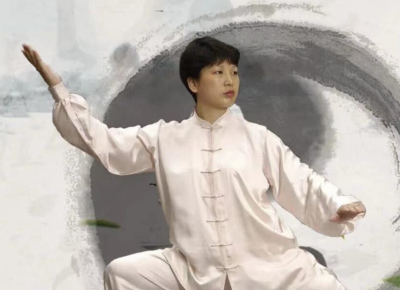
Tai chi Sword: Taijijian 太极剑

The Tai Chi solo sword form is the first step in learning to fight with a sword. If you have read my series on the Sword of Li Jinglin, you will be familiar with the process. After acquiring a basic competence in taijiquan (bare-hand Tai Chi), you incorporate the sword in your practice by adding the jianfa—swordfighting techniques.

me and sword: cha bu xia ci
Tai Chi 24-sword, Xia ci – Downward stab

The sword form is not a pantomime of a swordfight. It is the practice of one form of swordplay after another. The form is designed so these moves flow from one to the next. So, for example, in 32-sword, I practice the jianfa called 带 Dài, first to the right, then to the left.

Dai is a technique for countering a stab by an opponent directly in front of me. [Dai translates as “carry” but the English word is neither descriptive nor helpful.] To start, I am shifted left, so I first practice Dai to the right. Now my weight is on my right. I again practice what I could do in response to a stab from an opponent directly in front of me: I do Dai to the left.

At a comparable point in the sequence, Traditional Yang sword uses 拦扫 Lán Sǎo (block and sweep) to the right and then to the left. Lan Sao and Dai are two quite different movements, different jianfa altogether, but either one could answer a stab, and the principle is the same: you practice the move first on one side, then on the other.

demonstration of lansao (block and sweep).
Lansao (Block and sweep)

There are some basic assumptions that I make when practicing sword. One, I assume that I am facing a single opponent who is also wielding a sword. That is not to say that you cannot fight multiple attackers (good luck with that!) or that a sword cannot counter a different weapon, like a staff. These are interesting and valid variations on the basic moves. But these are advanced variations. As a default, when practicing a sword form, I assume I am fighting one other swordsman.

Another assumption: My opponent is in front of me. At a number of points in any sword form, I practice what to do in response to an attack from the side, the back, an angle, etc. That is, I practice what to do if my opponent is *not* in front of me. The answer is, in every case, that I first turn, so that he is front of me. Then I answer.

Bow stance, stabbing with a sword
Bow Stance, Level Stab; Bluegreen Dragon Emerges from the Water

For example, consider a move common to both Yang Sword (Qing Long Ch Shui—the Bluegreen Dragon Emerges from the Water) and 32-sword (Gong Bu Ping Ci—Bow Stance, Level Stab). In both forms, from the previous move, I am facing due East, and I am attacked from the left corner (NE). I first turn, then fall back and send out my own sword in front of me to contact my opponent’s weapon. Then I draw his sword to my right and counterattack.

In any case where you are attacked from anywhere but head-on, you never just throw your sword out toward your apponent. You first turn your body. Then answer.

This is corollary to a more basic principle in swordfighting, that my first priority is defense. Don’t let my opponent cut me! Then, if I can cut him, that’s good. But first and foremost, I want to stay alive.

In practice, this means that I keep my sword in front of me at all times. It could be the blade, it could be the tip, it could even be the hilt. But I need to at all times use my sword first to defend myself.

Correct position in preparation for ti xi peng jian
Can you see that the tip of the sword is on the blue line on the front of my uniform?

A good illustration of this principle is Ti Xi Peng Jian (Lift the Knee and Cup the Sword) in 32-sword. A comparable move in Yang sword is Ye Ma Tiao Jian (Wild Horse Jumps over the Stream). These two moves are quite different in the two forms, but the point here applies to both.

Sitting back in preparation to start these moves, you do not open up. Pei Yi taught me this. The tip of the sword should be in front of you, on the centerline of your body. Compare the two pictures (above and below): correct vs. incorrect position.
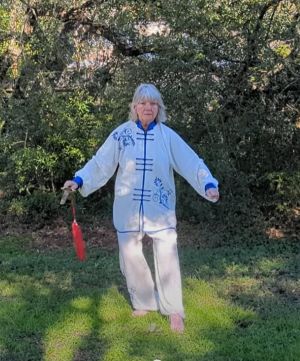
Incorrect: sword is not in front of the body.
In swinging my sword wide, I open myself to attack.

With the tip of the sword on the line from my center to that of the opponent in front of me, I am doing two things at once: I am defending myself and I am aiming my sword at my target. In the second picture, I am doing neither.

I should probably repeat my usual disclaimer: I am not a Tai Chi master! I am a diligent student who has been fortunate to study with more than one excellent Chinese master. I’m just lately doing sword quite a bit after a long-ish spell of not doing sword much at all, so I am thinking a lot about what I have learned, or at least come to think I know, over the years.

Go to Home and scroll down to the Sword section for links to previous posts on sword.

Yang-style 28-step Tai Chi Fan

This relatively new Tai Chi fan form, created in 2014, is elegant and short. It has many intricate and enjoyable movements, but no physically challenging moves, so it is appropriate for people of all abilities. It’s not very difficult to learn, so it would be a great one to start with, if you want to learn Tai Chi fan.

Above, Yang Li demonstrates the whole routine (beautifully!) in the first session of a video teaching series that used to be on a YouTube station called China Wushu. The series now resides on the Chinese Wushu Association YouTube station. The series:

Here’s the full playlist.

The name of the form is 杨氏28式太极扇:Yáng shì 28-shì tàijíshàn (Yang-style 28-step Tai Chi Fan). In my group, we call ited èr shì bā shàn (28 fan) for short. As you can see from Professor Yang’s demo, this form makes a very nice solo performance. It makes a good ensemble piece too, for group practice or a performance by three or five persons.

Here is a list of the 28 movements: PDF. Here’s my demo:

More Wu-style Tai Chi

In my last post, on the Wu 45, I didn’t include the list of movements. Here it is.

吴式太极拳45式竞赛套路 (Wu-style Tai Chi 45-step competition routine) [PDF]

The Wu 45 is the competition form, so it’s pretty demanding. For beginners, a very short routine—just 13 movements, no kicks, no low form—makes for an easy introduction to some of the most important movements. When I practice this one, I add Cloud Hands after Fair Lady Works the Shuttle, before Single Whip.

  1. Qishi (beginning)
  2. Lanquewei (grasp the bird’s tail)
  3. You zuo lou xi au bu (R/L brush knee push)
  4. Jin bu ban lan chui (step forward, block, parry, punch)
  5. You zuo ye ma fen zong (R/L part the wild horse’s mane)
  6. You zuo dao juan gong (R/L go back whirling arms)
  7. Hai di zhen (needle at sea bottom)
  8. Shan tong bei (flash the back)
  9. Zhuan shen pie shen chui (turn around strike with back fist)
  10. Jin bu zai chui (step up and punch down)
  11. You zuo yunuchuan suo (R/L fair lady works the shuttle)
  12. Danbien (single whip)
  13. Shou shi (close form)
Amin Wu demonstrates the Wu-13

Master Wu also teaches Wu 24, which is very much like Wu 13 but adds opposites sides of needle at sea bottom and flash the back, plus both directions of cloud hands. She offers instructional videos on this form as well.

Wu-Style Tai Chi (3)

The modern competition form in Wu-style is the Wu 45. Like other competition routines, it incorporates the opening of the traditional form, plus many of the most important moves of the old form, but it is more left/right balanced and contains no repetition. Also like other competition routines, the Wu 45 is about six minutes long.

宗維洁 Zōng Wéi jié (1969- Beijing) is a six-time national champion in Wu-style Tai Chi competition.

Here is a list of the 45 movements (PDF).

Alas! The excellent China Wushu YouTube station no longer exists! In fall and winter of 2022-2023, I used the teaching series by Zong Wei Jie to learn the Wu 45. I have hunted down most of the videos on other YouTube stations, but I cannot find the introductory piece anywhere. In it, one of Zong’s students gives an amazing performance of the whole routine.

Here is a demo of the whole routine by Zong herself. Video quality is not the best:

Of the introductory videos on the elements of Wu style, I have located only one:

Video 4: Bufa (footwork)

I have found links to all the segments teaching the routine:

Amin Wu (吳阿敏 Wú Ā Mǐn) (About Master Wu) is another great Wu-style Tai Chi Master. Like Zong, she studied under Master Li Bingci (李秉慈 Lǐ Bǐng cí). She offers a video teaching series on Wu 45, available on Vimeo for only $20. I have used many teaching videos by Master Wu over the years (Yang, Sun, and Wu!)—they are all excellent.

Master Amin Wu teaching Wu-style 45-step Tai Chi

And here is a demonstration of the whole routine by Master Amin Wu:

Traditional Wu-style Long Form

[See my previous post introducing Wu-style Tai Chi] Each of the major styles of Tai Chi has a traditional long form, and all of the long forms follow the same deep logic. The Wu-style long form tracks the Yang 108 quite closely, so if you know the 108, the sequence of the Wu is easy to learn.

Outstanding video instruction on this form is available from Master Amin Wu. Here is a video of the whole form, demonstrated by Master Wu.

Her instructional series, very reasonably priced at just $20, consists of eighteen segments of about 12-15 minutes each. Purchase the series on Vimeo.

The instruction is in Chinese, but Master Wu’s demonstrations are so clear and detailed that you don’t need to understand what she’s saying. I have transcribed her list of the movements, totaling 93, to arrive at this list:

吴式传统93式太极拳 (Wu-shi Chuantong 93-shi Taiji – Wu-style Traditional 93-step Tai Chi) (PDF)

One note on the names: the instructional word 措 (cuò) is new to me. It’s used with 掌 (zhǎng) palm in moves 87 and 90. None of the usual definitions makes much sense–“to handle/manage/put in order/arrange/administer/execute/take action on/plan.” What you do is much like 抹 (mǒ), smear. I translated as “apply.” It’s a term of art; you just have to copy what she does. [But see George’s comment below!]

Instructional videos by Jesse Tsao are available in English from Taichihealthways.com.* I have studied these as well. Master Tsao grew up (from the age of six!) practicing Wu-style Tai Chi at the temple in Penglei. He teaches the long form in two hour-long videos priced at $24 each, also a bargain given the quality and detail of the instruction.

*At this writing, Jesse is revamping his website, but you can still get the videos here.

Here’s another demonstration of the full long form, by Master Fayi Chang:

Wu-Style Tai Chi

I started learning Wu-style Tai Chi a few years ago, but it wasn’t until this year that I really started to feel I was getting the hang of it. I love it!

The Wu name comes from 吴全佑 Wú Quán yòu (1834–1902), who trained with Yang Luchan. Wu also studied with Yang Luchan’s oldest son, 杨班侯 Yáng Ban Bān Hóu (1837–1892).

The style is characterized by a leaning posture and unique footwork. The feet are parallel, both pointing straight to front. In bow stance, with the feet in this position, you naturally lean forward so your nose is above your knee.

However, the leaning posture is not maintained throughout. It alternates with an upright posture in sitting stance. This motion, alternating between leaning and upright posture, is captured by the lovely image of a willow tree blowing in the wind—leaning with the wind and rebounding. There are useful introductory remarks about Wu-style on the Ji Hong Tai Chi & Qi Gong Website (Mississauga, Ontario).

Amin Wu studied with Li Bingci, Chief Master of the 4th Generation of Wu-Style Tai Chi. She has a video on YouTube: An Introduction to Wu-Style Tai Chi with Sifu Amin Wu. The opening and closing are long; for the most important general instruction on Wu-style, watch from about 18:00 to 33:00.

吴鉴泉 Wú Jiànquán is the son of Wu Quanyou. Here he demonstrates Wu-style postures: https://www.youtube.com/watch?v=j1YZ0vRDklI&t=32s

Also characteristic of Wu-style is the flat circle with the palm in Lanquewei (Grasp the Bird’s tail). You can see that in this demo of elements of Wu-style, with explanations (in Chinese with subtitles):

Yang/Chen Side-by-Side (3)

Continuing the Yang and Chen style comparison project (scroll down for the first and second posts in this series), the third video starts with the second set of Cloud Hands and finishes with 收势 Shōu Shì (Closing Form).

Again, I am an old lady; there are no drop-splits to be seen in this video! But you can see that the two forms continue to track each other closely. One disparity occurs at the very end, where Yang does 搬拦捶 Bān Lán Chuí opposite the final occurance of pounding the mortar. Also, nothing in Chen corresponds to the final Yang 如封似闭 Rú Fēng Sì Bì (Like Sealing as if Closing). So I have slowed the closing of Chen to allow Yang time for a hasty finish.

It bears repeating that, necessarily, neither style has its normal pace in these videos. Both alternately speed up and slow down in order to line up against each other. The three videos total about thirteen minutes—a slow-ish Chen and defnitely a very fast Yang!

Also, both of these forms are widely practiced, with minor variations. Where I have had to choose which way to do a particular move, I have used to the following sources to settle the issue:

  • The Essence and Applications of Taijiquan by Yang Chengfu
  • Mastering Yang-Style Taijiquan by Fu Zhongwen
  • Chen’s Taichi Old Frames One and Two by Chen Zhenglei

See also, this series Part 1 and Part 2

Yang/Chen Side-by-Side (2)

Continuing the Yang and Chen style comparison project (see the first post in this series), the second video starts with the Single Whip before the first Cloud Hands and finishes with the Single Whip after Fair Lady Works the Shuttle.

This segment was considerably more difficult to make than the first. For one thing, the movements are more challenging physically; most of the kicks occur in Part 2. I am an old lady; I don’t kick high and I certainly don’t do double jump kicks! I have modified 踢 二 起 (Tī Èr Qǐ) to a slap kick.

But also, the two forms diverge more dramatically in some places. There really is nothing in Yang to correspond to the forward and backward tricks in Chen (前着 Qián Zhāo and 后着 Hòu Zhāo), and although there is a nice parallel between the right and left Part the Wild Horse’s Mane (野马分鬃 Yé Mǎ Fēn Zōng), Yang has a third and Chen does not.

Fair Lady Works the Shuttle (玉女穿梭 Yùnǚ Chuān Suō) is even more problematic. Both the Yang and Chen forms include a full 360-degree turn to the right, and both employ 挒 liè (splitting). They have the same name and occur in the same position in the overall sequence. But they are very different. It’s the only near-complete breakdown in alignment between the two forms.

Fair Lady Works the Shuttle (Yang on the left)

In the clip above, you can see the contrast between these two moves. The Chen lasts about 10 seconds, while this faster-than-normal Yang takes almost three times as long. Moreover, Yang finishes where it begins, while Chen travels about six feet. In making the middle side-by-side video, I have paused and reined in the Chen.

Next: Part 3 Cloud Hands (2) to the end

Yang/Chen Side-by-Side (1)

I’ve just completed a study comparing the Yang and Chen styles of Tai Chi. The two styles look and feel quite distinct, but the one (Yang) is derived from the other (Chen) and retains much of its essential content.

In an earlier post on this subject I made reference to a very clever video in which the Yang and Chen traditional long forms are shown side-by-side, with Chen Zhenglei performing Laojia Yilu and Yang Jun performing the Yang 108.

In that video, the alignment between the two forms is achieved entirely through very skillful video editing after the fact. The two separate videos have been subtly sped up and slowed down so that certain obvious touchpoints such as Single Whip and White Crane Spreads Wings occur at the same time side-by-side.

At the time I worked up a list (PDF) of the movements in the two forms, side-by-side, to show as many correspondences as possible. Now I’ve gone a step further. I wanted to link up the two forms much more closely, not just move-by-move but down to every corresponding step, shift, and block—as far as possible—working on the assumption that the two forms share a common deep structure.

In this manner, I’ve made three videos of roughly equal length:

  1. 起势 Qǐshì to 单鞭 Dān Biān 2 – Beginning to the second Single Whip (above)
  2. 单鞭 Dān Biān 2 to 单鞭 Dān Biān 5 – from Cloud hands through Fair Ladies
  3. 单鞭 Dān Biān 5 to the end

I am not a master of either style, so I am not the best person to make these videos. I would be happy to see this project replicated at a higher level of proficiency.

Necessarily, neither form has its normal pace. Laojia usually takes ten minutes or so, the 108 twice as long. To match the movements, I have slowed and sped up however and whenever necessary. And it’s not always Chen waiting for Yang!

One irreconcilable difference between the two forms in this first segment is the signature pounding of the mortar (金刚捣碓 Jīn Gāng Dǎo Duì) that occurs three times near the beginning of Laojia. That move has no counterpart in Yang, so in the first video, I simply pause Yang and wait for Chen to make that move.

Also, in Chen there is no counterpart for Slant Flying (斜飞势 Xié Fēi Shì) and the second Lift Hands (提手上势 Tí Shǒu Shàng Shì). However, the retreating move (倒卷肱 Dào Juǎn Gōng) in Chen has five steps; Yang repulse monkeys (倒黏猴 Dào Nián Hóu) is just three steps. So I have mapped the two extra Yang moves onto the last two steps of dao juan gong. The two forms then come together again with White Crane Spreads Wings (白鹤亮翅 Bái Hè Liàng Chì).

Throughout, both forms return again and again to the counterpoint of Six Sealing Four Closing (六封四閉 Liù Fēng Sì Bì) and Grasp the Bird’s Tail (揽雀尾 Lǎn Què Wěi) followed by the shared move, Single Whip. In all, this combination will occur six times.

Next: Part 2 – Cloud Hands to Fair Ladies

Yi Jian Mei Revisited

I first learned this beautiful sword form in 2016. It is unusually dramatic and theatrical, having its origin in a hugely popular song and both television and film dramas, the latter dating back to 1931.

This time around I found the following video on sword flowers (剑花 jiànhuā ) very helpful:

For more about this form, names of the movements, lyrics of the song, and links to instructional and performance videos, see these earlier posts:

Yi Jian Mei is not without its detractors. Some say it is not even Tai Chi Sword, and in fact, it is not. It is 抒怀剑, shūhuái jiàn, lyric (lit. express emotion) sword. The originator of this type of sword, and creator of the popular Yi Jian Mei sword routine, is 朱俊昌 Zhū Jùn Chāng. Read about him and shuhuaijian here: http://www.shuhuaijian.net/  [I owe thanks to Song Chen and Martin Mellish for this information.]

Professor Zhu is a teacher of dance, but he was trained in the martial arts from an early age. Odd as some of the movements in Yi Jian Mei might appear, I have seen most of them in one source or another in less well known, but definitely authentic, Tai Chi sword forms.

For example, this (to me) odd-looking position, called Fukan Renjian in Yi Jian Mei, is from the Michuan (secret) Yang Sword form that Yang Luchan taught the Manchu Imperial guards in the 1850s. The illustration here is from Scott Rodell’s excellent book on Chinese Swordsmanship.

The movements of Yi Jian Mei are so intricate that it’s hard to imagine using them in an actual swordfight, but though intricate, they are composed of familiar jianfa. I have modified my own practice of Yi Jian Mei to stay within bounds of the Tai Chi sword that I am familiar with.