Unknown's avatar

About elizabethbuhmann

Author of Mystery Novels--Lay Death at Her Door, Blue Lake, Accidents of Life, and Freewheeling--plus a new detective series, Murder on the Gulf Coast.

Wudang Notes 3

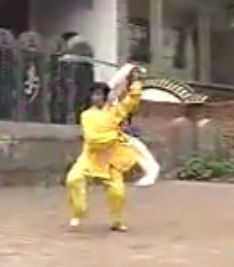
Watching the video in slow motion (click on the gear), I see that after the left ping dai, the left arm makes two circles: arms open when he shifts back, left goes low, sword high, then the left threads inside the right so the sword is low and the left is high; then as the sword blocks up for the kick, and the left hand circles up to the right shoulder.
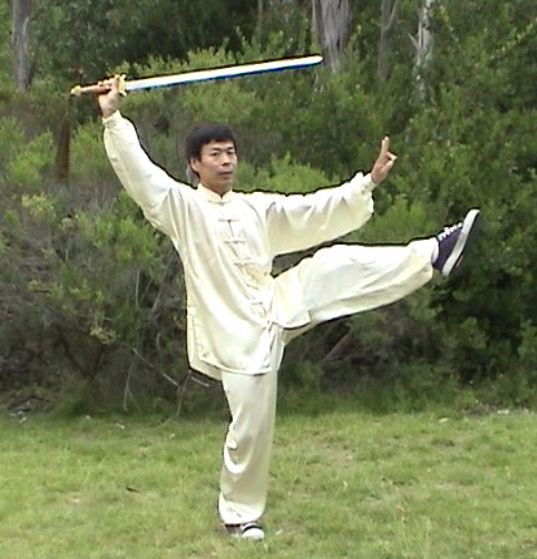
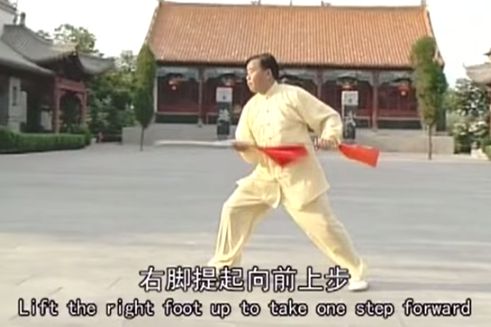
Fen Jiao - Master Tsao

Fen Jiao – Master Tsao

The grab above is from the instructional video, which I highly recommend. Available from Taichihealthways.com.

Lesson 3 begins and ends facing into the back left corner. We begin from Du Li Shang Ci, stabbing up, and end with Gong Bu Xia Ci, stabbing down. The seven movements in this lesson are (numbering for the whole 49-step routine):

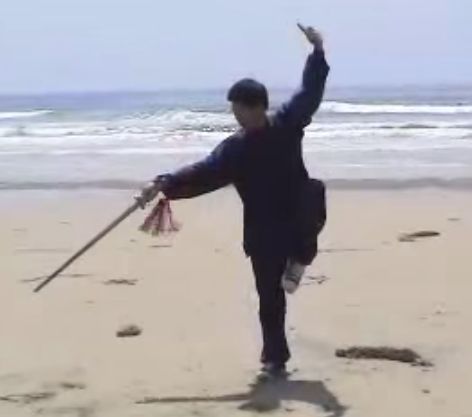
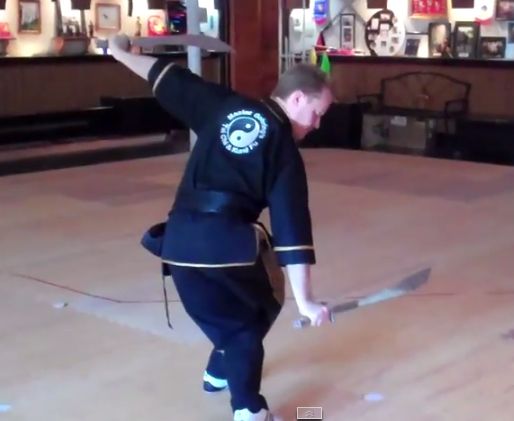
13. Pu bu chuan jian: To start, we are stabbing up with palm up. Turn the wrist counterclockwise, pulling the end of the sword back and up.Then with the sword pointing down and left, thread the point in the path of a snake creeping down. Traditional name is Snake Creeps Down to Pierce. The left hand circles up, just as it does for the Yang Snake Creeps Down, then presses down over the right hand.
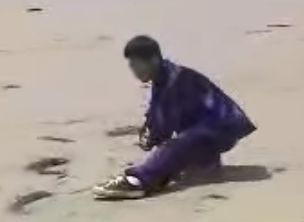
Pu bu chuan jian

Pu bu chuan jian

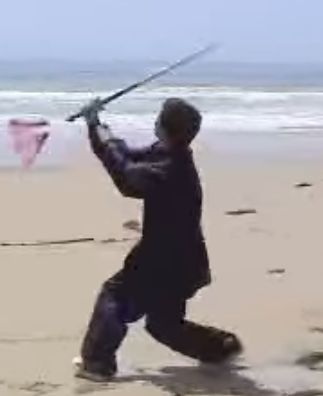
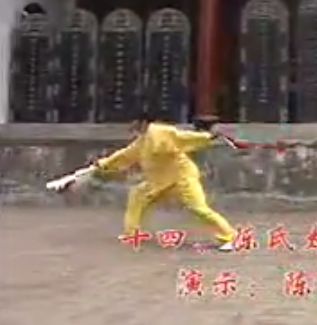
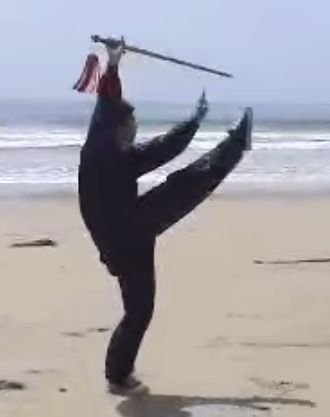
14. Deng Jiao Qian Ci: Qian means forward. Kicking Up and Thrusting Sword. Come up from snake on the left foot, opening arms to ward off. Scoop up the sword handle in both hands and lift the right knee. Thrust level forward (both hands) with the heel kick. When stepping down on the right, lower the end of the sword (point rocks up a bit). Reach to thrust forward with both hands.
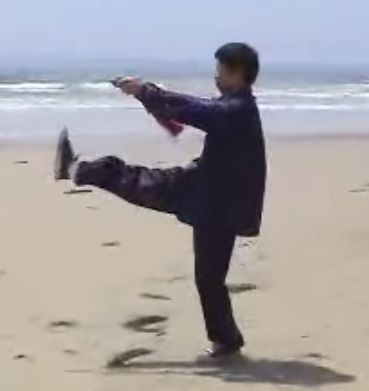
JTdeng

This whole movement (and the next) goes toward the back right corner; it travels diagonally.

15. Tiao Bu Ping Ci: Wild Horse Leaping Over Creek (that is the traditional name; the Chinese descriptive name means “jump step level stab”). From the reaching thrust after the kick, hop forward onto the left foot, opening the arms. Hands drop to the sides with the landing. Stab level, left arm high.
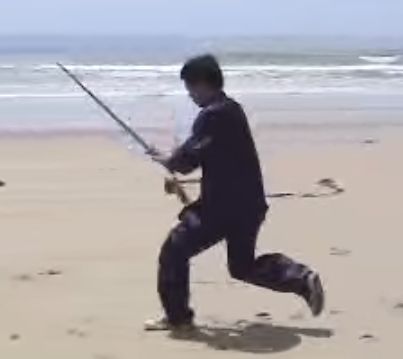
Leaping Across the Stream!

Leaping Across the Stream!

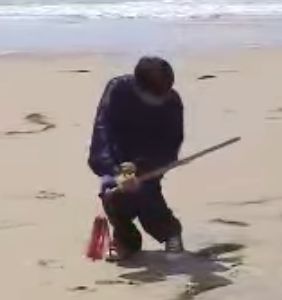
16. Zhuan Shen Ping Ci: Turn body level stab. Circle the sword to the left, and turn the wrist counterclockwise to palm down. Do this while shifting left and turning the right toes in. Sword fingers go to the right wrist. Then lead a full turn to the left with the sword fingers, finish in zuo gong bu ping ci (palm up) facing the back. Below:
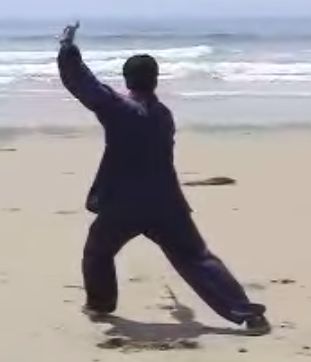
JTpingci

17. Chuan Jian Xing Bu: Bagua Walking. Block back and up to the right while shifting back. Turn left, pivoting on left heel, and thread the sword across the body to stab to the left. Curl under the right hand to go palm-down on the pull-back; spiral to palm-up on the stab. It’s a little hard to see, below, that his shoulders are facing us but his hips face away. Left arm is behind him (toward the camera).
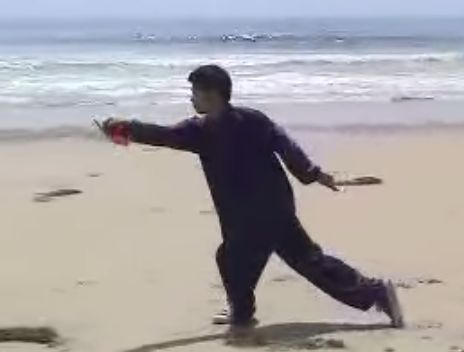
JTtwisted

18. Xing Bu Kou Jian: The right steps across the left and beng jian–flip the wrist to snap the sword up. Here’s where you walk in a big circle and a half. Starting with the left foot, four steps. Then on five, lift the hilt; on six, stab out to the right; on seven open the arms; on eight, bring them together overhead; on nine, circle down and pull the hilt up to the right, pressing down with the left.
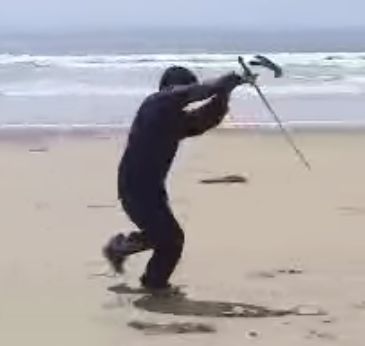
Count nine of Bagua Walking

Count nine of Bagua Walking

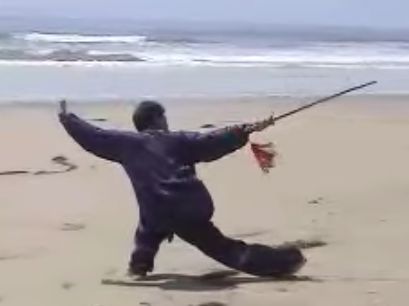
19. Gong Bu Xia Ci: Traditional name is Cat Catches Rat. Head for the back corner. On what would be the tenth step, open out the arms. On eleven, step toward the back corner. On twelve (we’re on the right foot now) stab down with both hands on the sword handle. You gong bu xia ci = right bow stance stab down. Master Tsao notes that with enough space, you can make it fourteen steps, and that’s what he does on the YouTube video — watch :55-1:05 in slow motion.
Wudang notes 2

Lesson two begins from Zuo Ping Dai, a left bow stance with left hand high and sword stabbing level. These first two lessons cover about the first 35 seconds of the YouTube video, a low-quality excerpt from the instructional video.

Fen jiao ling jian

Fen jiao ling jian

6. Fen jiao ling jian: Shift back and turn the left toe out. Step in and block high with the left, drop the sword handle into a counterclockwise circle outside the left hand. Block up with the sword, circle in with the left across the chest. The kick is a toe kick (not a heel kick as I once imagined). Ling means lead. The descriptive name he gives is Point Toe and Lead with Sword. After the kick, step down (onto left) and pull down on the handle to circle behind clockwise. Make a figure-eight, circling the sword counterclockwise in front.

Cha bu is the back cross stance

Cha bu is the back cross stance

7. Cha bu fan liao: Cha bu is the crossing stance pictured above. Fan liao means the sword is raised backwards. He gives the name as Back Slash in Cross Stance.

JTmabu

8. Ma bu yun bao: From cha bu, the left foot pivots on the toe, the right foot pivots on the heel, to reach ma bu (horse stance) as pictured above. The sword swings from pointing backwards to the right all the way around over the head to the position shown. Yun is cloud (the circle over the head), bao is embrace (note the rounded arms above). This horse stance is shifted to the left.

Ding bu jie jian

Ding bu jie jian

9. Ding bu jie jian: Jie is cut. Cut Down in T-Stance. Flip the sword over and cut down on the left. For me, this movement is improved with the knowledge that the ma bu is shifted left. That way, the step up to ding bu is more pronounced. Also, that flip is accomplished by leading the hilt in a tight counterclockwise circle. The cut is along the left thigh.

Fan shen beng jian

Fan shen beng jian

10. Fan shen beng jian: Beng jian is a new concept for me. Master Tsao in this lesson gives a good look at how the wrist flips to snap the sword around. His sword visibly flexes with this sharp movement. Beng means collapse (outside of its use in describing sword play); the sword snaps back to rest more or less upright in the hand, which is like a collapse or a folding up or cocking movement. The wrist rotates from palm down to palm up. Master Tsao uses the word “flick”–Turn Body to Flick Sword.

11. Gong bu xia ci: Both hands are on the sword handle for the downward stab. Between the fan shen and the gong bu, there’s a little pivot on the left foot so the posture faces stage-left. The traditional name is Cat Catches rat.

12. Du li shang ci: The arms open up (this is a ward-off) and then circle into the shang ci. A correction for me: don’t try to keep the left hand on the sword handle; it slides back on the right forearm, which allows the sword to extend more. The footwork is to step left, then right. The traditional name is Birds Return to the Tree at Dusk.

Wudang Notes 1

I’m working my way through the instructional video by Master Jesse Tsao–eight lessons in all for the 49 steps.

Master Tsao: ding bu dian jian

Master Tsao: ding bu dian jian

I know the form already from working through Master Liang’s demonstration video and from following Long Feng and Mr. Cao on weekends, but there is so much more to learn from Master Tsao! A low-quality video of Jesse Tsao demonstrating the whole form is free on YouTube, however the instructional video, available from his website, Taichihealthways.com, is excellent, detailed, high quality video, and well worth $35.

Lesson 1 covers the first five movements. The following are my notes on this section.

1. Qi shi: When circling the left arm across, the left heel leaves the ground and the right sword fingers cross the chest to protect the ribs. When the right sword fingers point ahead, they should pass by the ear and point at nose level, centered. To draw back the right hand, turn palm-up and pull down and back before releasing the arm to the back. Reach for the sword handle with “tiger mouth” (Hu Kou) again at ear level.

2. Ding bu dian jian: Pictured above. Master Tsao describes the pointing of the sword as a pecking movement, like a bird pecking with its beak. The traditional name for this is Dragonfly Dipping Water.

Master Tsao- hui shen dian jian

Master Tsao- hui shen dian jian

3. Hui shen dian jian: Pictured above. From ding bu, block up with the sword, leading a clockwise circle with the hilt. Left hand circles low. Then again the movement is a pecking action, while the left hand wards off high. Du li. Look at the point of the sword.

Pu bu heng sao

Pu bu heng sao

4. Pu bu heng sao: Heng means horizontal; this is a horizontal sweep from a low squat, cutting at ankle height. The traditional name for this move is Swallow Skimming Across the Water.

5. You Zuo ping dai: Carrying the sword level. On the right, Master Tsao thrusts forward palm-up, then slices right palm-down. On left ping dai, he thrusts forward palm down, then turns his sword hand palm up to sweep to the left.

Applications for sword

There are thirteen techniques for swordplay. I have found several versions of the list, including:

dianjian

Above, Amin Wu is doing 32-sword, and this is dian jian: point sword. Here’s the list

  1. 点: Dian – point
  2. 刺: Ci – stab
  3. 带: Dai – carry
  4. 劈: Pi – chop
  5. 抽: Chou – pull out
  6. 提: Ti – lift
  7. 击: Ji – hit
  8. 格: Ge – block
  9. 洗: Xi – clear off
  10. 绷: Beng – split
  11. 绞: Jiao – stir
  12. 压: Ya – press
  13. 截: Jie – intercept

The first seven are exemplified in 32-sword. Master Zhang (first link above) provides good descriptions of how all of them work as applications of sword forms. I am wondering how liao, gua, and sao fit in. Also, is lan just a synonym for ge or jie?

From Tao of Tai Chi, I’ve also found a list of techniques for the Tai chi broadsword: upper cut, under cut, cross cut, chop, split, lift, stab, block, pull coiling, push, intercept and parry.

Videos, Fan Form, etc.

Jesse Tsao offers an amazing line of instructional DVDs on Taichihealthways.com. The teasers are poor video quality, but the videos are excellent. I’ve started collecting them. So far I have the videos for 24 and 42 step.

photo (29)

Above, here is the wonderful Amin Wu doing 42-form. A few more times through Master Tsao’s instructions on this form, and I will be able to do it pretty confidently (within my sorry physical capacities). Of course, I follow Long Feng through it every weekend. Next, I’ll get Master Tsao’s video for Wudang sword.

Master Tsao was a collegiate wushu champion and studied with Chen Zhenglei and Li Deyin, so he’s pretty much got it all covered. Too bad he’s so far away (in San Diego). Watching the short clips last night, I was amazed to see Pao Chui in Fan II!

In section five, when you snap the fan backwards, that’s Yan Shou Gong Quan! Then left-right-left punches! Then you turn around and do what I thought was a kick. It’s chong! A sidekick.

In the move that follows, at school, we do a cat stance and snap the fan down. Long Feng does a little jump to cat stance. But what Master Tsao teaches is…Fan Hua Wu Xiou!!! Overturning Flowers! It’s Chen. And Master Tsao learned this form from Li Deyin, who created it. So I’ll need to get that video as well.

Meanwhile, I just finished reading The Joy Luck Club, by Amy Tan. What a great book! How have I never read it before now? I’m reading it because I am writing up the story of how my Chinese friend Lily came to the US by way of Vietnam.

I have many times been invited to join my Chinese Tai Chi friends for potluck dinners, so I loved the scene where Waverly takes her American boyfriend home for dinner. With the best intentions he commits one faux pas after another. He takes too much on his plate to begin with:

“…he had helped himself to big portions of the shrimp and snow peas, not realizing he should have taken only a polite spoonful, until everybody had a morsel.”

Then:

“He thought he was being polite by refusing seconds, when he should have followed my father’s example, who made a big show of taking small portions of seconds, thirds, and even fourths, always saying he could not resist another bite of something or other, and then groaning that he was so full he thought he would burst.”

I was relieved to know that I had always cautiously taken small portions at first–and it was no artifice on my part that I then accepted seconds, thirds and fourths because I couldn’t resist! Until I begged off because I was so full!

Rich also falls for Waverly’s mother’s criticism of her own cooking–believing her and offering condolences! Only a man could make that error, and not only among Chinese people. But anyway, that’s how you behave at dinner.

Double Saber Next Moves

Also: English names for all the moves so far. I using the translations from Master Cai’s instructional video, in which the form differs only very slightly from the one we’re learning. We are up to the move called Three Cutting, which is covered at about the 27-minute mark.

The Wild Goose Spreads its Golden Wings

The Wild Goose Spreading its Golden Wings

I don’t have Chinese names (yet!) because they appear only as images of characters, which of course I can’t copy and paste into a dictionary. But the English names for the moves are as follows:

  • The Sun Facing Broadsword
  • The Whole Flowery Circling Broadswords
  • The Sun Facing Broadsword
  • Broadsword Faces the Sun after Cutting Three Times
  • Advance to Cut Once with the Broadsword
  • Three Cutting

The next few moves are as follows:

  • The Wild Goose Spreading its Golden Wings
  • The Solitary Wild Goose Flying Out of the Flock
  • One Broadsword Facing the Sun
  • Arrange Flowers Left
  • Arrange Flowers Right
  • Two Broadswords Facing the Sun

This, by the way, is the end of Section One.

Three cutting, what I call a flurry, is not repeated; it’s just one three-cutting flurry on the left (with a step forward on the left, toe turned out), then two cuts on the right (stepping right, toes turned out).

Then step and turn left and step right to the position shown at the top of this post. This is the Wild Goose Spreading its Wings. The snap is the Solitary Goose Flying Out of the Flock. Note here that in class we do a vertical snap; Master Cai is doing a horizontal snap, as does Chen Zhenglei.

The Solitary Goose Flies Out from the Flock

The Solitary Goose Flying Out of the Flock

For the next move, Master Cai first draws back the right saber, as shown below. Then he cuts right over the right foot, left with the left foot, and turns around into the Sun-Facing position. He executes a simple turn; in class we are adding a “blade-cleaning” flourish.

caiprepares

Next, right and left Arranging Flowers. These are what we call monkey hops that finish with a lunge, as shown below. I notice that he backs up a couple of steps, right left, after the hop (which, if correct, solves a problem for me, getting into the lunge). The sabers circle overhead and cross in front of the chest before opening to the final position below:

Arrange Flowers Left (end position)

Arrange Flowers Left (end position)

Arrange Flowers Right mirrors what he’s just done, except that you have to lift out of a lunge (whereas the first time we stepped out from Xu Bu). Steps are Right, left, right, left, right.

rightabove

The demo and explanation for this movement starts at 32:30 in the video. Again, the sabers cross in front of the chest, with the right above the left, before opening to the final position.

Wudang Sword 49 steps

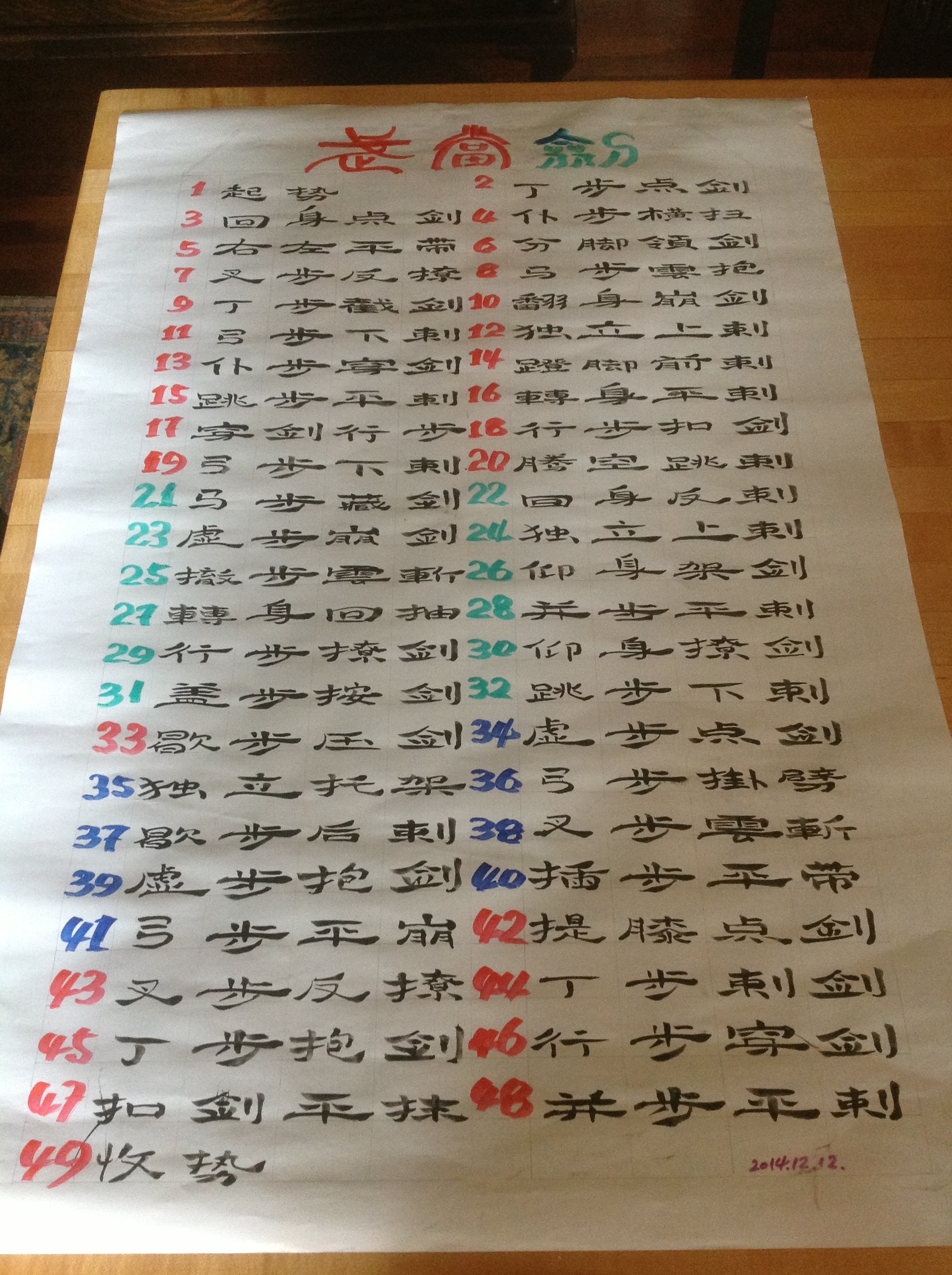
On the Tai Chi section of his website, Phil Cheung lists the 49 steps in the Wudang sword form I’ve been studying. He lists the steps in Chinese characters–it’s the same list I was given in handwritten Chinese! But as these are digital characters, I can look them up, and I did, all of them, to arrive at the list below (a few words might be wrong).

The 49 steps in Standardized Wudang Sword form, handwritten

The 49 steps in Standardized Wudang Sword form, handwritten.

The importance of this list lies in the music I have for this form: The movements are called out in Chinese. I can pick up almost nothing without Pinyin, but from the Cheung list, I now have Pinyin that corresponds to what I am hearing in the music, which, sorry, I don’t feel I can post for fear of violating a copyright. If you know where to find this Chinese Tai Chi music (I don’t), I’m sure you can find this popular accompaniment for Wudang.

I haven’t tried to translate it all–a lot of the vocabulary and descriptive moves are familiar from 32-sword, some of it is mystifying–but I have added notes connecting directions with movements for staying with the music, especially where new words occur.

  1. Qui Shi
  2. 丁 步 点 剑       Ding bu dian jian
  3. 回 身 点 剑       Hui shen dian jian
  4. 仆 步橫扫         Pu bu heng sao  (the low sweep)
  5. 右 左 平 带       You zuo ping dai
  6. 分 腳領 剑        Fen jiao ling jian (the kick)
  7. 叉 步反撩         Cha bu fan liao  (wheeling the sword)
  8. 马 步云抱         Ma bu yun bao (horse stance)
  9. 丁 步截  剑       Ding bu jie jian (the cut on the left)
  10. 翻 身崩 剑       Fan shen beng jian
  11. 弓 步下 刺        Gong bu xia ci (bow stance stab down)
  12. 独 立上 刺        Du li shang ci  (stand on one leg stab up)
  13. 仆步穿 剑         Pu bu chuan jian (squat and thread sword)
  14. 蹬腳前 刺        Deng Jiao qian ci (beginning of the run)
  15. 跳 步平刺         Tiao bu ping ci
  16. 转身平 刺         Zhuan shen ping ci (turn around level stab)
  17. 穿 刺行 步       Chuan jian xing bu
  18. 行 步扣 刺       Xing bu kou jian (begin the walk in a circle)
  19. 弓 步下 刺        Gong bu xia ci (bow stance, stab down)
  20. 騰空跳 刺        Teng kong tiao ci (the jump)
  21. 马步藏 剑         Ma bu cang jian (ma bu after jump)
  22. 回 身 反 刺       Hui shen fan ci
  23. 虛 步崩 剑       Xu bu beng jian
  24. 独立上刺          Du li shang ci (stand on one leg and stab up)
  25. 撤 步雲斬        Che bu yun zhan
  26. 仰 身架 剑       Yang shen jia jian
  27. 转 身 回抽        Zhuan shen hui chou (turn body withdraw)
  28. 并步 平 刺        Bing bu ping ci (the compass)
  29. 行步撩 剑         Xing bu liao jian (run and skip)
  30. 仰 身 撩 剑       Yang shen liao jian
  31. 蓋步按 剑        Gai bu an jian
  32. 跳 步 下 刺       Tiao bu xia ci (Skip and stab down)
  33. 歇 步壓 剑       Xie bu ya jian (first sit)
  34. 虛步 点 剑        Xu bu dian jian
  35. 独 立 托架        Du li tuo jia
  36. 弓 步 掛劈        Gong bu gua pi (bow stance wheel)
  37. 歇 步後 剑       Xie bu hou jian (second sit)
  38. 叉步雲斬         Cha bu yun zhan (feet apart circle sword)
  39. 虛 步抱 剑       Xu bu bao jian (empty stance embrace sword)
  40. 插 步 平 带       Cha bu ping dai
  41. 弓 步 平崩        Gong bu ping beng
  42. 提 膝 点 剑       Ti xi dian jian (lift knee point sword)
  43. 叉 步反 撩        Cha bu fan liao
  44. 丁 步 刺 剑       Ding bu ci jian
  45. 丁 步抱 剑        Ding bu bao jian
  46. 行 步穿 剑       Xing bu chuan jian (walk in circle)
  47. 扣 剑平抹        Kou jian ping ma
  48. 并步 平 刺        Bing bu ping ci (feet together level stab)
  49. Shou shi

More Shuang Dao Video

Master Gohring has recorded walk-through video for the Chen Tai Chi Double Saber up through the flurry that we’ve just reached in class. There are six videos in all, links listed below.

doubledao

Video 1: Opening move to diagonal open chop

Video 2: Second movement through “blade cleaning”

Video 3: Three times jump to kneeling

Video 4: Return to Sun-Facing Broadsword

Video 5: Crossed Sabers Clashing

Video 6: Flurry to parallel stab and fajin

Also available on YouTube is a video of Michael Guidry performing Chen Double Sabers at graduation (he was graduating to fourth degree black sash):

guidry

Finally, here a performance of Double Saber recorded at the Legends of Kung Fu tournament (looks like Houston, 2012); I don’t know the performer (but she’s good!).

doubledaolegends


Double Saber – first moves

I’m looking at the Pennsylvania Chen Taiji (www.pachenjaiji.com) video of the Shuang Dao form. A second or so is missing from the very start. We begin much the way we do for the single saber: step left, step back with the right and step up to right cat stance. Step back with the right and chop right and left with the sabers to reach this position:

rightread2y

I note that Chen Zhenglei steps up with the left, rather than back with the right; then up with the right to right xubu (which we call cat stance).

The position pictures above is called 朝阳, Cháo Yáng, or 朝阳刀, Cháo Yáng Dāo. Chauyang translates as sun-facing or salute the sun. Chauyang dao can be called Sun-Facing Broadsword, and this position, either on the right or the left, recurs throughout this form. Strike this position sitting on the right leg, and you are prepared to cut with the right; Strike it on the left leg and you are prepared to cut with the left.

Next is 全舞花朝阳刀,  Quán Wǔ Huā Cháo Yáng Dāo: The Whole Flowery Circling Broadswords and the Sun-facing Broadsword (I’m taking the English from the Master Cai video). I would have called this three moves, as follows.

(1.) Feet: From the position above, step left, step around right, step across in front with the left, and step out diagonally with the right. Blades: Slash right, left, circle left overhead (now your arms are closed, sabers crossed left on top), and open the sabers. You’re here:

double1

(2.) Withdraw to a left Sun-Facing Broadsword, like this:

leftready

(3.) Feet: Right, step around left, step back right and draw back into (right) Sun-Facing Broadsword. Blades: Slash left, then right, lift the left (leading with back of blade), then return to right Sun-Facing Broadsword.

That last flourish, where the left dao flashes up and then returns to the hidden position, is an added touch of flower; it does not occur in either of these videos I’m using. Master Gohring calls it “cleaning the blade,” but the blades do not actually touch. You could add this flourish nearly anywhere that Sun-Facing Broadsword occurs.

When Chen Zhenglei does this “washing the blade” movement, he circles the head a second time with each blade. I notice that he adds this, or doesn’t, randomly from one repetition (of the same move) to the next, so I conclude that it’s optional flower.

Next is Broadsword Faces the Sun After Cutting Three Times. One move is repeated three times, then followed by another move to reach Sun-Facing Broadsword, as follows.

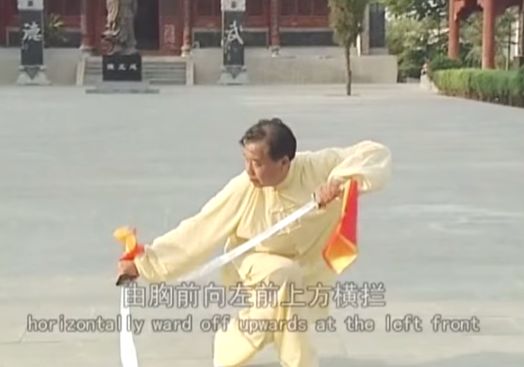
Feet for cutting three times: Step left, then right, turning the right foot in, and step across behind with the left. In class, we call this “jump to kneeling” and give it a little leap. Blades: Slash right so both arms are crossed (right on top) and open out. Master Cai says the left blade blocks up, the right down. Finishing position is like this:

caijump

Above, that’s Master Cai (Master Cai Instructional Video); Chen Su Yang is moving so fast I can’t even grab this position in slow motion! Master Cai gives the other side, too (this is a great video!)–click on the image below for a better look:

caiback

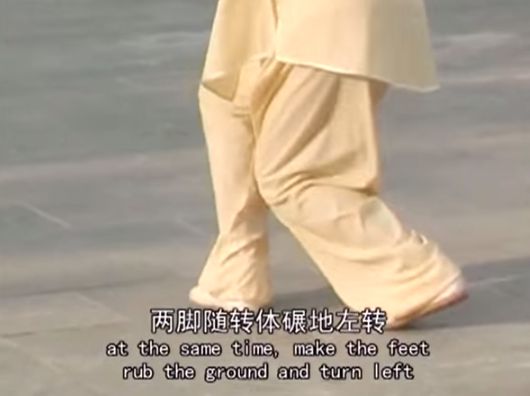
Then swivel to the left, step right, step across behind with the left to repeat. And repeat again, for a total of three cutting turns. Swivel–or as Master Cai says, make the feet rub the ground! It looks like he’s pivoting on the left toe and right heel.

caiswivels

Master Cai does not jump on these turns; he glides through them. But he does jump into the Sun-Facing Broadsword. Swivel the last time, then jump around with the right and step back with the left. The blade slashes right, so the arms are closed as they would be for a fourth round of cutting, but instead of opening up, the right saber circles the head to finish here:

caifacing


Next comes Advance to Cut Once with the Broadsword. From left Sun-Facing Broadsword, step right, pivoting to the right on the right heel, step around with the left, pivot the right on the heel again, and step up and over with the left to left-front-crossing sit:

caisits

On this one, the blade slashes left, then right (while the left circles over the head). The right circles overhead and the two blades cross in front at the same time as left foot crosses over. In the ending position above the two swords are not vertical but oblique.

Seriously, it is well worth wading 25 minutes into this video. So slow and clearly broken down! One more small discrepancy in technique: we do not touch sabers in this sequence; Master Cai does. The sabers clang against each other, crossed, as they open for the xie bu sit.

Double Broadsword

Below: Chen Xiaowang does Chen Double Saber. The video has some distracting background effects, so I’m not using it as a study aid. It appears to have been shot in Chen Village.

Xleftready

This next one is better, although the performer, Chen Su Yang, FLIES. Very fast moving, and look at the size of the flags. He covers what we’ve done so far in class in 15 seconds. This was shot in Chen Village, too. I see variations in all these examples, just in terms of the number of flourishes, or perhaps the number of steps in the Bagua Walking part.

guyflies

双刀, Shuāng Dāo, is the Chinese for double saber, and Googling that or even double broadsword gets better results than Googling double saber.

mastercai

Most interesting to me is the above very long instructional video featuring Master Tzu Tian Cai. Part one of two (I haven’t even looked for part two yet), it is almost an hour long. Most of the lengthy (about 7 minutes) intro is in Chinese, but the video clips (of other Chen forms) are entertaining while you wait for the double dao.

The opening of this form is a little different: He does a sort of Buddha Stamp. But from there, at least as far as we have gotten in class, the movements are the same as ours. The form instruction includes English subtitles, and the detail is wonderful. Click on the picture below!

leftleft


This video doesn’t get down to actual step-by-step instruction until about the 18-minute mark, so it requires patience. It’s worth it! He breaks down both footwork and blades and gives us the names of the movements, too. We’ve done only three or four so far. I’ll write up study notes on all this and post tomorrow.