On the question, What is Tai Chi? Here is a recent, in-depth and wonderful interview with Grand Master Aiping Cheng: https://cinaoggi.it/2026/07/05/intervista-con-aiping-cheng-allenatrice-e-giudice-di-tai-chi-e-wushu-di-fama-internazionale/
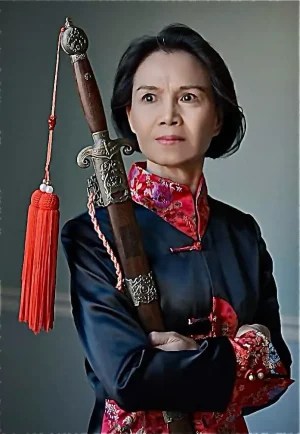
Master Aiping is unusual in the Tai Chi pantheon in being not only a great Tai Chi master but also a leading Wushu artist. Here is a short but stunning demonstration of Aiping doing a straight sword routine.
After reading the interview, and seeing this video, I found myself pondering the difference between Tai Chi and Wushu. So I asked Aiping that question, and she sent me this answer:
What is the difference between Wushu(武术) and Tai Chi?
Grand Master Aiping Cheng: “Wushu(武术) is the collective term for all Chinese martial arts, including empty-hand systems, weapon forms, and combat events. More precisely, your question is really about the difference between the external martial arts (外家拳) and the internal martial arts (内家拳), because Tai Chi is simply one style within the broader system of Chinese Wushu.
“Chinese Wushu has a history spanning thousands of years, giving rise to numerous styles and schools. Traditionally, these systems have been broadly categorized as internal and external martial arts.
“However, the distinction between “internal” and “external” is neither absolute nor a matter of superiority or inferiority. Rather, they represent two different paths of cultivation that evolved throughout the long history of Chinese martial arts.
“The internal arts are represented by Tai Chi (太极), Xingyiquan(形意), and Baguazhang(八卦), while the external arts include Shaolin Kung Fu(少林功夫)and many other traditional systems. Although their methods of training differ in emphasis, both are founded on martial application, aim at self-cultivation, and are rooted in Chinese culture. Together, they form the rich and complete heritage of Chinese martial arts.”
Different Cultural Expressions, the Same Spiritual Pursuit
Grand Master Aiping Cheng: “External martial arts place greater emphasis on the martial spirit. They stress strength, speed, courage, and decisiveness. Through rigorous fundamental training, practitioners develop physical fitness and practical fighting ability, embodying the spirit of strength, perseverance, and continual self-improvement.
“Internal martial arts place greater emphasis on inner cultivation. Drawing upon the Confucian ideal of harmony and the Daoist philosophy of following nature, they emphasize the balance of yin and yang, the integration of hardness and softness, and using stillness to control movement. Physical training and mental cultivation are developed together as one.
“One emphasizes the martial, while the other emphasizes the Way (Dao道). One focuses more on external capability, the other on inner refinement. Yet both ultimately pursue the same martial ideal: to cultivate virtue through martial practice and to realize the Dao through martial skill.
“True martial arts are not merely about learning how to defeat others; more importantly, they teach us how to improve ourselves.”
Two Different Paths of Training
Grand Master Aiping Cheng: “External martial arts generally follow the approach of ‘from the outside inward.’ Training begins with the body. Fundamental skills, kicking techniques, footwork, strength, speed, explosive power, flexibility, and offensive and defensive techniques all form essential parts of practice.
“Through constant repetition, movements become more precise, the body becomes stronger, and coordination and combat ability gradually develop. As a result, external martial arts are often characterized by powerful, fast movements, distinct rhythms, and striking visual impact.
“Internal martial arts, by contrast, follow the path of ‘from the inside outward.’ Training begins by correcting body structure and developing a relaxed, rooted, and stable posture. Through breathing, intention, weight transfer, and whole-body coordination, movements gradually become unified internally and externally, with the upper and lower body moving as one.
“Tai Chi emphasizes ‘guiding qi with the mind, and moving the body with qi.’ Xingyiquan emphasizes ‘the harmony of mind and intention, intention and qi, qi and power.’ Baguazhang emphasizes continuous walking, turning, and transformation, with the body changing in harmony with the steps. Although their methods differ, all of them stress developing an integrated movement system from the inside outward.
“Therefore, although the movements of the internal arts often appear slow and gentle, they require every part of the body to work together in complete coordination, achieving the principle that ‘when one part moves, every part moves.’
“These two methods—one progressing from the outside inward, the other from the inside outward—may seem different, yet both follow the same martial principle of gradual, systematic progression from the simple to the profound.”
From Form, to Strength, to Jin(劲) – The Three Levels of Chinese Martial Arts Training
Grand Master Aiping Cheng: “Whether one practices the internal or external arts, a complete martial arts education ultimately consists of three progressive levels:
- Form (形): establishing correct structure, posture, movement, and technical precision.
- Strength (力), developing physical power, endurance, speed, coordination, and functional ability.
- Jin劲(Refined Power): transforming physical strength into integrated, efficient power through whole-body coordination, timing, relaxation, and intent.
“These three stages are not separate, but build upon one another. Form provides the foundation, strength supplies the capacity, and jin represents the highest level of martial expression.”
Conclusion
Grand Master Aiping Cheng: “The internal and external martial arts represent two distinct paths that emerged during the historical development of Chinese Wushu.
“One emphasizes the cultivation of physical capability; the other focuses on developing whole-body integration and internal coordination. One progresses from the outside inward; the other from the inside outward.
“Yet regardless of which path one chooses, genuine martial arts training cannot be separated from the proper development of form(形) the accumulation of strength(力) and the refinement of jin(劲).
“When form becomes natural, strength becomes unified throughout the body, and jin is fully integrated into both body and mind, martial arts transcend mere technique. They become a means of self-cultivation rather than simply competition; a cultural tradition rather than merely physical exercise; and ultimately a lifelong path toward self-understanding and the refinement of character.
“This enduring philosophy is precisely why Chinese martial arts have flourished for thousands of years, and why they continue to transcend geographical and cultural boundaries, inspiring practitioners around the world today.
-Aiping
7/24/26
Visit her website: https://aipingcheng.com/

