Unknown's avatar

About elizabethbuhmann

Author of Mystery Novels--Lay Death at Her Door, Blue Lake, Accidents of Life, and Freewheeling--plus a new detective series, Murder on the Gulf Coast.

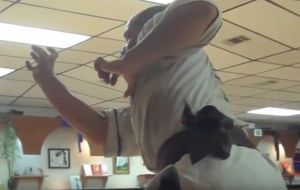
Drunken Fist

We’re up to the next-to-last section of the Tiger-Crane Set. It’s short, and Master Gohring’s videos combine it with the Dragon Section that comes after it. Here’s a good video of both sections, with names; the Drunken part is less than a minute.

drunkenchew

The names of the moves are as follows:

  • Eight drunken gods
  • Old man exits cave
  • One finger asks the question
  • First star punching method
  • Second star punching method
  • Two fists punching downward
  • Immediately punching upward
  • Fist like an arrow

Crane Section

This is the sixth of eight sections in the Tiger-Crane 108. Video:

crane

Names are:

Hard and soft crane walking
Descending arm hand and waist
One finger asks the question
Crane wing punching
Fist through the sleeve

[Repeat on the other side:]
Hard and soft crane walking
Descending arm hand and waist
One finger asks the question
Crane wing punching
Fist through the sleeve

Crane pecking
Reviving crane

Flying crane
Hungry crane stands on one leg
Hungry crane captures shrimp

[repeat on the other side:]
Flying crane
Hungry crane stands on one leg
Hungry crane captures shrimp

Crane head punching
Crane head punching

Dragon swings its tail
Monk summons corpse
Tame the tiger shoot the tiger

Footwork and Stances

步法 (bu fa) means footwork. I’ve been working on building a comprehensive list of names of steps and stances. I use the Chinese names, because translations of the everyday meanings of the Chinese words are mostly not applicable; these are terms of art. I do offer some English equivalents, especially where the English expression is well established.

弓步 gong bu (bow stance) is the long stride in which the leading foot points straight ahead and the back foot is at a 45-degree angle. How long, low, and wide the stride is varies with the individual and the style of tai chi. In the modern forms that I have studied, long and low is good, as long as you don’t have to lunge or lurch to move around, and about 8 inches in width is desirable. The weight is 60-70% on the leading foot.

Amin Wu is doing 24-form, in which gong bu is the basic forward step.

Amin Wu is doing 24-form, in which gong bu is the basic forward step.

In 虚步 xu bu (empty stance), the weight is entirely (or at least 90%) on one foot. The other can be in front with the ball of the foot or the heel touching and bearing a slight amount of weight. A variation is 点步, dian bu, in which the foot is pointed.

Xu Bu Xia Chuo from 32-sword

Xu Bu Xia Chuo from 32-sword

歇步 xie bu (resting stance) is a low position with the legs folded. The front foot points straight ahead and bears most of the weight. The knee of the back foot is turned in and rests on the back of the front leg. The heel of the back foot is off the ground. Xie bu can be specified as di (low), which means all the way down so the back knee is on or near the ground.

Master Faye Li Yip does Xie bu in Fan Form.

Master Faye Li Yip does Xie bu in Fan Form.

仆步 pu bu is a low stance in which the body is turned sideways and one leg is folded into a low squat while the other is extended. This stance is also called fu hu (tame the tiger), and is most famously exemplified in the taiji movement called Snake Creeps Down. Both feet face front, parallel, and the heel of the bent leg should be on the ground. The upper body should be upright.

Master Faye does Pu Bu Chuan Jian in Wudang Taiji Combined sword form.

Master Faye does Pu Bu Chuan Jian in Wudang Taiji Combined sword form.

扣步 kou bu is a pigeon-toed stance used when turning the body around.

Pigeon-toed, kou bu

Pigeon-toed, kou bu

马步 ma bu (horse stance, or horse-riding stance) is a wide stance with thighs parallel to the ground. Weight is equally distributed in plain ma bu, but the stance may be staggered left or right. It can also be easily shifted into left or right bow stance. In a general list of fighting stances, this one should probably have come first, but it is not so common or basic in taiji as in kung fu.

Ma Bu, Chen Zhenglei

Ma Bu, Chen Zhenglei

擦步 ca bu is the forward step in Chen style taiji, in which the heel skids forward (ca means brush or clean or polish).

Professor Li's wife does ca bu at the opening of Fan II.

Professor Li’s wife does ca bu at the opening of Fan II.

叉步 cha bu is a cross-step behind. When stepping into xie bu, one foot is set down behind the other, but just behind. In cha bu, the back foot crosses well behind.

Cha Bu Yun Shou, Fan II

Cha Bu Yun Shou, Fan II

Jesse Tsao, Cha Bu Fan Liao

Jesse Tsao, Cha Bu Fan Liao

盖步 gai bu is the opposite of cha bu: it is a cross-step in front.

Gai Bu, stepping across in front.

Gai Bu, stepping across in front.

并步 bing bu means feet together.

丁步 ding bu means feet are together, but the weight is on one foot, while the heel of the other foot is lifted. The empty foot may point forward or to the side.

开步 kai bu is a step to the side; kai means open. In Cloud Hands, the sidestep is kai bu.

Kai Bu Yun Shou (Fan II)

Kai Bu Yun Shou (Fan II)

撤步 che bu is a side-facing bow stance.

Che Bu, bow stance with hips turned sideways

Che Bu, bow stance with hips turned sideways

in 摆步 bai bu (swing step), the leading foot is set down on the heel and then swings outward 90-degrees. The heel of the back foot releases with the shift of weight, and the hips turn.

Bai Bu, swing step 90-degrees outward, releasing the heel of the back foot.

Bai Bu, swing step 90-degrees outward, releasing the heel of the back foot.

独立 du li [bu] is standing on one leg. The standing foot is at 45 degrees with respect to the body, as is the knee, which should be lifted waist-high, with the free foot pulled in toward the center of the body for balance.

du-li

跳步 tiao bu is a jump. This generally refers to the move traditionally called Horse Jumps Over the Stream.

tiao-bu

進步 jin bu is an advancing step.

退步 tui bu is a retreating step.

半步 ban bu is a half-step, where the back foot follows the front foot half-way, as for example, to set up Bai He Liang Chi (White Crane Spreads Wings) or Shou Hui Pipa (Playing the Guitar).

上步 shang bu means step up one step with the back leg, as in Shang Bu Qi Xing (Step Up Seven Stars).

行 步 xing bu is a walking step, usually in a circle as in Bagua Walking.

This list is not exhaustive–I keep coming across new steps! I haven’t found all the names of the shifted horse stances or the special empty step for Bai He Liang Chi (in which you set the toe in front, between the opponent’s legs, in preparation for a snap kick) or the staggered horse stance that you jump to in the fan forms (I do know there’s a special name for that, too). But this is most of them.

See also Wikipedia on Wushu Stances. Also, Jesse Tsao covers basic Taiji stances in his Tai Chi Fundamentals DVD, which is also available as Amazon Stremming Video. This book, Complete Taiji Dao, also covers many of the stances described in this post.

Chen Yi Dao

I’m reviewing Chen Saber for a demonstration next week. For video, I’m looking at Chen Zhenglai. This sequence is slightly different from what I’m used to, but it’s mostly the same.

Chen Zhenglei performs Chen-shi Yi Dao

Chen Zhenglei performs Chen-shi Yi Dao

Also, Master Gohring has an entire playlist from a workshop that Master Blue Siytangco held at our school a few years ago.

Master Siytangco teaches Chen Saber

Master Siytangco teaches Chen Saber

I’ll combine this post with an earlier one on Chen saber to make a page for the form and link to that from the Moving Forms page.

Tiger Section

The Tiger section of the Tiger-Crane 108 is all footwork, and travels to four corners like the Yang Fair Lady Works Shuttles. Here’s the video, with names:

Snake section leads into Butterfly Scatters and Black Tiger Claw Method. Then Tiger Exits Cave points to the right front corner. Tiger Captures Sheep points to the right rear corner. Repeat.

Then Tiger Combats Wolf points to the left rear corner. Tiger Exits Cave (same move as before but mirror image) points to the left front corner. Repeat Tiger Combats Wolf.

Tiger Ascends and Descends Mountain are left and right symmetrical moves, as are the two Return Horse to the Stable. Here’s the full list of names:

  • Butterfly Scatters
  • Black Tiger Claw Method
  • Tiger Exits the Cave
  • Tiger Captures Sheep
  • Tiger Exits the Cave
  • Tiger Captures  Sheep
  • Tiger Combats Wolf
  • Tiger Exits the Cave
  • Tiger Combats Wolf
  • Tiger Ascends the Mountain
  • Fierce Tiger Descends the Mountain
  • Return Horse to the Stable
  • Return Horse to the Stable

Yi Jian Mei: Names

From the instructional video on Yi Jian Mei I have gleaned the names of the movements. It wasn’t easy! I took screen shots of the captions, but of course I couldn’t paste the characters into a dictionary because they were images. So I drew them one by one into the MDBG dictionary.

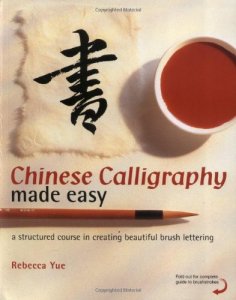
For all but the very simplest characters, the dictionary will not recognize a character unless the brush strokes are entered in (at least approximately) correct order. So from the lovely book shown below, Chinese Calligraphy Made Easy by Rebecca Yue, I learned (more or less) the proper order of brushstrokes. Altogether, this list took hours!

calligraphy

Of course, I could have just asked my friend Pan Huai to translate, but doing it myself the hard way was fun and I learned a lot. Pan Huai did tweak my translations of the movement names, many of which, like traditional names of other forms, are poetic, folkloric, and idiomatic.

Yi Jian Mei was the title of both a 1931 silent movie and a 1984 Taiwanese TV show. The plots are completely different, so I assume the two dramas are unrelated. The song written and recorded by Taiwanese singer-songwriter Fei Yu Qing was the theme for the TV show.

The sword form, which is based on the song, must therefore be less than thirty years old and might be a lot more recent: New versions of the 1984 TV show were made in China in 2000 and 2009. I’ve been told that the sword form was created by a master who is no longer living, but I haven’t been able to find out his name. [Update: See the comments below by Martin Mellish.]

The list of 20 movements is divided into stanzas of the song, and I’ve included the lyrics that go with them. Love the song, the lyrics, and the sword form!

Names for 32-sword

I’ve put together a list of the 32 movements in the standardized short sword form. The contemporary forms have two sets of names, descriptive and traditional. Descriptive names are instructions, like Feet Together Point Sword. The traditional names are mostly poetic, often idiomatic, and sometimes make reference to folklore and legendary gods and heroes.

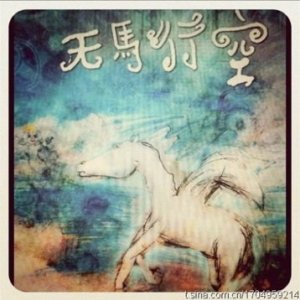
Heavenly Horse Crosses the Sky

Heavenly Horse Crosses the Sky

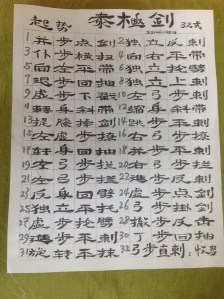
For descriptive names, I have used the list written out for me by a friend (below). For the traditional names I have relied heavily on Michael Garofalo’s excellent blog, Cloud Hands. He has compiled an extensive list of names for each movement–these older names appear in many forms and have numerous translations. I have chosen the poetic names used at my school for the Yang sword form.

photo (15)

起势, Qi Shi (Commencement) is not one of the 32 movements. For 32-sword, 三環套月 (San huan tao yue) is a form of Three Rings Around the Moon, which also varies in traditional forms, but is mostly the same in contemporary sword forms.

Long Feng doing 32 sword

Three Rings Around the Moon

Here’s the list, in Chinese, Pinyin and English, as a PDF: 32-Sword Names of Movements

If you are confused by the two different names for Da Kui Xing—Big Dipper and Major Literary Star—Michael Garofalo explains how and why the great scholar Kui Xing took up residence in the constellation. See Cloud Hands.

Interestingly, the MDBG dictionary translates 海底撈月 (Hai Di Lao Yue), which we call Scooping the Moon from the Bottom of the Sea, as an idiom for a hopeless illusion, which makes sense, since the moon in the sea is just a reflection that you couldn’t scoop up.

Push Boat with Current is an idiom for taking advantage of a situation for one’s own benefit, and Shooting Star Chases the Moon is an idiom for swift action.

Heavenly Horse Crosses the Sky ia an idiom for boldness and imagination, unrestrained style, especially in calligraphy. Garofalo notes that a number of words for sword techniques are also terms for strokes in calligraphy, and that many sword masters have also been accomplished calligraphers.

42-Step Taiji Quan

I’ve just been through Li De Yin’s instructional video on the 42-step combined form for competition. I have the DVD and have not found that material on YouTube; it might not be available on the Web.

42deyin

I did stumble upon a short video in which Professor Li explains (in Chinese, alas and of course) and demonstrates one of the moves I have found most baffling: the sequence of Yan Shou Gong Chui and Ye Ma Fen Zong. The Hidden Hand Punch I get, and although it’s different from the Chen I know, Part the Wild Horse’s Mane is clear, too. What I have been puzzled about is the little fajin in between. This is the clearest exposition I’ve seen. Helpful!

42aminwu

For sheer beauty of form, Amin Wu’s version is the performance I am trying to keep in my mind’s eye. I’m a big fan of this many-time Chinese champion. You can read about her accomplishments here: wuamintaichi.com/master_wu.

I’ve been learning the Chinese characters for numbers and a few of the words that occur most commonly in tai chi. The red letters in the image above say 42 form taiji quan:  = 4,  = 10, = 2 (combine four, ten and two for 42), 式 = shì = form, 太极拳 = taiji quan. Learn Chinese numbers here: learnchineseez.com/characters/learn-to-write-chinese.

For names of movements, other videos, etc., see the main 42-form page.

Wudang Tai Chi Videos

Here’s an additional (and excellent!) resource for the combined Wudang (49-step)Tai Chi Sword form: an instructional video in two parts on YouTube, with Li De Yin teaching and his daughter Faye Li Yip demonstrating.

Master Faye Yip demonstrating

Master Faye Yip demonstrating Pu Bu Chuan Jian

The videos are 45-50 minutes long, each covering about half of the form. The second video includes the optional flourishes that can follow #36, gong bu gua pi.

Snake Section

The Snake Section is the fourth part of the Hung Gar Tiger Crane set. Videos:

snake

And the names are:

  • Wipe the Sleeve
  • Snake Spits Poison
  • Rising Falling Block
  • Lift and Press
  • Snake Points to Heaven
  • Double Falling Back Fist
  • Fist Going Through the Sky
  • Continually Piercing the Sky
  • Staggered Horse Stance, Fist Like an Arrow

Repeat other side. Then:

  • Snake Pierces the Eye
  • Cat Stance Chopping Down
  • Turn Around and Slice bamboo
  • Snake Strikes from the earth

We are going to stop here for a while and return to Laojia Yilu, but there are two more sections remaining to this form. We’ll learn them before the end of the year.