Unknown's avatar

About elizabethbuhmann

Author of Mystery Novels--Lay Death at Her Door, Blue Lake, Accidents of Life, and Freewheeling--plus a new detective series, Murder on the Gulf Coast.

Yang Sword

I am in love with the double-edged sword. This is the third sword form I’ve learned, after Chen sword and 32-sword. It is NOT required for either the first or second degree black sash test at Master Gohring’s school. Like other traditional forms, this one is somewhat time-obscured.
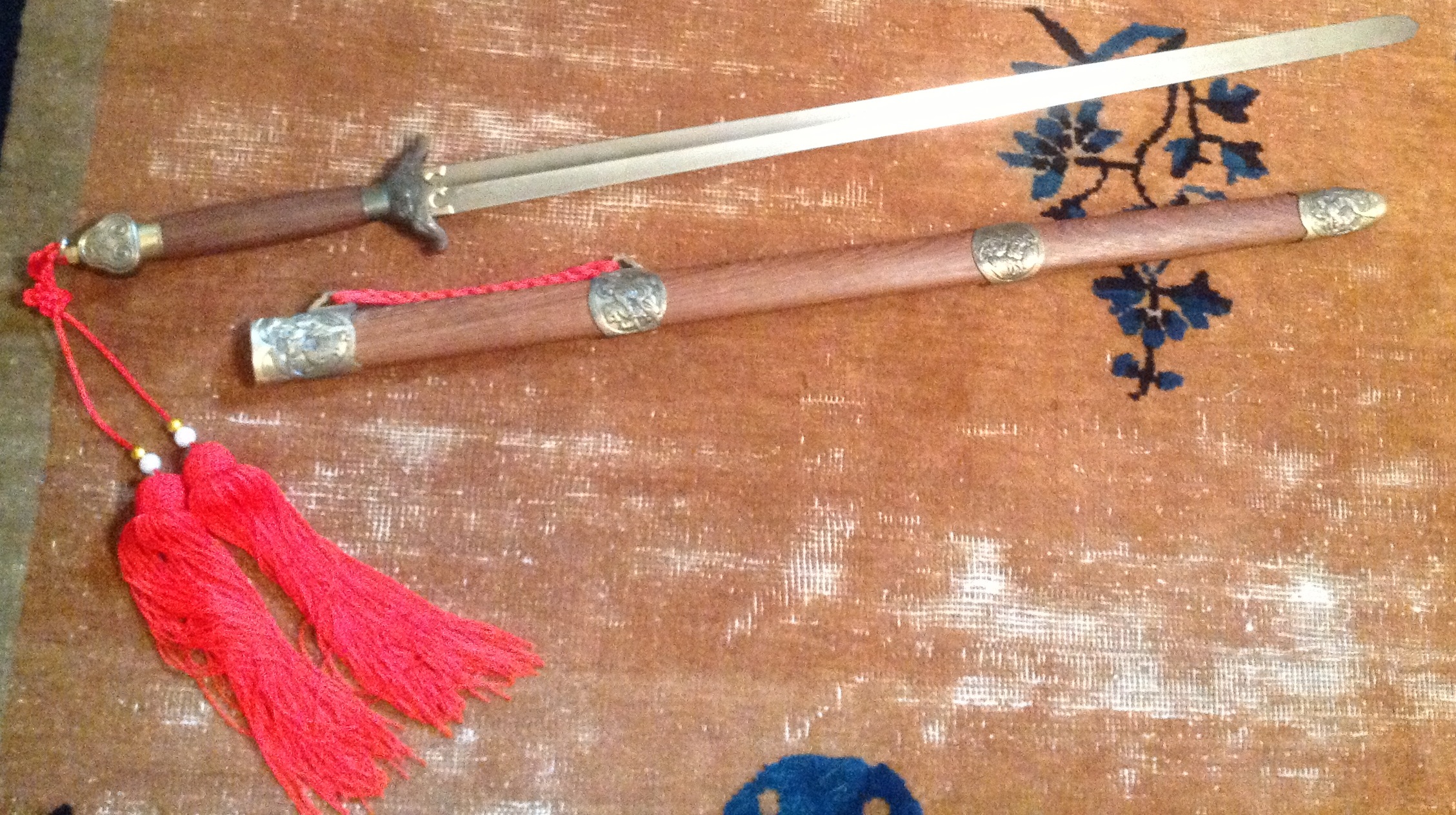
Sword

My sword is from KungFuDirect.com

I’ve found six videos, two from Master Gohring’s school and four by other masters. (1) This video of class with names seems a little brisk in pace to me; it takes only about three minutes. That’s barely enough time to say all those long names! (2) This student demo was performed at Master Gohring’s 2013 Black Sash Graduation (4 minutes). The form runs a bit longer when performed by (3) Sifu Peter Tam Hoy, (4) Yang Jian Chao, (5) Li Guang Qi, and (6) Yang Jun.

1. Yang sword class  2. Yang sword demo 3. Peter Tam Hoy

4. Yang Jian Chao 5. Li Guang Qi 6. Yang Jun

The form looks quite different from one video to the next! I think it might be characteristic of traditional forms, which are by nature handed down from one teacher to another, that they vary this much.

Michael Garofalo lists the same movements we learn in class, along with numerous alternative translations that he has come across in his rather extensive research. Here’s the list of names.

  1. Step forward moving sword and hand together
  2. Divinity points the way
  3. Three rings around the moon (L,R)
  4. Major literary star
  5. Swallow beats the water (times three)
  6. Block and sweep from the left
  7. Block and sweep from the right
  8. Minor literary star
  9. Bee enters the cave
  10. Alert cat catches the mouse
  11. Dragonfly strikes the water
  12. Swallow returns to the nest
  13. Phoenix spreads both wings (slant flying)
  14. Whirling wind counterclockwise
  15. Minor literary star
  16. Whirling wind counterclockwise
  17. The attitude of catching a fish
  18. Divide the grass in search of a snake (times three)
  19. Embrace the moon
  20. The bird returns to the forest
  21. The black dragon wags its tail
  22. The wind rolls the lotus leaf
  23. The lion shakes its head
  24. The tiger holds its head
  25. The horse leaps over the stream
  26. Turn your body to stop the horse
  27. The compass
  28. Wave tassels against the wind
  29. Push boat with current
  30. Shooting star chases the moon
  31. The running horse goes wild
  32. Rolling up the screen
  33. The wheel spins left and right
  34. The swallow holds mud in its beak
  35. The roc spreads its wings
  36. Scooping the moon from the bottom of the sea
  37. Embracing the moon, the spirit searches the sea
  38. The rhino gazes at the moon
  39. Shooting the flying goose
  40. The dragon stretches its claws
  41. The phoenix spreads both wings
  42. Cross fence with left leg
  43. Cross fence with right leg
  44. Shooting the flying goose
  45. The white ape offers fruit
  46. The flowers fall left/right/left/right
  47. Fair lady works shuttles
  48. The white tiger wags its tail
  49. The fish leaps over the dragon’s gate
  50. The black dragon coils around the pillar
  51. The divinity points the way
  52. The wind sweeps the falling flowers
  53. Holding the tablet before your bosom
  54. Embrace the sword
  55. Return to starting position

On my to-do list: learn the standardized 56-form and figure out how it compares to this traditional form.
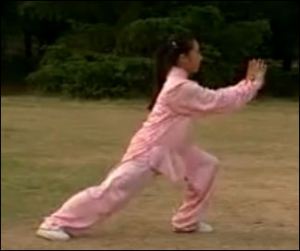
Beijing 24-form

The so-called simplified form was created under the auspices of the Chinese Sports Committee in 1956 by four Tai Chi masters. It contains many of the major elements of the traditional long forms without the repetition. It was intended for popular use as exercise and conditioning, and because it has been so widely taught in mainland China, it is undoubtedly the most widely known and practiced moving form in the world.

Beijing form

Videos are numerous. This one by taiji.de captured my imagination as I was just setting out to learn Tai Chi, and I still refer to it. By the time I learned 24-form, every movement was already familiar to me from my study of the 108, but I had to learn the sequence and then relearn all the details of the movements. 24-form is good training for the numbered forms coming out of post-war China, which I call modern standardized Tai Chi (my term), because they are all similarly styled. Almost every movement is quite different from the traditional style we practice at Master Gohring’s school.

The movements are as follows, and again the pronunciations are available from Lau Sui Taijiquan.

  1. Commencement – Qishi [Q=ch]
  2. Part the Wild Horses Mane – Ye ma fen zong (L, R, L) [fun]
  3. White Crane Spreads Wings – Bai he liang chi
  4. Brush Knee Push – Luo xi ao bu (L, R, L) [x=sh]
  5. Playing the Lute- Shou Hui Pi Pa
  6. Repulse Monkeys L, R, L, R – Dao Juan Hong
  7. Grasp the Bird’s Tail Left – Zuo Lan Que Wei
  8. Grasp the Bird’s Tail Right – You Lan Que Wei
  9. Single Whip – Dan bian
  10. Cloud Hands – Yun Shou
  11. Single Whip – Dan bien
  12. High Pat on Horse – Gao tan ma
  13. Strike with Heel – Deng jiao [dung; ji=ch]
  14. Box the Tiger’s ears – Shuang Feng Quan Er
  15. Turn and Strike with Heel left – Zhuan Shen Zuo Deng Jiao
  16. Snake Creeps Down Left (usual way)/Golden Rooster – Zuo Xia Shi Du Li
  17. Snake Creeps Down RIGHT/Golden Rooster – You Xia Shi Du Li
  18. Fair Lady Works the Shuttle R, L – Yu Nu Chuan Shuo
  19. Needle at Sea Bottom – Hai Di Zhen
  20. Fan Through Back – Shan Tong Bei
  21. Turn Around Block Parry and Punch – Zhuan Shen Ban Lan Chui
  22. Withdraw and Push – Ru Feng Si Bi
  23. Cross Hands – Shi Zi Shou
  24. Close Form – Shou Shi

I wanted to learn this form because it is the form you are most likely to have in common with other people you meet who do Tai Chi. Certainly, if you meet anyone who has recently come to the US from mainland China, they will begin with 24-form. In 2008, in celebration of the Olympics, squads of 2008 women performed 24-form in all the provinces of China! Long Feng was among them; she still has the white silks with red piping and embroidered Olympic rings with the year 2008 under them.

32-Sword

This short sword form is a simplified version of the standardized 56-sword–simplified just in being shorter. All the movements in 32-sword are also in 56-sword. Michael Garfalo (Valley Spirit Taijiquan, Green Way Research, Red Bluff, California) offers an illustrated list of movements on his website. He also offers a PDF with drawings, but although this seemed like a great idea, I found it impossible to follow. Learning from video is hard enough! Luckily, I have Long Feng–nothing is better than a good teacher.

Long Feng doing 32 swordExcellent video is available for this one, from  taiji.de website–I don’t see the name of the man who performs– and from Sifu Amin Wu:

32 sword   32sword

Names of movements (with notes to self):

  1. Commencement
  2. 三環套月  Three Rings Around the Moon (twist step, right cross, take sword)
  3. 大魁星  The Big Dipper (aka the major literary star)
  4. 燕子抄水  The Swallow Beats the Water
  5. 边拦扫  Block and Sweep, Right and Left
  6. 夜叉探海 Yecha explores the sea [stand on right leg pointing sword down]
  7. 懷中抱月 Holding the Moon [stand on right leg, holding sword up]
  8. 宿鳥投林 The Birds Returns to the Tree at Dusk [pointing out]
  9. 乌龙摆尾  Black Dragon Swings Tail [turn around and sweep out]
  10. 青龍出水  Green Dragon Emerges from the Water [pull back left]
  11. 風捲荷葉  Wind Rolls the Lotus Leaf [pull back right to left cat]
  12. 夜叉探海 Lion Shakes Its Head [step up to right]
  13. 虎抱頭 Tiger Holds Its Head [fall forward]
  14. 野馬跳澗 The Horse Jumps Over the Stream [finish run with right bow thrust]
  15. 小魁星 The Little Dipper [pull back to right cat]
  16. 海底撈月 Scoop Up the Moon from the Sea Bottom [sweep left to cat, right to bow]
  17. 預備式 Shoot the Flying Geese [chop overhead, pull back to left cat]
  18. 猿献果 White Ape Presents the Fruit [elsewhere the compass]
  19. 迎風撣塵 左 Sweep the Dust into the Wind, L, R, L [swallow beats the water]
  20. 順水推舟 Push Boat With Current [open arms]
  21. 彗星飞行由月亮 Comet Chases the Moon [stab overhead]
  22. 飛馬行空 Pegasus Crosses the Sky[pivot left, chop to right bow]
  23. 挑簾式 Lifting the Curtain [turn left chop to right cat]
  24. 左輪劍 Wheeling Sword to the left [sit to minor literary star]
  25. 右輪劍 Wheeling Sword to the right
  26. 右輪劍 Right Wheeling Chop [to right cat]
  27. 大鵬展翅  Phoenix Spreads Its Wings
  28. 黃蜂入洞 Bee Enters the Cave [slash and shift left, shift right to left cat]
  29. 懷中抱月 Holding the Moon [step to right bow]
  30. 風掃梅花 Wind Blows the Plum Blossoms [turn over the sword and step around]
  31. 指南针 The Compass Points South [left bow, then shift back to take sword]
  32. Conclusion

Chen Saber

This short, flashy form is required for the second degree black sash. It’s performed with a flexible broadsword and lasts only a little more than a minute. A section can be repeated to add length for purposes of competition, where a minimum time of two minutes or more may be required.

Chen SaberVideo resources for this one are scant! On Master Gohring’s YouTube, you can see Mister Hunter and Mister Rodriguez performing at Black Sash Graduation 2010. Very dark! And shot from the back.

Master Blue Siytangco studied with Grand Master Cheng Jincai along with Master Gohring. A few years ago he taught a class in Chen Saber at Master Gohring’s school. Here’s a video–wonderful instruction but doesn’t cover the whole form.

Here’s the list of movements:

  1. Preparing Form
  2. Protect the Heart
  3. Blue Green Dragon Leaps from the Sea
  4. Wind Sweeps the Wilting Flowers
  5. White Clouds Overhead
  6. Black Tiger Searches the Mountain
  7. Su Chin carries the Sword on His Back
  8. Golden Rooster Stands Alone
  9. Turn to Coming Force
  10. Cut the White Snake at the Waist
  11. Three Rings Around the Sun
  12. Part Clouds to See the Sun
  13. Search Grass for Snake
  14. Blue Green Dragon Leaps from the Sea
  15. Wind Sweeps the Wilting Flowers
  16. White Crane Inserts Golden Wing
  17. Nei Zha Searches Sea Bottom
  18. Turn and Chop Left
  19. Turn and Chop Right
  20. White Snake Spits Poison
  21. Embrace the Moon
  22. Close Form

Chinese Names

Few of my Chinese friends speak English. In the year that I’ve been working with them, we’ve managed to learn only a handful of words in each other’s language. Up until recently, I’ve really struggled to hear Chinese–I’ve learned much less than they have–but suddenly, I’ve experienced a very small breakthrough. My brain, for some reason, is beginning to accept a little Chinese.

White Crane

Bai He Liang Chi – White Crane Spreads Wings

I found a great website run by the Lau Sui Taijiquan school in the UK. Not only do they list the Chinese names for movements of many forms–they even provide audio to help with pronunciation! For example: movements of 42-form. Fantastic!

Many of these movements are familiar from other forms. I’m working on the following list right now:

  • Grasp the bird’s tail: Lan Que [cheh] Wei
  • Single whip: Dan Bian [bi-en]
  • Lift hands: Ti Shou
  • White crane spreads wings: Bai He Liang Chi
  • Brush knee push: Luo Xi [lo shee] Ao Bu
  • Step forward, deflect downward etc: Jin Bu Ban Lan Chui [chway]
  • Fist under elbow: Zhou [jo] Di Chui*
  • Part the wild horse’s mane: Ye [yay] Ma Fen [fun] Zong [tzong]

*Different for some reason from what I’ve learned in school.

42 Form

Also called the combined form and the competition form, 42 was created in 1989 by Grand Master Li De Yin. It incorporates elements of all four styles of Tai Chi: Yang, Chen, Sun and Wu. Wikipedia offers this interesting discussion by Dr. Paul Lam.

video of 42 form

I’ve been using an excellent video demonstration by Miss Ng Ah Mui.

For comparison, here’s an excellent performance by Gao Jiamin on YouTube.

Here’s a list of the 42 movements in English and Chinese, derived from Lau Sui and a list that Long Feng gave me.

The form takes 6-7 minutes. The movements are:

  1. Preparing Form – Qishi
  2. Right Grasp the Bird’s Tail [Wu style] – You Lan Que Wei
  3. Single Whip – Zuo Dan Bian
  4. Lift Hands – Ti Shou
  5. White Crane Spreads Wings – Bai He Liang Chi
  6. Brush Knee Push – Luo Xi Ao Bu [right and left]
  7. Fist Across the Body – Pie Shen Chui
  8. Roll Back and Press – Lu Ji Shi
  9. Step Forward, Block, Parry, Punch – Jin Bu Ban Lan Chui
  10. Withdraw and Push [Sun Style] – Ru Feng Si Bi
  11. Open and Close Hands – Kai He Shou
  12. Single Whip [Wu style] – You Dan Bian
  13. Fist Under Elbow [Sun style] – Zhou Di Chui
  14. Turn to Push Palm [Sun style] – Zhuan Shen Tui Zhang
  15. Fair Lady Works the Shuttle [Wu? style] – Yu Nu Chuan Shuo
  16. Right and Left Heel Kick – You/Zuo Deng Jiao
  17. Hidden Hand Punch [Chen style] – Yan Shou Gong Chui
  18. Part the Wild Horse’s Mane [Chen style] – Ye Ma Fen Zong
  19. Cloud Hands – Yun Shou
  20. Hit the Tiger on One Leg [Wu style] – Du Li Da Hu
  21. Right Snap Kick – You Fen Jiao
  22. Box the Tiger’s Ears – Shuang Feng Quan Er
  23. Left Snap Kick – Zuo Fen Jiao
  24. Turn Body Slap Foot – Zhuan Shen Pai Jiao
  25. Step Up and Punch Down – Jin Bu Zai Chui
  26. Slant Flying [Wu style] – Xie Fei Shi
  27. Snake Creeps Down – Dan Bian Xia Shi
  28. Golden Rooster Stands on One Leg- Jin Ji Du Li
  29. Step Back Piercing Palm – Tui Bu Chuan Zhang
  30. Press Palm in Empty Stance – Xu Bu Ya Zhang
  31. Lift Palm on One Leg – Du Li Tuo Zhang
  32. Strike With Shoulder – Ma Bu Kao
  33. Turn Body Big Pullback – Zhuan Shen Da Lu
  34. Grab to Punch – Xie Bu Qin Da
  35. Squat to Palms Through – Chuan Zhang Xia Shi
  36. Step Up Seven Stars – Shang Bu Qi Xing
  37. Step Back to Ride the Tiger [Wu style] – Tui Bu Kua Hu
  38. Turn and Sweep the Lotus – Zhuan Shen Bai Lian
  39. Bend Bow Shoot Tiger – Wan Gong She Hu
  40. Left Grasp the Bird’s Tail – Zuo Lan Que Wei
  41. Cross Hands – Shi Zi Shou
  42. Close Form – Shou Shi

The form is predominantly Yang style; I’ve indicated where the other styles occur (as best I know).

A New Tai Chi Notebook

I’m considering testing for my second degree black sash this year — if not this year, next year — and my trusty Tai Chi Notebook on Pommelhouse is hard-coded. So I’m moving it to WordPress and updating everything.

For the second degree black sash, I’ll need to know the Chen 38 and its applications, Ba Fa, Chen sword, and Chen saber. I’ll also have to pass the first degree test again, which shouldn’t be a problem; I’ve stayed with it.

I study at Master Gohring’s Black Sash Academy, and that’s where I’ll be testing, but I also practice with a group of Chinese friends in my neighborhood. The Tai Chi they do is quite different, and although it keeps me spread somewhat thin to study with them, too, I love working with them.

I feel the need for a hardcopy notebook, so I’ll be adding printable versions of some of the material on this site.