Unknown's avatar

About elizabethbuhmann

Author of Mystery Novels--Lay Death at Her Door, Blue Lake, Accidents of Life, and Freewheeling--plus a new detective series, Murder on the Gulf Coast.

49-Step Wudang Sword (3)

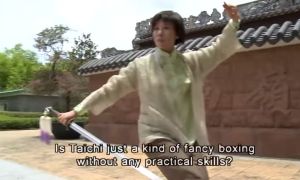
I’m liking these Kung Fu Quest videos! Here’s another one, also 45 minutes long, YouTube, with English subtitles. This one is about Tai Chi.
kungfuquest

The emphasis is again on fighting, and the Tai Chi is mostly traditional. However, our two pilgrims do go to Beijing and touch on standardized Tai Chi, and the promotion of Tai Chi in the last century as a form of healthy exercise for most people, and especially for older people.

In the Wudang sword form, I have gotten to the 1:30 mark. In the next section, we walk in a circle and jump to a squat. Long Feng has led me through this section more than once; it’s time to learn the sequence.

Master Faye Li Yip 49-step Wudang

Another video of 49-step Wudang sword

We left off in Zuo Gong Bu — left bow stance — stabbing palm up and level, away from the direction we faced at the beginning. Left hand is up.

Rock back on the left heel, withdrawing the sword. Step across to the left with the right foot; the sword snakes across the body and turns right so you are following its point.

Walk in a complete circle to the right, counting the first step with the left, up to twelve steps. On eleven, turn to the left and step to right bow stance (twelve), stabbing down with both hands.

The movement of the sword is tricky. It leads, hilt high and point low, left hand high, for four steps. On step five, the left hand comes up to the hilt. Then both arms circle around: up, out, back, in (that’s 6, 7, 8, 9), crossing hands at nine.

On step ten open up again, sword circles like Swallow Beats the Water on eleven, and then stab on step twelve. This whole sequence, the 12 steps, starts out slow and accelerates right up to the Yo Gong Bu. That stab is with both hands, downward. All this takes only15 seconds!

We are up to the jump. Shift back, swing to the left, sit back on the right leg in left cat stance, arms open, palms down. Settle. Step left and jump to the right foot, making a 360-degree turn in the air. Set the left foot down and squat, sword pointing left.

It’s not a hard jump. Long Feng does it easily and gracefully, and it’s not too hard for me, either, except that Master Liang, I notice, lands on both feet in a squat. Landing in a squat is not so easy.

He then rocks back to the right, pivots to the left on the left foot, steps right and back with the left into right bow stance facing back the way he came. The man is beset from all sides! Very dramatic! I like it. The sword pulls back when he rocks back, the swoops and stabs down on the You Gong Bu. Left arm is up.

We are almost at the two-minute mark. That jump is right about the halfway point in the form. Next, we’ll get to the Compass, run around, and do my favorite part, a cute little flip of the sword and foot that captures the spirit of this form for me.

49-Step Wudang Sword (2)

This long (nearly 45 minutes, with English subtitles) YouTube video about the Wudang Kung Fu Academy is fascinating. I have never seen anything like the Tai Yi Wu Xing form of Tai Chi. The Wudang Mountains are beautiful (as are the temples and the Academy).

Kung Fu Quest - Wudang (video)

Kung Fu Quest – Wudang (YouTube video)

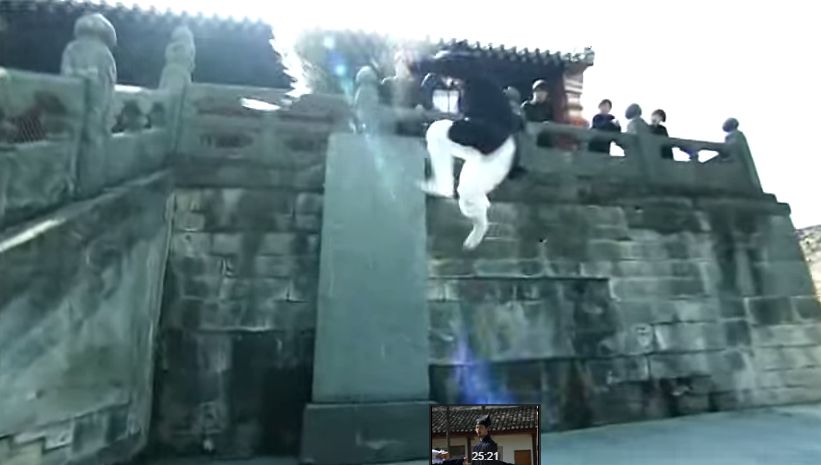
The training is fiercely difficult, and you can’t help worrying about the children who are sent there. It’s definitely all about fighting, which is not my goal in learning Tai Chi. But the sword play and light body skills (at about the 26-minute mark) are amazing.

“Light Body Skills” Master Chen Shiliu

As for the 49-step Wudang Sword that I’m trying to learn, picking up from Ma Bu, with the sword pointing to the right, the next section is as follows:

  • Step up with the left, turn sword to left
  • Step around with left (turning to the right), sword pointing right
  • Step forward right and stab downward (palm down, left hand on hilt)
  • Step left and right, sweeping sword
  • Stand on one leg, sword pointing up, palm up (Holding the Moon)
  • Step back left, turn to left and squat to lower sword (palm down)
  • Step up to right cat stance, holding sword palm up

From here, lift the right knee, extend the leg, and perform a run like that in 32-sword, consisting of Lion Shakes his Head, Tiger Holds its Head and Horse Jumps Over the Stream.

Finish by pulling the sword back to the right hip, pivot 270 degrees on the right foot, step to left bow stance and stab, palm down, level (or slightly down). This completes the next half-minute; we are at about 1:30 of 3:40.

49-Step Wudang Sword (1)

The standardized version of Wudang sword starts out much like 32-sword. I haven’t found a good list of names for this form yet, so I am borrowing the names from 32-sword, even though the moves may be slightly different. This is just an aid to learning the rough sequence of the form.

49-step Wudang Sword

Another demo: 49-step Wudang Sword

  1. Commencement (slightly different)
  2. Three rings Around the Moon
  3. [Stand on one leg]
  4. Swallow Beats the Water
  5. Block and Sweep left and right.
  6. [Stand on one leg]
  7. Sweep the Dust into the Wind on right
  8. Wheeling the Sword to the right
  9. Slash left, right, left to horse stance, sword pointing right.

In step 3 above, the sword points downward, as in Yecha Explores the Sea, and back. Step 6 resembles the Big Dipper, except the right leg extends in a heel kick. Step 8 is the one that looks back; in Chen sword we call this Rhinoceros Gazes at the Moon (after the similar Nei Kung posture).

These first nine moves comprise about the first minute of the form (which is about three and a half minutes long, give or take).

Wudang Sword

I’ve had a moratorium on new material since I decided to test for second degree, but now that the test is over, I am eager to learn another sword form. Long Feng has started teaching me Wudang sword.

Traditional Wudang Sword

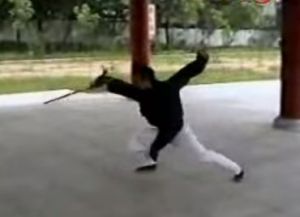
Master Chen Shixing Traditional Wudang Sword

There are several versions of this form. The one in the video above is traditional; what Long Feng is teaching me is the standardized 49-step version, demonstrated in the video below.

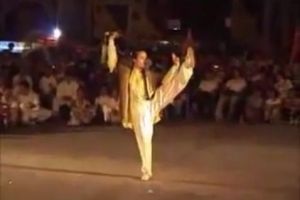
Standardized Wudang Sword 49-step Master Liang

Wudang Sword 49-step Master Liang

I’d like to learn both eventually, if that wouldn’t be too confusing. A third form, Wudang Seven Sword, seems to be a Kung Fu version (below).

Wudang Kungfu Academy China demo

Wudang Kungfu Academy China demo

Eight Energies

Each of eight forms of energy (or power) has a traditional name in Chinese and is associated with an element such as Earth, Air, Fire or Water (which, to the imaginative, it resembles). On a practical level, each corresponds to a movement in the first part of the moving form and to a technique used in combat or in the sparring game called push-hands. These are techniques for meeting and defeating (or at least deflecting) an opposing force.

Trigrams

Each form of energy is defined as a combinaton of Yin and Yang — yielding or resisting — first on contact with an attacking force, then at the center, and then at the end, or release. The yin-yang nature of each form of energy is represented by three straight (yang) or broken (yin) lines. The trigrams representing the eight energies can be seen in the symbol above.

In general, Yin is the defensive weapon of the smaller and weaker of two opponents. It is axiomatic in Tai Chi that a small, weak opponent may defeat a bigger, stronger attacker by yielding (and using the attacker’s size and weight against him). The eight energies are:

  1. Ward-off: Peng corresponds to SKY, trigram yang yang yang.
  2. Pull-back: Lu corresponds to EARTH, trigram yin, yin, yin.
  3. Press: Ji corresponds to WATER, trigram yin yang yin.
  4. Push: An corresponds to FIRE, trigram yang yin yang.
  5. Grabbing (pull-down): Tsai corresponds to WIND, trigram yang yang yin.
  6. Breaking (splitting): Lieh corresponds to THUNDER, trigram yin yin yang.
  7. Elbowing: Zhou corresponds to LAKE, trigram yin yang yang.
  8. Shouldering: Kao corresponds to MOUNTAIN, yang yin yin.

Peng is all hard opposing energy. Ward off meets the attacking force with unyielding resistence, uses outward opposing force, and holds its ground. It is a straightforward exertion of strength, but also is achieved by correct alignment and positioning.

Lu all yielding, soft energy. Pull back gives and turns away from an attacking force, allowing it to pass by. The attacker’s own energy is used to propel him past you.

Ji rebounds with hands connected, to repel the attacking force. This is the energy associated with water, which is soft on the surface but irresistably powerful force at its center.

An meet a force with resistance, then yields momentarily before surprising with a strong thrust.

Together, Peng, Lu, Ji and An comprise the familiar combination called Grasp the Bird’s Tail, or Lan Que Wei, found in nearly every Yang form.

Tsai commits to a string pull downwards, throwing the opponent all the way down to the ground before releasing.

Lieh yields, turns, and then breaks with splitting force at the finish. Repulse Monkeys and Slant Flying are both splitting movements using Lieh.

Zhou first yields, folding the elbow, before striking. The water is again soft in contact, but powerful at its center, and the lake is unyielding at the bottom.

Kao is unyielding at contact, striking with the shoulder, but then becomes rooted and immovable like a mountain.

Ten Important Points

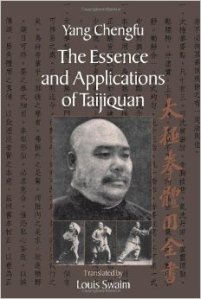
Yang Cheng Fu, grandson of Yang Luchan and foremost proponent of modern Yang-style Tai Chi, published two books in Chinese, one of which has been translated into English (by Louis Swaim).

YCFbook

The master’s most famous written legacy is the list of “Ten Important Points” for the practice of Tai Chi. Numerous translations are available for this part of Yang Cheng Fu’s teachings. For the first and second degree tests, we are required to know and understand (not necessarily to quote) the ten important points.

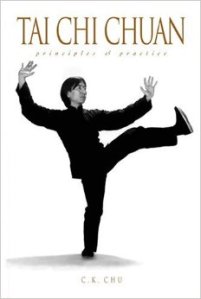
I was delighted to find that Lau Sui Taijiquan provides the ten important points in Chinese! The Chinese phrases are direct from Yang Cheng Fu’s classic text. For the English, Master Gohring relies on CK Chu, so that’s what I have used here.

ckchubook

  1. Xu Ling Ding Jin. Head suspended. Be light and swift, as if the head is suspended from above, so the spirit can rise to the top. Do not use strength or become stiff, or the chi will not circulate.
  2. Han Xiong Ba Bei. Chest concave. This allows you to lift the back so the chi will sink down. If the chest sticks out, the chi rises and the center of gravity is too high.
  3. Song Yao. Waist loose. If the waist is loose, the root is strong. The change from substantial to insubstantial should come from the waist. If you are not strong, pay attention to the waist.
  4. Fen Xu Shi. Differentiate substantial from insubstantial (Video).This is essential to light and swift movement. If you cannot differentiate, footwork will be heavy and clumsy.
  5. Chen Jian Zhui Zhou. Sink the shoulders and elbows. If the shoulders are held up, the chi will not sink, the center of gravity will be too high, and you will not be able to repel opponents far.
  6. Yong Yi Bu Yong Li. Use mind not force. The whole body remains loose and open. There is no localized muscular force. Instead, the whole is light and swift, and chi flows freely throughout the body.
  7. Shang Xia Xiang Sui. Coordinate upper and lower body. “Root starts in the feet, springs from the legs, is executed through the waist and expressed through the fingers.” And “eye spirit follows them all.”
  8. Nei Wai Xiang He. Internal and external coordinate. Movement is nothing more than substantial and insubstantial, and opening and closing, and this occurs in the mind and heart as well as the body.
  9. Xiang Lian Bu Duan. Continuous and connected movement. The strength of Tai Chi is like a chain, unbroken and continuous, moved by mind and circulating without end.
  10. Dong Zhong Qiu Jing. Stillness in movement (“the slower the better”). Tai Chi uses quiet movement with long deep breaths, and the movement does not cause panting and shortness of breath.

For verbal instruction on the ten important points, also refer to Master Gohring’s YouTube playlist on this subject.

The Yang Family website offers a translation of the ten essential points: Part 1 and Part 2. Their version is based on a transcription from Yang Cheng Fu’s oral teachings.

Nei Kung

Nei Kung means internal work. Ten postures and exercises are specifically designed to build the strength and flexibility needed for Tai Chi. Master Gohring uses the Nei Kung set to help beginning Tai Chi students get up to speed in their physical conditioning. More advanced students benefit from regular practice as well.

The primary sourcebook for CK Chu's Nei Kung system

The primary source book for study of Nei Kung.

Nei Kung was created by Grandmaster CK Chu (1937-2013) as part of his Eternal Spring system for health, self-defense and meditation. His book (above) describes the ten postures in detail with excellent illustrations. Master Gohring offers video demonstration and instruction of all the postures.

Then ten postures and video links are:

  1. Embracing Horse
  2. Ride the Wild Horse (includes general discussion of Nei Kung by Master Gohring)
  3. Playing Guitar
  4. The Compass
  5. Double Dragons Leap from Sea
  6. Rhinoceros Gazes at the Moon
  7. Ride the Tiger (Additional demo)
  8. Phoenix Spreads Wings
  9. Hit the Tiger (On the cover of CK Chu’s book above!)
  10. Owl Turns His Head

The eight important points for Nei Kung are listed below. The ten postures and eight important points are on both the first and second degree black sash tests. Repetitions and durations of postures for beginning, intermediate and advanced students can be found in the book. For the black sash test, we are required to hold Embracing Horse for 20 minutes.

  1. Head suspended
  2. Toes in, knees out, pelvis tucked under
  3. Chest concave
  4. Body rounded
  5. Shoulders and elbows down
  6. Waist loose
  7. Kua (hip joints) loose
  8. Deep breathing

Additional video can be found on Master Gohring’s YouTube Channel.

Yang Applications

For the black sash, both first and second degree, we are tested on self-defense applications of the Yang 108. The list and applications may vary slightly from year to year. This is the list for 2014 (as far as I know! I may be in for a surprise).

apps

  1. Ward-off right/left: RIGHT punch. Pivot on right heel to get out of the way of the blow while blocking with the right arm. This is a yielding ward-off. Then step into the attacker with a left blocking blow to the body. [Note: weight on left leg; adjust right foot position as needed.]
  2. Grasp the bird’s tail: RIGHT punch followed by left, then by two-handed rush. Step in to block with the right arm while the left hand checks the elbow. Block left punch with left and pull the attacker past you. Press back on the left shoulder. [Note: be prepared to step back with the left foot.] The attacker comes straight on, arms outstretched. Block the arms apart from inside and push the attacker away. [Note: let the ugi come in close enough to get a good push with the legs.]
  3. Single whip: LEFT punch. Deflect and send the attacker past you by shifting to the left foot, and grabbing the left wrist with the left hand. Transfer the wrist to the right hand and shift back to the right (whipping the ugi around). Step into a chop to the neck with the left hand. [Note: ugi should protect the neck, as this can easily be a very sharp blow.]
  4. Lift hands: RIGHT punch. Block with the right, check the elbow down with the left and strike the chin with the right hand while shifting some weight onto the right heel. [Note: start with weight on the left foot; right foot makes the kick stand.]
  5. White crane: RIGHT punch and kick. Block the kick down with the left hand, blosk the punch up with the right.
  6. Brush knee push: BOTH sides. Block a right punch with the left hand and/or left punch with the right hand. Step forward on the side of a block and push the attacker back with the other hand. [Note: step in with the block on the same side as the punch; i.e., block a left with the right, right with left to expose the chest.]
  7. Playing guitar: RIGHT punch. Step back on the right foot, out of reach. Strike the elbow with the left and the forearm with the right while shifting forward onto left heel. [Note: be prepared to step back more or less, depending on the reach of the punch. Strike above the elbow when sparring to avoid injuring the ugi’s elbow.]
  8. Step forward, deflect etc: RIGHT punch. Block a punch with the right arm while checking the shoulder with the left, step in and punch to the body. [Note: weight on left, T-step onto right. Step left into punch.]
  9. Embrace tiger return to mountain: RIGHT kick. A right kick is aimed at the body from behind right. The right arm catches the leg and holds it up until the ugi can be pushed away with the left.
  10. Fist under elbow: LEFT punch. Block the punch with the left, grab and pull the left wrist. Strike with beak/wrist in the back of the head (middle of back when sparring). Simultaneously hammer punch with the right fist and stomp behind the left knee to take the ugi down. Pull the left wrist up with the left hand and force the shoulder down with the right, transferring the weight to the right foot. Lean forward onto the left heel to complete the arm bar. [Note: take a little time to get all the component moves in place. Start with weight on the right foot. After stomping, step inside with the right. Don’t forget to step forward onto the heel of the left foot when cranking the arm.]
  11. Repulse monkeys: BOTH sides. Catch a left-leading punch with the left, twist and pull up while turning to the left and forcing the shoulder down with the right. Catch a right punch with the right, turn to the right, twist and push down with the left. [Note: be sure to sink rather than bending over.]
  12. Slant flying: LEFT punch. Block with the left, grab the left wrist with the left hand and pull down while stepping right behind the attacker’s left foot. From under the ugi’s left shoulder, lift the right arm to throw the ugi over your back. [Note: step well in with the right to get leverage. Start with weight in the left.]
  13. Needle at sea bottom: RIGHT handed grab on the right wrist. Trap the ugi’s hand with the left. Turn the right palm to your face, then to his face and down. [Note: This works best if the movement with the right hand is circular (clockwise) and ends up pointing down.]
  14. Fan through back: LEFT punch. Block the punch with the right hand and step into a blow with the heel of the hand into the chin or face. This movement follows Needle at Sea Bottom, so the starting position is somewhat bent over. [Note: ugi should protect the face.]
  15. Cloud hands: BOTH sides. Block a right punch with the right arm, stepping left and checking the elbow with the left hand. Block a left punch with the left arm, closing with the right foot. Yield (lu) when warding off the right; turn into the left punch with peng.
  16. High pat on horse: RIGHT punch. Hook the punch aside with the left and chop into the neck with the right. [Note: start with weight on the right and don’t forget the cat stance with the left.]
  17. Heel kick: LEFT punch. Block the punch with the left hand and push the ugi with the heel. [Note: start with weight on the left foot and place the right at optimum distance before starting the kick. May hold on briefly with the blocking arm for balance.]
  18. Four corners: BOTH sides. Block with the right against a right punch from behind; block with the left against a left punch from in front. One hand blocks, the other pushes (or strikes under the chin).
  19. Snake creeps down/Golden rooster: RIGHT punch deep. Block down and out with the left and circle back up to the ugi’s right shoulder. With the ugi’s right arm pinned, bring the right elbow down on the ugi’s head while simultaneously kneeing him with the right leg.
  20. Step back ride the tiger: RIGHT kick. Crossed wrists strike down to deflect and catch the kick. Right chop to the neck. [Note: start with weight on the left, step back with the right. Go to left cat stance with the chop. Ugi should protect the neck.]
  21. Sweep the lotus: RIGHT punch. Block with the right hand and transfer to left while pivoting on the right heel heel. Step all the way around and plant the left foot. Coming out of the full turn, contact the ugi with the right hand while crescent-kicking in the back (of the head in theory; middle of the back in practice). [Note: weight is on the right foot to start, as if from Ride the Tiger, but shift onto the left foot with the block. Be careful about the distance of the step back with the left.]

Notes for Ugi: Protect for Single Whip, Lift Hands, Fan Through Back, High Pat, and Ride the Tiger (all blows to the neck or face). Be prepared to:

  1. Ward-off R/L: Right punch
  2. Grasp the bird’s tail: Right then left punch, then rush
  3. Single whip: Left punch
  4. Lift hands: Right punch
  5. White crane: Right punch/kick
  6. Brush knee push: BOTH sides
  7. Playing guitar: Right punch
  8. Step forward etc: Right punch
  9. Embrace tiger: Right kick
  10. Fist under elbow: Left punch
  11. Repulse monkeys: BOTH sides
  12. Slant Flying: Left punch
  13. Needle at sea bottom: Grab R w/ R
  14. Fan thru back: Left punch
  15. Cloud hands: BOTH sides
  16. High Pat: Right punch
  17. Heel kick: Left punch
  18. Four corners: Both sides (R behind)
  19. Snake creeps: Deep right punch
  20. Ride the tiger: Right kick
  21. Sweep the lotus: Right punch

Chen 38 Breathing (1)

For the second degree test, we are expected to pace the Chen 38 so it takes no less than 12 minutes. The key to meeting this requirement is correct breathing. The untethered mind may race ahead under test conditions, but the heart and lungs will not.

breathing

The movements of this form are complicated; a single movement may have as many as a dozen components. Correct pacing and rhythm depends on correctly placed inhales and exhales.

Nearly every move involves more than one full breath (inhale and exhale) plus at least one settle and/or fajin. Settles are complete exhales with full relaxation and pause. Fajin is an explosive movement with an outburst of air. Fajin usually follows an extended inhale, and may be followed by an extended exhale and settle.

Qishi: Lift knee (in); step left and settle (ex).

Jin Gang Dao Dui: One of the most complex movements in the form, the Buddha Stamp occurs five times, and each one is somewhat different from all others except in the signature stamp itself. The opener is the most complicated, with ten full breaths (in, ex) leading up to fajin (the stamp) and a final exhale and settle.

  1. Lift arms (in); lower arms (ex).
  2. Turn right (in); return (ex).
  3. Right over left (in); sink down (ex).
  4. Lift up (in); settle (ex).
  5. Reach back left (in); block right (ex).
  6. Pull in (in); push (ex).
  7. Turn left (in); kick/step (continue); settle (ex).
  8. Reach back (in); face front (continue in); settle (ex).
  9. Flick, brush (in); hold fist (ex).
  10. Raise fist (in); fajin (pound fist) and settle (ex).

Lan Zha Yi: Five full breaths.

  1. Form an X (in); lower hands and settle (ex).
  2. Lift left knee/step left (in); settle (ex).
  3. Lift wrist (in); shift left (continue in); lift knee (quick in); step right/settle (ex).
  4. Circle hands up and right (in); press to left (ex).
  5. Open arms (in); settle (ex).

Liu Feng Si Bi: Three breaths and settle.

  1. Press R (in); press down (ex).
  2. Block up (in); press down (ex).
  3. Push (in); settle (ex).

Dan Bian: This is the first of five single whips in the form, all identical, with four full breaths.

  1. Left reach (in); right reach (continue in); press across body (ex).
  2. Form beak (in); lift left knee and step (continue in); settle (ex).
  3. Turn to left (in); reach right (ex).
  4. Open arms (in); settle (ex).

Jin Gang Dao Dui (2): Much simpler: just three full breaths.

  1. Block down to left (in); black across to right (ex).
  2. Reach (in); face front (continue in); settle (ex).
  3. Flick, brush (in); hold fist (ex).
  4. Lift fist (in); fajin (pound fist) and settle (ex).

Bai He Liang Chi: Five breaths.

  1. Circle hands to form X (in); settle (ex).
  2. Lift knee/step back (in); settle (ex).
  3. Lift wrist (in); shift back (ex).
  4. Step in (in); step back (ex).
  5. Reach out and up (in); settle (ex).

 Xie Xing: Four breaths.

  1. Turn left (in); turn right (ex).
  2. Qin na (in); push (ex).
  3. Circle arms/lift knee (in); Step (continue in); settle (ex).
  4. Brush knee (in); push with right (continue in); open arms (ex).

Lou Xi Ao Bu: Four breaths.

  1. Circle/press hands (in); hands down to left (ex).
  2. Push up (in); load up (continue in); press forward (ex).
  3. Lift knee (in); step and load (continue in); push (ex).
  4. Circle arm/step up (in); Qin na (ex).

Yan Shou Gong Quan: Two breaths.

  1. Lift knee (in); step left (ex).
  2. Load punch (in); fajin (ex).

Jin Gang Dao Dui (3): Three breaths.

  1. Lift fist (in); touch fists (ex).
  2. Pull fists back (in); sweep right leg (continue in); rest fist (ex).
  3. Raise fist (in); fajin (pound fist) and settle (ex).

Continued: Chen 38 Breathing (2)