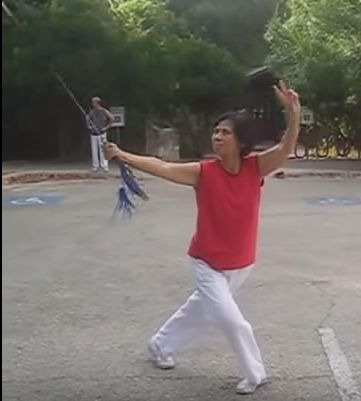
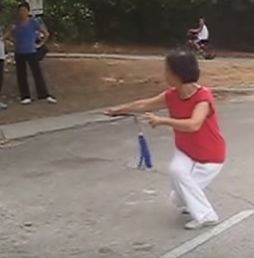
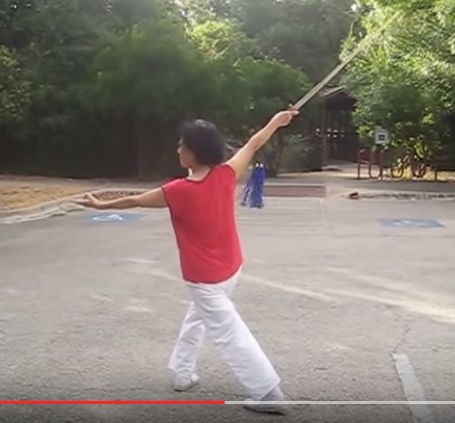
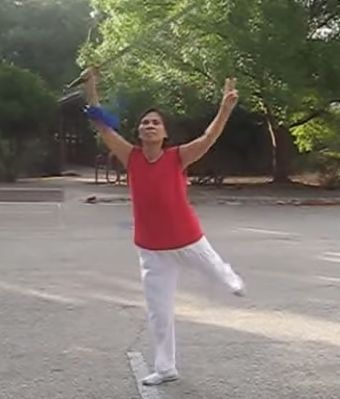
Unknown's avatar

About elizabethbuhmann

Author of Mystery Novels--Lay Death at Her Door, Blue Lake, Accidents of Life, and Freewheeling--plus a new detective series, Murder on the Gulf Coast.

56-Sword

Long Feng is satisfied that I know both Wudang Tai Chi Sword and Yi Jian Mei, and has started teaching me 56-sword. I think I need a lot of practice before I will be able to do either of those two forms as well as I’d like, but I am excited to start learning the sequence for 56–wo shi liu shi. That was my goal for the coming year.

Excellent video of 56-sword; Qi Shi.

Excellent video of 56-sword; Qi Shi.

To start with, here’s an excellent video, which I think will turn out to be the same thing Long Feng is doing. So many of the movements are also found in the other two forms and 32-sword as well! Other movements are reminiscent of the traditional long form, with which I have only a small acquaintance.

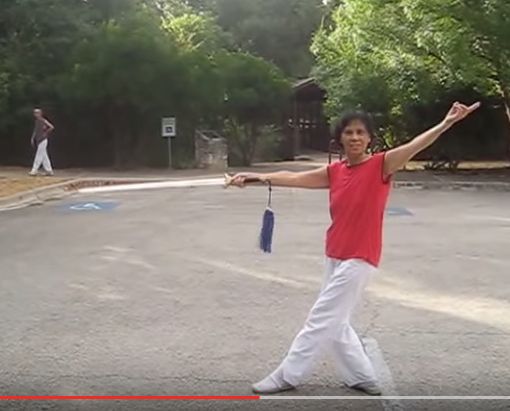
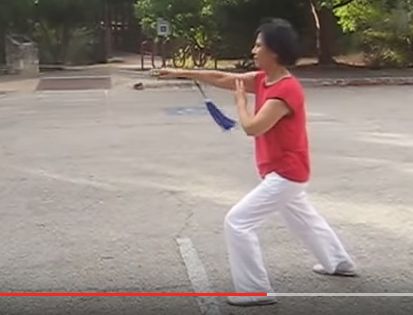
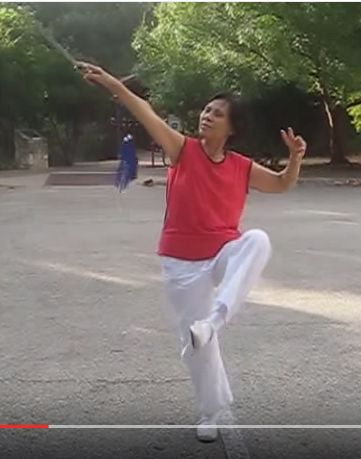
Looking at the opening, the first thing she does (in the picture above) is turn to her right and, as in lan que wei, does press and push. Then she continues with Three Rigs Around the Moon. So Qi Shi is like 32-sword, except for that press and push. What I see so far is:

  1. Qi Shi
  2. Ding Bu Dian Jian
  3. Du Li Fan Ci
  4. Pu Bu Heng Sao
  5. You Zuo Ping Dai

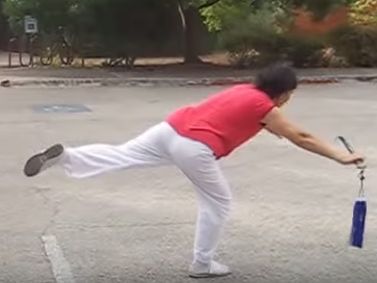
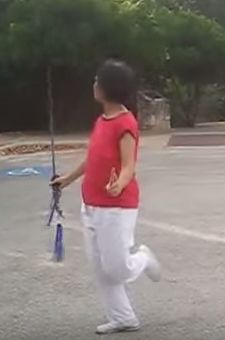
Then she transitions as if to do Fen Jiao Ling Jian (Wudang) but instead of kicking, she does this:

65xubu

Looks like Xu Bu Liao. Then she turns to face the back and continues with a series just like Wudang Taiji Jian:

7. Pu Bu Chuan Jian

8. Deng Jiao Qian Ci

9. Tiao Bu Ping Ci

10. Zhuan Shen Ping Ci

She then does what looks like Phoenix Spreads Wings, or what in 32-sword is called Che Bu Fan Liao and then again Zuo Xu Bu Liao. The move after that is unrecognizable to me (except it somewhat resembles the last move in Yi Jian Mei!). This is enough to get me started. I need to find a real list of names.

Clearly, knowing the forms I’ve already learned, this will go a lot faster. That’s already the first minute and a half. To be continued!

Ba Duan Jin: first four

Continuing our study of the Chinese official instruction video (Pan Huai interpreting): here are some of the important points and details for the first four movements. I gave an overall description and illustration of all the movements in earlier posts, and those are generally correct. So this information is a refinement.

Qi Shi

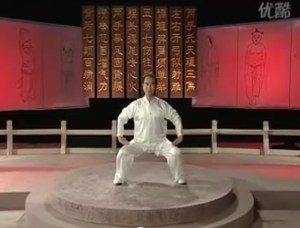
Qi Shi: opening position.

Qi Shi: Preparing form. Feet together, toes facing forward. Arms are at the sides, with a little space between the arms and sides of the body, palms facing back. Step left (first releasing the right heel). Open the arms out to about a 45-degree angle*, then sink and hold the hands in front of the dantian (lower belly) with palms facing in, fingertips about 3 inches apart.

Open arms to sides before assuming Qi Shi position.

Open arms to sides before assuming Qi Shi position.

This posture resembles what we call Embracing Horse in Nei Kung, but the arms are much lower. The knees are not bent very much, either. From the side:

qishiside

Shuang Shou Tuo Tian (#1): The hands travel straight up; there is no outward-pushing. Eyes follow the hands, so when the hands are fully extended, the head hangs back.  Then look forward, which allows an even longer stretch straight upwards. Also, when the hands are released, the wrist is flexed so the fingers point up, until the arms are about level, when the hands can scoop down to starting position.

Hands are flexed when lowered. Lead with the base of the hand, continuing the stretch.

Hands are flexed when lowered. Lead with the base of the hand, continuing the stretch.

Speaking of starting position, each movement ends in position to start the next movement. Qi Shi ends by rotating the hands to a palms-up circle with the arms extended below, ready to interlace fingers and begin Shuang Shou. That movement in turn ends with in cross-hands (a little lower and more level, actually), ready for Kai Gong.

Kai Gong Si She Diao (#2): Lift and separate the crossed hands at chest height, weight centered on the right. Then step out to ma-bu width (this is more than shoulder width). Feet should face front, and not be turned out (which means the tailbone is somewhat tucked).

5stepout

Extend the left hand and right elbow to stretch at shoulder height. The extended hand is not pointing! It is flexed so the index finger points up. The other hand is not a fist; the fingers are bent at the middle joint (including the thumb), more like a tiger claw.

handkaigong

Look at the extended hand. Then turn to look at the other hand while extending it and shift the weight back to that side. Return to starting position.bingbu

Tiao Li Pi Wei Dan Ju Shou (#3): As described before. The only reminders would be that the high hand is flexed so the fingers are point in (palm up and flat), while the low hand is palm-down, flat with fingers pointing forward.

This is left hand high, fingers pointing to the head.

This is left hand high, fingers pointing to the head.

lefthandqishen

Sink when bringing down the high hand and straighten the legs while lifting. Finish in sunken position with both hands as shown above, ready for the next exercise.

Wu Lao Qi Shang Xiang Hou Qiao (#4): The key point on this one is not to twist the body or bend the back. The head turns to the side without tipping (very much like Owl turns His Head in Nei Kung), chin remaining tucked, so head is suspended. The head turns, but the shoulders do not, although the chest opens. It is not a twist from the waist.

Not twisted at the waist, back straight.

Not twisted at the waist, back straight.

The arms rotate outward, but are not flung back. The hand turns palm-out, thumbs toward the back.

turnedhand

The instructional video is an hour long. Where all the exercises are shown together, background changes, changing camera positions, even clouds! Obscure the movements somewhat. To watch a demonstration of all the movements in real time (with the same music), try Master Faye Yip’s video, which (unsurprisingly) looks correct in every respect–except for one note…

*Faye Yip does not make a point of opening the arms this way during Qi Shi.

Principles of Qigong

This continues the translation and interpretation of the official Chinese instructional video on Ba Duan Jin (the Eight Brocades). My friend Pan Huai is translating for me as we both study this qigong form.

The following are key concepts for understanding the content of this part of the video and for understanding the practice of Qigong:

  • Yinian—the mind or will that commands Qi.
  • Qi—energy, sometimes also called life force. Vitality.
  • Hu xi—breathing (hu = exhale, xi = inhale).
  • Shen—facial expression, through which inner mood or emotion is visible.
  • Qing—mood or emotion.
  • Xing—outward appearance of the body as a whole; posture, carriage.
  • Jing—spirit; the essence or center of being from which energy flows.

How these concepts relate: Qing, the inner state (mood, emotion), is readable from outside through both Shen (facial expression) and Xing (posture, carriage). Qi (energy) flows from the Jing (spirit) and is directed by Yinian (the mind or will).

Qigong could be described as the practice of directing, at will, energy from the jing (spirit) to the shen and xing (outward expression and posture). The video provides three principles for how to practice Qigong.

principle3Reading the right column first, from the top down:

Rou He Huan Man

Rou means soft or gentle. He (pronounced like “her” without the R) means coming together, combining or coordinating. Rou he can be translated to mean that body movements are soft, gentle and coordinated. Huan means slow. Man is grounded; in Tai Chi, this relates to knowing where the body’s weight is centered. Huan man means standing steadily and moving smoothely, knowing where the weight is centered.

The left column from the top down reads:

Yuan Huo Lian Guan

Yuan means rounded; curved or circular. Huo is relaxed, loose, or nimble. Lian means connected. Guan means in sequence, or strung together. In the practice of Qigong, movements are soft and rounded, and connected in sequence.

principle2The second principle reads (again, starting at the right, top to bottom):

Song Jin Jie He

Song means loose or relaxed. Jin means tight or tense. There is a point of stillness in a movement, like the fullest extension of a stretch, the point where one movement ends and another begins. Or where one repetition of a movement ends and the next begins. Jie He means coordinate, in the sense that the loose, relaxed movement and the moment of tension flow from one to the other in a deliberate way.

The left column reads:

Dong Jing Xiang Jian

Dong is move, or movement. Jing is stillness. Xiang jian means both are present, by turns.

In the video, the looseness and relaxation is described as involving all the layers and aspects of the mind and body. The body relaxes on four levels, from the outside in: skin, muscles, bones, organs. Four aspects of the mind, from the visible outward expression to the deepest layer, are expression (Shen), posture (Xing), breathing, and mood or emotion.

So the practice of Qigong a deep state of physical relaxation together with a calm internal state that is reflected in relaxed breathing, expression and overall body posture.

principle1The third principle reads from the top right down:

Shen Yu Xing He

Shen and Xing are defined above as facial expression and overall body posture, or the carriage. Yu means and; He is come together or coordinate. So the expression and posture should be commensurate; in harmony.

In the left column:

Qi Yu Qi Zhong

I am not typing in accents. Qi occurs twice in this sentence, but it’s two different words here (they have different intonations). The first Qi is the familiar term for energy or vitality. The second is a pronoun referring back to the first part of this principle; it refers to Shen and Xing (expression and posture). Yu means contained in, and zhong means in the middle. Energy is contained within them (Shen and Xing). In the practice of Qigong, facial expression and overall body posture are suffused with Qi.

These principles can be compared  to Yang Cheng Fu’s Ten Important Points for the practice of Tai Chi. The last five points are the most relevant here (eg, stillness in motion, use mind not force, internal and external coordinate, upper follows lower), but as we move closer to the actual descriptions of the Ba Duan Jin forms, we’ll find that some of the first five important points apply as well. That’s next.

History of Ba Duan Jin

My friend Pan Huai is interpreting for me the official Chinese-language instructional video for Ba Duan Jin (Eight Pieces of Brocade), a popular Qi Gong routine. If you know Chinese, you can watch the video for yourself:

photo (46)

The video begins with a brief history of Ba Duan JIn. The earliest evidence of the form was found in the Mawangdui Han Tombs excavated in 1972-1974. The archaeological site is in Changsha, the capital of Hunan Province in south-central China. The tombs date from the Western Han Dynasty (202 BC – 9 AD).

The Han Dynasty was a high point in the production of fines silks and brocades, and numerous extraordinary textiles were found in the Mawangdui Tombs. Many of them were painted with intricate scenes, and one of them, called Dao Yin Tu, shows figures exercising.

Dao Yin (or Tao Yin) is an ancient precursor to modern Qi Gong and Tai Chi. Dao Yin is also the name of a modern form of Qi Gong. The Dao Yin Tu (Tu means drawing) shows more than forty exercising postures. At least four of them are similar to postures of what is now known as Ba Duan Jin.

silk

More about the Mawangdui Tombs:

The earliest written record of Ba Duan Jin dates from the Northern Song (pronounced soong) Dynasty (960–1279). The routine is described as well as illustrated. The Song Dynasty documents contain the first written mentions of the name Ba Duan Jin.

Ba means eight, Duan means pieces or sections, and Jin refers to the finest silk, or brocade. Jin has the connotation of a person’s best, most precious and decorative possession. The Ba Duan Jin Qi Gong is composed of eight postures, and the name suggests that this form of exercise is the most valuable thing a person could have.

According to one Song Dynasty source, the exercises were performed at midnight (!). There were both standing and seated versions of Ba Duan Jin. A number of variations on the standing form have evolved over time.

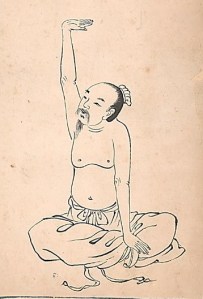
A Qing Dynasty (1644-1911) manual describes the postures of Ba Duan Jin by name and provides illustrations. The figure below, which is from a Qing Dynasty manual, shows the sitting form of Shuang Shou Tuo Tian (Two Hands Hold up the Heavens). A script, which can be chanted, guides the sequence of movements.

Image courtesy of Gueyang Shanren

Image courtesy of           Gueyang Shanren

In 2001, the Taiji and Qigong department of the Chinese National Sports Committee set out to study and standardize Ba Duan Jin. Experts from a number of fields such as physiology and sports medicine participated in the study.

Experiments were conducted to determine which versions of the exercises and also what sequence of postures were the most beneficial and effective. The resulting standardized Ba Duan Jin routine is described in detail in the official instructional video that we’ll be studying in this series of posts.

Next: the essential principles of Qi Gong.

Finishing Yi Jian Mei

All that’s left are the four instrumental lines in the middle of the song and the closing. That middle section begins from this position.

LFYJMchorus5

Line 1: Step with the left foot around to face stage right, then step out toward the front with the right to face front again. The arms close and cross. Swing the sword backhand out to the right.
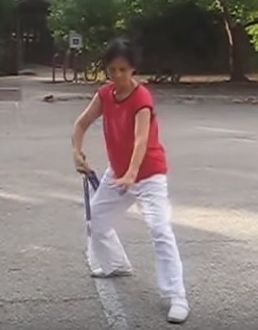
Line 2: Turn the sword over and draws a big backward C as if winding up for zuo gong bu lan. Facing stage right, step right and strike the odd pose shown below. The hands are positioned as if to push the blade—but you would cut yourself! So don’t actually touch the blade with the left hand.
lastyjm2

Line 3: Turns around to the left while straightening, and set the left foot down facing the opposite way. Stab forward, left hand touching the upper arm, gong bu, as shown.

lastyjm3

Then step forward on the right while wheeling the sword in front (hilt circles clockwise) to point the sword, and look, to the back, left arm extended as shown.

lastyjm4

Step forward on the left, closing the arms so the wrists cross. Left foot is turned out to face left near corner. Step around so the right foot also points to the left front corner and lifts the left foot from the knee. Collapse the sword as shown below.

lastyjm5

Line 4: Step left, cross step right, left (travelling to stage right), then walk in a circle right-left-right. Pivot the left foot and xie bu to prepare to resume at verse 3 in this position:

LFYJMV2-4

While traveling left, draw big clockwise circles with the sword. At the start of the walking-in-a-circle part, circle the sword to go palm up and lead with the hilt. Swing it around for finish in xie bu.

On the very first step left, Long Feng rises to make a little hop onto the right cross-step. The lift coincides with the lift of the sword. It’s a cute little step.

Shou Shi begins from the position shown at the top of this post (after the long repeat). Close the arms and take the hilt in the left hand. Extend the left arm and set the sword fingers at the hip.

Swing the left across in front while twisting the wrist as if to hold a tray. At the same time, lift the left knee and pulse up with the right. Looks like this:

lastyjm6

Then take four steps, LRLR in a circle to face front, left xu bu. Spiral the sword down on the left on the last two steps..

Step back with the left, bring the right back to the left, knees bent, feet shoulder width. Make another circle with the right hand at the same time. Lower the right hand and straighten the knees. Feet together. That’s it!

Chen ZiQiang Videos

Chen ZiQiang is the son of Chen Xiaoxing and nephew of Chen Xiaowang. He’s also the great grandson of Chen Fake. (In case you’re wondering, as I was, that’s pronounced Fah-kuh.) Kungfumagazine.com has a good article (from 2006) on Chen ZiQiang: What it Takes to be a Taiji Master in Chen Village.

Chen ZiQiang step-by step Pao Chui

Chen ZiQiang step-by step Pao Chui on YouTube

A lot of video has been posted, and continues to be posted (he is young and active), on YouTube. As recently as May 2015, an hour-long tutorial on Laojia Erlu was posted. He demonstrates each move multiple times, slowly, with names in both Chinese and English.

The intro is long, with history of Chen Taiji (interesting!) and Chen ZiQiang’s lineage and credentials. The actual breakdown begins around the 18-minute mark. The English translations of names vary from what I’ve seen elsewhere, but the Chinese names are the same. It’s my first opportunity to learn how to pronounce them correctly.

Chen ZiQiang Double Saber Demo

Chen ZiQiang Double Saber Demo

I learned about Chen ZiQiang when Grandmaster Gohring (my teacher) sent around the link to Chen ZiQiang’s demo of the double sabers, which we are working on in class. Other Chen ZiQiang video links to study:

The Chen sword demo is another step-by-step tutorial. Laojia Yilu and saber are just demos. For those who like to do push-hands, YouTube has a whole slew of Chen ZiQiang Tui Shou video.

Yi Jian Mei Chorus

I left off in this position, at the end of line 3, verse 3:

YYS7

From here she pulls the sword up and over to the left, hopping onto the left foot. The sword circles down and up as she steps onto the right and touches the left. This move is a little like zuo xu bu liao in 32-sword.

LFYJMchorus1

Next she steps left, stabbing the sword down to the left, and then steps right, stabbing the sword right–this is somewhat like the optional flourish in Wudang sword. Then she hops onto the left, circling the sword overhead (from palm-up to palm-down). Then she steps back with the right, the sword turns palm-up, and she extends the sword to the right, left hand extended. Xie bu:

LFYJMchorus2

That’s the end of verse three. Now there is a two-line chorus. She does (more or less) you gong bu lan (no pause, keep going), but on the other side she skips on the left, then swings the sword all the way to the left as she steps out with the right. Then she swings the sword right while cross-stepping behind with the left into Xie bu:

LFYJMchorus3

Unwind all the way around (sword following overhead) and step out to the left. Fully spread-eagled here, facing front. The sword keeps swinging, lift the right knee facing stage left. Then step out to the right, stabbing up (facing back). Cross-step behind left, still facing back, left arm pointing to stage right:

LFYJMchorus4

Finally, unwind and step back with the right. Meanwhile, arc the sword down, leading with the point, across on the left, then circle it in front of the face (go from palm-up to palm-down, to palm-up, step back onto right, pulling the sword back with both hands. Step up on left and open to position shown.

LFYJMchorus5

The good news is, there is just one more instrumental verse, and then the form repeats to the end. Closing form is a little complicated, but the end is in sight.

Yin Yang Sword

I left off after the first line of verse three of Yi Jian Mei. Line 2: walk in a circle to the left, leading the sword (held high) by the hilt. Footwork is left-right-left-right. On that last right step, circle the sword as if drawing a big heart in the air with both hands like so:

YYS2

Swing both arms closed while stepping forward on the left:

YYS1

Then withdraw the sword, shifting back on the right, sword held palm-up and left hand palm-down, as shown below. That’s line two, verse three.

YYS3

Yin Yang Sword is a stabbing movement with a shift forward and back. The hands turn so that either palms or backs of hands are facing each other. On the stab forward, sword palm is down, left hand palm-up. Then withdraw palm-up and turn the left hand palm-down. You could picture using your sword-fingers (left hand) to push shish-kabobs off a skewer (!).

YYS4

After two such stabs, step up with the right foot, draw another big heart in the air and stamp the right foot once in cross-hands (left hand on top):

YYS5

Swing both arms to the left, twisting at the waist:

YYS6

Swing the sword to the right, stepping out to the right, and then cross-step left behind like so:

YYS7

That’s line three, verse three. I have caught up with myself! The last line of verse three, which had me stumped anyway, is completely different the way Long Feng does it. It looks a bit like a part of Wudang sword (between the sits). I’ll tackle that next time.

Yi Jian Mei Corrections

I studied the first three verses of the Meng Fok video until I thought I could do them, then fell into a state of complete confusion when I tried to follow Long Feng. Took me a while to figure out what all the differences were between her form and Meng Fok’s.

When Meng Fok takes the sword, she steps right and left, pivots, and then steps left to stab overhead. Long Feng steps right, left, right, shifts left and stabs up, like so:

LFYJMV2-2

They are oriented differently. Meng Fok stabs to the back right corner, Long Feng to the front left corner.  I’m going to do this form Long Feng’s way.

The last line of verse two is also different, even though they start and finish in similar positions. In line 4, Meng Fok takes four steps, Long Feng takes only three (RLR). Somehow, they both unwind to this position (except Long Feng is in a deeper xie bu):

LFYJMV2-4

The first line of verse three is different. Both swing the sword right, but then Meng Fok lifts the hilt (standing on her left), where Long Feng stabs up (standing on her right):

YJMcompare

They both wheel the sword and finish in the same position, like so:

LFYJMV3-1b

That’s as far as I’ve gotten, so I’m not even quite as far along as I thought I was a couple of weeks ago. To be continued!

Master Faye Yip Videos

I came across some new (to me) videos of Master Faye Li Yip. Excellent! The first is Tai Chi sword. It’s made up of several clips, the first of which looks like 42-sword, but most of it is Wudang Tai Chi sword. Beautiful!

Master Faye Li Yip

Master Faye Li Yip-Tai Chi sword

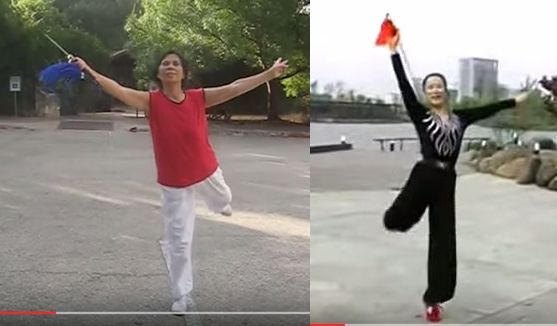
The other two are both Fan Form II, both beautiful performances (and great uniforms, especially the pink and black).

Faye3

Faye2The video on the left was posted on the Deyin Institute Facebook page (like it!) on August 11, 2015 with lyrics to Xi Yang Mei, which turns out to be all about China’s martial arts (“crouching like a bow,
standing like a pine”). Translation by John Fairbairn.

I tend to consider Master Faye’s demonstrations of this form definitive, seeing as her father created the form. A third video of this form, also by Faye Yip, can be found on the page for Fan Form II.