Unknown's avatar

About elizabethbuhmann

Author of Mystery Novels--Lay Death at Her Door, Blue Lake, Accidents of Life, and Freewheeling--plus a new detective series, Murder on the Gulf Coast.

Yang Saber

The Chinese saber, or Dao, is a single-edged long knife used for chopping and slashing. It is the weapon of the infantry, the foot soldier. For the Yang saber form, we use a saber with a rigid blade (for Chen saber, we use a flexible blade).

The form we learn at Master Gohring’s school is not the most common version; it’s a little faster, more martial and more dramatic than most other Yang saber forms I find on the Web.

Saber is one of the three forms required for the first degree black sash, so of course it will be part of the second degree test as well. The full playlist of demonstration and instructional videos can be found here:

The list of the movements below is somewhat sketchy. While some of the names seem to be real Chinese names, others are improvised descriptions. Also, the original form has been modified to accommodate space and timing issues.

  • Step Up Seven Stars Left
  • Step Up Seven Stars Right
  • White Crane Spreads Wings
  • Turn Around Hidden Knife
  • White Crane Stands on One Leg
  • Diagonal Push-Knife
  • Lift Knife Left
  • Lift Knife Right
  • Straightforward Push-Knife
  • Fair Lady Works the Shuttle
  • Center Lift
  • Middle Pull
  • Horizontal Push-Knife
  • Straightforward Push-Knife
  • Turn Around Over the Head Hidden Knife
  • Slice Up Left
  • Slice Down Right
  • Straightforward Push-Knife
  • Turn Around Over the Head Hidden Knife
  • Slice Up
  • Slice Down
  • Slice Up
  • Golden Rooster Stands on Left Leg
  • Double Jump Kick Hit the Tiger Form
  • Turn Around White Crane Spreads Wings
  • Heel Kick
  • White Crane Spreads Wings
  • Toe Kick
  • Brush Knee Push
  • Straightforward Push-Knife
  • Turn Around Over the Head Hidden Knife
  • Push Boat with Current (L, R, L)
  • Turn Around Hidden Knife
  • Slice Up
  • Slice Down
  • Slice Up
  • Heel Kick Jump Step
  • Use Strength to Axe Mountain
  • Embrace Knife Stab and Kick
  • Flip Over Change Step
  • Use Strength to Axe Mountain
  • Close Form

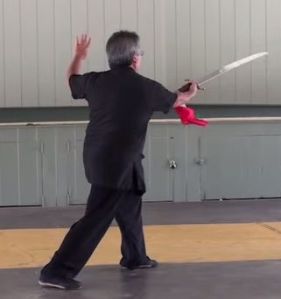
I haven’t found any one dominant Yang saber form. Here’s one interesting alternative, not too unlike ours:
The Yang 108

The Yang 108 is the traditional Yang-style empty-hand long form and the major component of our first degree black sash curriculum for Tai Chi at Master Gohring’s Tai Chi and Kung Fu. The form originated with Yang Luchan and was widely promulgated by his grandson, Yang Chengfu, in the first half of the 20th century.

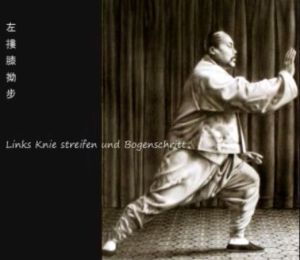
Here’s a cool video–not exactly a video; rather a succession of stills of Yang Cheng Fu performing the 108 moves:

You can see that the names of the movements are provided in Chinese and German. I’d like to study the stills and the Chinese names to see how this compares to the list I have arrived at. And I wonder if I can find a list of the names from Yang Cheng Fu himself? I wonder what the source for this video was?

The Yang family today lists 103 moves in basically the same form; here’s the Yang Family long form, which does not include a shoulder strike after Lift Hands. There are other variants of this form, some of which differ only in how the moves are counted, others making a difference in how the form is actually done. All this makes me appreciate the modern Chinese campaign to standardize.

Quibbling over the most authentic way to count the moves, or what exactly to call them, doesn’t seem very important to the practice of Tai Chi, but I am hung up on it anyway! My list below is based on the names mostly as we learn them at Master Gohring’s (but not exactly) and the Chinese as best I can gather from sources such as this list of the movements, which is close to ours but differs in a few details.

  1. Preparing Form – Yubei Shi
  2. Commencement – Qishi
  3. Ward-off Left – Zuo Peng
  4. Grasp the Bird’s Tail – Lan Que Wei
  5. Single Whip – Dan Bian
  6. Lift Hands – Ti Shou
  7. Strike with Shoulder – You Kao
  8. White Crane Spreads Wings – Bai He Liang Chi
  9. Brush Knee Push – Lou Xi Au Bu
  10. Playing the Lute – Shou Hui Pipa
  11. Left Brush Knee Push – Zuo Lou Xi Au Bu
  12. Right Brush Knee Push – You Lou Xi Au Bu
  13. Left Brush Knee Push – Zuo Lou Xi Au Bu
  14. Playing the Lute – Shou Hui Pipa
  15. Left Brush Knee Push – Zuo Lou Xi Au Bu
  16. Step Forward Block, Parry and Punch – Jin Bu Ban Lan Chui
  17. Withdraw and Push – Ru Feng Si Bi
  18. Cross Hands – Shi Zi Shou
    [Second section:]
  19. Embrace Tiger Return to Mountain – Bao Hu Gui Shan
  20. Grasp the Bird’s Tail – Lan Que Wei
  21. Diagonal Single Whip – Xie Dan Bien
  22. Fist Under Elbow – Zhou Di Chui
  23. Repulse Monkeys – Dao Nian Hou
  24. Repulse Monkeys – Dao Nian Hou
  25. Repulse Monkeys – Dao Nian Hou
  26. Slant Flying – Xie Fei Shi
  27. Lift Hands – Ti Shou
  28. Strike with Shoulder – You Kao
  29. White Crane Spreads Wings – Bai He Liang Chi
  30. Brush Knee Push – Lou Xi Ao Bu
  31. Needle at Sea Bottom – Hai Di Zhen
  32. Fan Through Back – Shan Tong Bei
  33. Turn and Strike with Backfist – Zhuan Shen Pie Shen Chui
  34. Step Forward Block, Parry and Punch – Jin Bu Ban Lan Chui
  35. Grasp the Bird’s Tail – Lan Que Wei
  36. Single Whip – Dan Bian
  37. Cloud Hands – Yun Shou
  38. Single Whip – Dan Bian
  39. High Pat on Horse – Gao Tan Ma
  40. Separate Right Foot – You Fen Jiao
  41. Separate Left Foot – Zuo Fen Jiao
  42. Turn and Strike with Heel Left – Zhuan Shen Zuo Deng Jiao
  43. Brush Knee Push – Lou Xi Au Bu
  44. Brush Knee Push – Lou Xi Au Bu
  45. Step Up and Punch Down – Jin Bu Zai Chui
  46. Turn and Strike with Backfist – Zhuan Shen Pie Shen Chui
  47. Step Forward Block, Parry and Punch – Jin Bu Ban Lan Chui
  48. Strike with Heel Right – You Deng Jiao
  49. Hit the Tiger Left – Zuo Da Hu Shi
  50. Hit the Tiger Right – You Da Hu Shi
  51. Strike with Heel Right – You Deng Jiao
  52. Box the Tiger’s Ears – Shuang Feng Guan Er
  53. Strike with Heel Left – Zuo Deng Jiao
  54. Turn and Strike with Heel Right – Zhuan Shen You Deng Jiao
  55. Step Forward Block, Parry and Punch – Jin Bu Ban Lan Chui
  56. Withdraw and push – Ru Feng Si Bi
  57. Cross Hands – Shi Zi Shou
    [Third secton:]
  58. Embrace Tiger Return to Mountain – Bao Hu Gui Shan
  59. Grasp the Bird’s Tail – Lan Que Wei
  60. Diagonal Single Whip – Xie Dan Bian
  61. Part the Wild Horse-s Mane – Ye Ma Fen Zong
  62. Part the Wild Horse-s Mane – Ye Ma Fen Zong
  63. Part the Wild Horse-s Mane – Ye Ma Fen Zong
  64. Ward-off Left – Zuo Peng
  65. Grasp the Bird’s Tail – Lan Que Wei
  66. Fair Lady Works the Shuttle – Yu Nu Chuan Shuo
  67. Fair Lady Works the Shuttle – Yu Nu Chuan Shuo
  68. Fair Lady Works the Shuttle – Yu Nu Chuan Shuo
  69. Fair Lady Works the Shuttle – Yu Nu Chuan Shuo
  70. Ward off Left – Zuo Peng
  71. Grasp the Bird’s Tail – Lan Que Wei
  72. Single Whip – Dan Bian
  73. Cloud Hands – Yun Shou
  74. Single Whip – Dan Bian
  75. Snake Creeps Down – Xia Shi
  76. Golden Rooster Stands on One Leg – Jin Ji Du Li
  77. Golden Rooster Stands on One Leg – Jin Ji Du Li
  78. Repulse Monkeys – Dao Nian Hou
  79. Repulse Monkeys – Dao Nian Hou
  80. Repulse Monkeys – Dao Nian Hou
  81. Slant Flying – Xie Fei Shi
  82. Lift Hands – Ti Shou
  83. Strike with Shoulder – You Kao
  84. White Crane Spreads Wings – Bai He Liang Chi
  85. Brush Knee Push – Lou Xi Au Bu
  86. Needle at Sea Bottom – Hai Di Zhen
  87. Fan Through Back – Shan Tong Bei
  88. Turn and White Snake Spits Out His Tongue – Zhuan Shen Bai She Tu Xin
  89. Step Forward, Block, Parry, Punch – Jin Bu Ban Lan Chui
  90. Grasp the Bird’s Tail – Lan Que Wei
  91. Single Whip – Dan Bian
  92. Cloud Hands – Yun Shou
  93. Single Whip – Dan Bian
  94. High Pat on Horse – Gao Tan Ma
  95. Pierce Palm – Chuan Zhang
  96. Cross Form Kick – Shi Zi Tui (?)
  97. Step Forward and Punch to Groin – Jin Bu Zhi Dang Chui
  98. Grasp the Bird’s Tail – Lan Que Wei
  99. Single Whip – Dan Bian
  100. Snake Creeps Down – Xia Shi
  101. Step Up Seven Stars – Shang Bu Qi Xing
  102. Step Back and Ride the Tiger – Tui Bu Kua Hu
  103. Turn and Sweep the Lotus – Zhuan Shen Bai Lian
  104. Bend Bow Shoot Tiger – Wan Gong She Hu
  105. Step Forward Block, Parry and Punch – Jin Bu Ban Lan hui
  106. Withdraw and Push – Ru Feng Si Bi
  107. Cross Hands – Shi Zi Shou
  108. Close Form – Shou Shi

Ha! I just typed that from memory! I’ll have to double-check.

I’ll post more (maybe much more) on this form, including links to video sources and applications. I love all the new material I’ve learned since I got my black sash, but this form remains my favorite and (as Master Gohring says) my core discipline.

Flute Form

This short, energetic form is required for the first degree black sash. Master Gohring’s YouTube play list includes a full walk-through (about two minutes), a full-speed demo (about half a minute), and several more clips of instruction and demonstration. It’s almost impossible to learn a form entirely from video (for me anyway), but you can certainly polish and/or resurrect your form with these video tools.

The full-speed demo above is faster than most of us can manage. For me, this form takes about one minute. The movements don’t have names, so these are just my notes on the sequence:

  1. Strike left, left hand only
  2. Hit left with two-hands on
  3. Pull in and kick right
  4. Turn left, hit/stamp down
  5. Shove, Row
  6. Pivot left and right, hitting over, over, under under
  7. Row, Shove
  8. Helicopter (360 turn with ball-change to hit)
  9. Block up (skip), hit under arm
  10. Row, shove
  11. Turn 180/hit
  12. Block up (skip), hit under arm
  13. Row, shove
  14. Turn 180/hit
  15. Step right/hit back
  16. Turn 180/hit

Switch to one hand and advance, striking:

  • High, high, low, low, high, high, low, low

Close form:

  • Turn to left, brace wrist
  • Pivot 270 on right
  • Open arms, thrust with two hands
  • Step back left, left hand
  • Circle and bow

The pivots in step number 6 above are on the heel of the leading foot and the ball of the trailing foot, 180 degrees per step. For the striking advance before the closing, step forward left and close with the right.

Logistics!

I often pick Long Feng up on my way to the park. When an interpreter isn’t handy, we need to be able to agree on plans.

Do you want me to pick you up tomorrow? 你要我来接你的明天?

Ni yao lai jie ni de mingtian? 

saturday

I will pick you up tomorrow.  明天我去接你

Míngtiān wǒ qù jiē nǐ.

We already know how to say next week/xiage libai and next Saturday/xiage libai liu so we can just substitute those for mingtian/tomorrow.

Will you pick me up tomorrow? 你明天来接我?

Nǐ míngtiān lái jiē wǒ?

Sometimes she comes with her husband:

You don’t need to pick me up tomorrow.  你不需要来接我的明天

Nǐ bù xūyào lái jiē wǒ de míngtiān.

mistercao

And the time options are:

Seven thirty                  7:30            七点半                Qi Dian Ban

Seven forty-five            7:45           差一刻八点       Cha Yi Ke Ba Dian

Eight o’clock                 8:00           八点                    Ba Dian

That’s AM. Chinese time is on a twenty-four hour clock. And just in case:

Don’t come if it’s raining!  不来,如果下雨!

Bù lái, rúguǒ xià yǔ!

Extra credit:

Car                                                    汽车                    Qiche

Park                                                  公园                    Gong Yuan

Chen 38: Additional Instruction

Master Gohring has recorded an introduction to Chen style Tai Chi in several parts.

stamp

In addition, he’s made video demonstrations of a number of movements and sections within the Chen 38.

One last video: Mr. Figg leads the Chen 38 up through Fist Under Elbow.

When I Google the Chen 38, what comes up most often (apart from our own videos above) is the (or a) competition set. Here is a video of the competition set that Master Gohring teaches: American Chen Tai Chi Competition Form. Our Yang competition set is just a subset of the regular Yang moves, but the Chen competition set is quite different from the 38…and looks formidably difficult to me!

The Chen 38

Grandmaster Cheng Jincai is a student of 18th generation Chen Master Chen Zhaokui. From Cheng Jincai, Master Gohring learned the Chen 38, which is currently one of the main requirements for the second degree black sash in either Tai Chi or Kung Fu at Master Gohring’s martial arts academy.

Cheng Jincai

Grand Master Cheng Jincai – Chen 38

The Chen 38 takes between ten and fifteen minutes to perform; for the test, we should take no less than twelve minutes. The stance should be low, with thighs roughly parallel to the ground, but not everyone is able to achieve this.

Videos

Master Gohring demonstrates the Chen 38 in two parts with English names. In background audio (sometimes hard to make out) Cheng Jincai provides Chinese names and breathing.

Master Gohring Chen 38

Chen 38: Part One | Part Two

Two more videos of the whole form:

In addition, Master Gohring has made several instructional videos for the opening section and for certain specific movements later in the form. I’ll list these in a separate post: Chen 38: Additional Instruction.

Names of the movements

The following list of names was provided by Master Gohring, who teaches the Chen 38 at his black sash Academy in Austin (where I have studied since 2010). These are the names used by Grandmaster Cheng Jincai.

The form may begin as usual with Yu Bei Shi (Preparing Form) and/or Qishi (Commencement),but the first movement is the Buddha Stamp..

  1. Jin Gang Dao Dui – Indra Pounds with Tilt Hammer (Buddha Stamp)
  2. Lan Zha Yi – Lazy About Tying the Robe
  3. Liu Feng Si Bi – Six Sealing Four Closing
  4. Dan Bian – Single Whip
  5. Jin Gang Dao Dui – 2nd Buddha Stamp
  6. Bai He Liang Chi – White Crane Spreads Wings
  7. Xie Xing – Oblique Form
  8. Lou Xi Au Bu – Brush Knee Twist Step
  9. Yan Shou Gong Quan – Hidden Hand Punch
  10. Jin Gang Dao Dui – 3rd Buddha Stamp
  11. Pie Shen Quan – Lean with Back (Draping the Fist)
  12. Qing Long Chu Shui – Blue Green Dragon Emerges from the Sea
  13. Shuang Tui Shou – Double Push Hands
  14. Zhou Di Kan Quan – Fist Under Elbow
  15. Dao Juan Gong – Whirling Wind Arms
  16. Bai He Liang Chi – White Crane Spreads Wings
  17. Xie Xing – Oblique Form
  18. Shan Tong Bei – Flash the Back
  19. Yan Shou Gong Quan – Hidden Hand Punch
  20. Liu Feng Si Bi – Six Sealing Four Closing
  21. Dan Bian – Single Whip
  22. Yun Shou – Cloud Hands
  23. Gao Tan Ma – High Pat on Horse
  24. Shi Zi Bai Lian – Cross Form Kick
  25. Zhi Dang Chui – Punch Downward
  26. Yuan Hou Xian Guo – Ape Picks Up the Fruit
  27. Dan Bian – Single Whip
  28. Hu Xin Quan – Shield Heart with Fist (Protect the Heart)
  29. Xie Xing – Oblique Form
  30. Hui Tou Jin Gang Dao Dui – Turning Back and 3rd Buddha Stamp
  31. Lan Zha Yi – Lazy About Tying the Robe
  32. Liu Feng Si Bi – Six Sealing Four Closing
  33. Dan Bian – Single Whip
  34. Shuang Bai Lian – Sweep Leg with Both Hands
  35. Shang Bu Qi Xing – Step Up Seven Stars
  36. Xia Bu Kua Hu – Step Down to Ride the Tiger
  37. Bai Lian Dang Tou Pao – Sweep Leg and Cannon Forward
  38. Jin Gang Dao Dui – 4th Buddha Stamp

88-Step Taiji Quan

Long Feng surprised me one day by showing me Ba Shi Ba — 88 form. The surprise was that 88 turned out to be the traditional long form that I know as the Yang 108. And sure enough, if you look it up, 88 is supposedly the traditional long form.

Li Deyin Instructional Video on Youtube

Li Deyin Instructional Video on Youtube

What I call the Yang 108 and what Long Feng knows as the 88 are unmistakably the same form, but the differences are numerous. One movement is missing entirely–the shoulder strike–and some movements are almost unrecognizable, most notably Embrace Tiger Return to Mountain (Bao Hu Gui Shan).

In addition, nearly every single movement is styled a little (or a lot) differently, more like the modern Beijing-style forms that I’ve been learning from Long Feng. I take it that 88 is the traditional Yang long form as performed and taught in China today. Modern Tai Chi is highly standardized. It’s taught in universities in China and is a college sport.

Although it sounds like 88 would have twenty fewer movements, it’s not actually any shorter except for lacking the shoulder strike. The difference is in how the movements are counted. I haven’t studied the details, but I’ve watched (and followed) the whole 88, and it is the complete 108 (sans Kao). Lan Que Wei alone could account for the difference, depending on whether you counted each Peng, Lu, Ji and An separately.

The picture above links to an instructional video by Li Deyin, who has been an enormously influential Tai Chi Master and instructor in Beijing for many years. He created 42 and 48 forms, and is considered an authority on 88. The performer is one of his students.

I would love to learn to do the long form this way, but I am afraid of confusing myself in advance of my test. Maybe this spring.

History of Yang Tai Chi

The originator of Yang-style Tai Chi was Yang Luchan (1799-1871), who studied with Chen Changxing for 18 years. Yang was the first non-family member allowed to study with a Chen master.

Yang Luchan

Yang Luchan

Yang Luchan took his own style of Tai Chi to Beijing, where he trained many students and became very well known. In 1850, he was hired by the Imperial Family to train the palace guards. He was called Yang the Invincible because no one could defeat him in a fight (and allegedly, he never seriously injured his opponents).

Yang Luchan had three sons who also became influential Tai Chi masters. Out of the four major styles of modern Tai Chi (Chen, Yang, Sun, and Wu), three spring from the influence of Yang Luchan.

  • Yang Pan Hou, also retained by the Imperial Family, trained Wu Chuan-you, who along with his son created the Wu style of Tai Chi.
  • Yang Chien Hou trained his own son, Yang Chengfu, whose influence on modern Yang Tai Chi rivals that of his famous grandfather.
  • Wu Yuxiang developed the Wu/Hao style which eventually became Sun style.
Yang Chengfu (1883-1936)

Yang Chengfu (1883-1936)

Yang Chengfu’s Ten Important Points (published in the 1930s) define the modern Yang style of Tai Chi, with its slow, smooth and circular movements. Yang Chengfu was the first to popularize Tai Chi, offering classes to the general public in Beijing from 1914 to 1928.

Test Requirements

This notebook is my study guide for the second degree black sash test under Master Gohring in 2014. Requirements may vary somewhat from year to year. Also, please note that I have no role in setting test requirements (hardly!) and no written assurance of what will or will not be on the test. What follows is just my best understanding of what I need to prepare for.

For second degree we will be retested on the material for first degree. My account of first degree requirements is based on my own first degree test in 2012; so far, I don’t know of any changes in those requirements.

This post is incomplete and will be updated as the test date (in November 2014) approaches. The material for first degree can be found on Pommelhouse for the time being; it will eventually be updated and moved to this site.

Master Gohring awards my black sash in December 2012.

Master Gohring awarding my black sash in December 2012.

First Degree Requirements

Three forms:

  1. The Traditional Yang-Style Long Form (The Yang 108)
  2. Flute Form
  3. Yang Saber

Martial arts applications from the Yang-Style form

Nei Kung

Miscellaneous study topics:

  • Eight Energies (and push hands applications)
  • Ten Important Points
  • Some history of Tai Chi

Extra credit: Fast Form.

Second Degree Requirements

Four Forms:

  1. Chen 38
  2. Chen Sword
  3. Chen Saber
  4. Ba Fa

Martial arts applications from the Chen 38

And all first degree requirements above.

Chen Applications (Summary)

Here are the 21 required applications and key notes to remember, including the attacking move that is being defended and the type of defensive response.

  1. Buddha Stamp 1: Right punch. Block, Qin Na, Arm Bar, Qin Na.
  2. Buddha Stamp 2: Right punch from the side. Block, grab, and push.
  3. Buddha Stamp 3: Right punch. Block, grab and kick left.
  4. Buddha Stamp 4: [No attack!] Slap left, palm strike to groin with right.
  5. Lazy About 1: Wrist grab* from right. Break and grab, pull across and kick.
  6. Lazy About 2: Wrist grab from left. Trap, arm bar, Qin Na and push.
  7. Six Sealing: Left punch** from right. Block up, sink, push.
  8. White Crane 1: Wrist grab. Break and grab, pull across and strike palm up.
  9. White Crane 2: Wrist grab. Trap, circle and twist hand.
  10. Oblique 1: Right punch. Block, arm bar, Qin Na and push.
  11. Oblique 2: Ugi grabs arms. Trap and twist left.
  12. Brush Knee 1: Left punch. Block with left, pull down and push with right.
  13. Brush Knee 2: Right punch. Block up with right, strike with shoulder.
  14. Brush Knee 3: Wrist grab. Trap and Qin Na.
  15. Draping the Fist: Ugi grabs wrists. Sink and twist.
  16. Blue-green Dragon: [No attacking move.] Six blows of the Dragon!
  17. Fist Under Elbow: Right punch. Block up with left, punch ribs w/ right.
  18. Whirling Wind: Wrist Grab. Trap and twist.
  19. Flash the Back: Right punch. Block down right, grab, twist and throw.
  20. Cloud Hands. Right, left punches. Block with same hand.
  21. Cannon Overhead. Right punch, kick.*** Block, kick, block and punch.

*In every case, for the purposes of testing, the ugi grabs the right wrist with the right hand. Most applications have a mirror version if the ugi grabs the left with the left, and there are also variations for grabbing the opposite hand.

**Six Sealing Four Closing and Brush Knee Twist Step (#1) are the only applications that start with a left punch from the ugi. Cloud Hands is practiced on both sides.

Cannon Overhead is the only combination. Ugi punches, defender blocks and kicks, ugi kicks, defender blocks and punches with both fists.