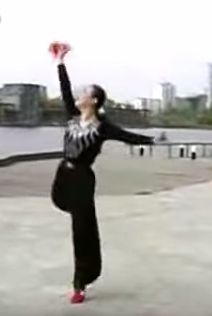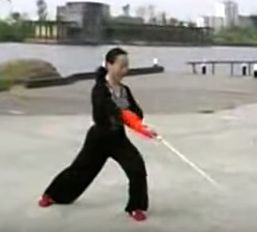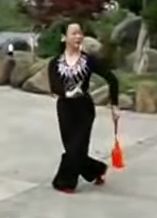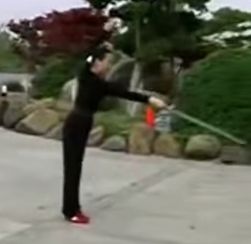
Unknown's avatar

About elizabethbuhmann

Author of Mystery Novels--Lay Death at Her Door, Blue Lake, Accidents of Life, and Freewheeling--plus a new detective series, Murder on the Gulf Coast.

Yi Jian Mei Verse 3

Correcting a couple of details: the opening circle (verse 1, line 1) is clockwise (I’ve updated my earlier post); and in line 2, when she steps across with the left, she swings the sword left, too.

YJM3end2

I’m halfway through verse three, in the position shown above, at 1:20 in the Meng Fok video. To recap verse 3 (see Aug 8):

  1. Xue hua piao piao bei feng xiao xiao: Step R, lift hilt, wheel sword, step R.
  2. Tian di yi pian cang mang: step around L/R/L, gong bu xia ci, withdraw.
  3. Yi jian han mei au li xue zhong: Now see below.
  4. Zhi wei yi ren piao xiang

From the position shown above: Stab once, then bing bu xia ci, wheel the sword the other way (counterclockwise) while stepping across in back with the left foot. Swing the sword first back, then out to this position:
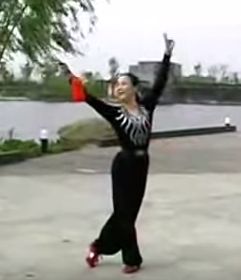
YJM126

That was line 3. This is line 4 (tres complique!): The right foot is nailed to the ground until the very last beat. From the position above, step out to the left, as in the first frame on the left below. Circle the sword up, left and down (ie, big counterclockwise circle).

Then step left around to the right to face backwards (180 degree turn on the right foot, which has not moved, frame 2). The sword, still making a big counterclockwise circle, has reached the high point when you’re facing the back.
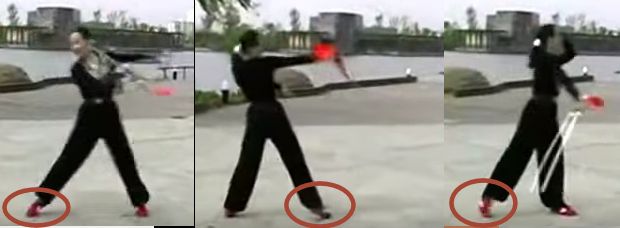
The right foot does not move as she steps around left, left, left.

The right foot (circled) does not move, except to swivel, as she steps around left, left, left.

Keep going! Step around with the left again to face front (frame 3), shift left and make a small counterclockwise circle with the sword. Then the right foot will cross behind. So footwork for this line is left, left, left, right.

The sword emerges from the small circle leading with the point rather than the hilt. It then spirals through a figure eight on the right side. This whole thing takes 6 seconds, between 1:26 and 1:32, and ends like this:

YJM132


This is the hardest move in the whole form if you ask me. That last bit with the sword is tricky; I can only suggest using the gear tool to slow the video way down. After this, there are just two more lines of lyrics. Then four lines of instrumentals. And from there, it’s all repeats! And close form.
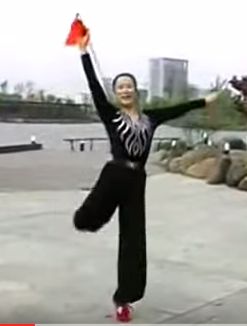
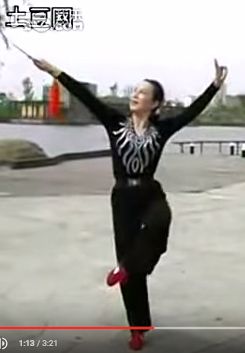
Double Saber Names Parsed

For the Chinese, I am using the Absolute Tai Chi list (note one typo in move 16, chang for chao). For the English I am using that list but also referring to the translations in Master Tzu’s instructional videos and the MDBG online Chinese dictionary. In brackets, I am connecting to the informal descriptive names we’ve been using in class.

Qi Shi – Preparing form
Quan Wu Hua Chao Yang Dao – Full circle of flowers, Salute the Sun
Qie San Dao Chao Yang – Three cuts, Salute the Sun [3x jump to kneeling, turn around]
Yi Dao Yue Bu – One Cut Jump Forward [turn around, cross blades]
Shang San Dao – Step up with Three Cuts [3x chop on left; cuisinart]
Yan Bie Jin Chi – Swallow/Goose Spreads its Golden Wings [stab both dao on left]
Gu Yan Chu Quan – Lone Swallow/Goose Leaves the Flock [fajin with R dao]
Yi Dao Chao Yang – One Cut Salute the Sun [over the shoulder turn around/reset]
Zuo/You Cha Hua – Left/Right Arrange Flowers [monkey hops]
Hu Die Xi Shui – Butterfly Drinks Water [turn around, 3-cut left and double stab overhead]
Zuo/You Cha Hua – Left/Right Arrange Flowers [monkey hops]
Fu Hu – Tame the Tiger [turn around, 3-cut left, stomp R and cross blades]
Yi Dao Chao Yang – One Cut Salute the Sun [over the shoulder, turn around/reset]
Zhong Kui Zhang Jian – Zhong Kui Wields his Sword [jump L/R to snap blade]
Gu Shu Pan Gen – Uproot the Old Tree [360 turn, cross-step and double chop]
Fan Shen Kan – Turn Body and Cut [jump around to double chop]
Yi Dao Chao Yang – One Cut Salute the Sun [over the shoulder, turn around/reset]
Zuo Jiao Xiang – Left Stir the Top [180 degrees, double chops]
You Jiao Xiang – Right Stir the Top [1.5 turns, double chops]
Liang Dao Chao Yang – Two Cuts Salute the Sun [retreat L/R, turn around]
Liang Dao Zuo Zhuan Xiang – Two Cuts Left Rotation [Bagua Walking left]
You Zhuan Xiang – Right Rotation [Bagua Walking to the right]
Ba Wang Ju Ding – Ba Wang Lifts the Ding (= 3-legged urn) [stamp R and cross blades]
Luo Han Xiang Long – Luo Han Subdues the Dragon [double stab overhead left]
You/Zuo Pian Ma Dao – Left/Right Cut the Horse [fen jiao (toe kick) right and left]
Bai She Tu Xin – White Snake Spits its Tongue [turn around/ reset and snap blade]
Zuo/You Pu – Left/Right Pounce/Attack [Snap blades 1-2]
Shang Bu Qi Xing – Step Up Seven Stars [Turn around to face opposite way]
Xia Bu Kua Hu – Step Down to Ride the Tiger [Turn around to face opposite way]
Yi Dao Xia Shi – One Cut Downwards [repeat Quan Wu Hua then chop down left]
Shou Shi

I needed both Master Tzu (second video of two) and the Chen Zhenglai video to parse the last few names, but I think I’ve got it right. Names, at least. I’m not sure we are doing Shang Bu Qi Xing or Xia Bu Kua Hu quite the way these two masters are doing them, or that those two are doing the same thing as each other. I think not?

Then, where we repeat Quan Wu Hua, Masters Tzu and Chen are doing something different (talking about Yi Dao Xia Shi)–I haven’t figured out what! See ca. 25:00-30:00 on Master Tzu’s second video. But again, there are a lot of discrepancies, throughout, between these two versions and between both of them and ours, which is essentially Cheng Jincai’s (I think). This seems always to be the case with traditional forms. Makes me appreciate the standardization movement.

Yi Jian Mei Continued

This is slow work. First line in the third verse: Xue hua piao piao bei feng xiao xiao: First half of the line, step out to the right (wide, to gong bu), swing the sword across in front (palm-down) and then step up onto the left, thrusting the hilt of the sword up like this (palm-up):

YJM 3-1a

Chop down, touching left hand to right and right foot behind to a xu bu dian jian position, but don’t stop there; immediately wheel the sword and step out to the right. Swing through to this position:

YJM 3-1b

As you can see in the lower lefthand corner of the picture, we are up to 1:13. Next line is tian di yi pian cang mang, 1:13-1:20. Step around to the left, L-R-L, while leading the sword by the hilt, head-high, palm-up. Then lift up onto the left foot (by now, facing front again) and circle the sword overhead, like so:

YJM 3-2

The line is not finished. She steps back with the right and swings the sword around to a gong bu xia ci position as shown:

YJM 3-2b

She shifts all the way up on the left, lifting the hilt, then steps back onto the right and shifts into this withdrawn (chou) position at 1:20. End of verse 3, line two.

YJM3end2


I’ve only advanced about 11 seconds! But these moves are very unfamiliar, and I am working straight out of video.

Yi Jian Mei verse 2

Yi Jian Mei (One Plum Blossom) is the title of a drama set in pre-revolutionary China.  Apparently there is more than one version and production—a 1931 movie? A Taiwanese TV show in the 1980s, apparently. A TV show popular in China in 2010? And the popular theme song was composed when? I would have to be able to read Chinese to get to the bottom of it.

520px-Xin_Yi_Jian_Mei

I have been reading the Inspector Chen novels set in post-Tiananmen Shanghai. Qiu Xiaolong describes a nostalgia among the new generation for the glory days of Shanghai in the 1930s. I’ve just started his internationally best-selling book of short stories spanning the decades between those days and the present. His next Chen mystery, Shanghai Redemption, is coming soon. Nice covers! Macmillan/Minotaur.

yearsofred

redemption


Anyway, I’m learning the Tai Chi sword form to the popular theme song, currently working on the sequence of movements for the first two verses (4 lines each) using a video by Meng Fok. I had gotten as far as the middle of the second verse. To recap, Verse 1:

  1. Zhen qing xiang cao yuan guang huo [Circle arms, lift knee, point toe]
  2. Ceng ceng feng yu bu neng zu ge [Step L, R, point left and du li da hu]
  3. Zong you yun kai ri chu shi hou [Point to left, lift right knee]
  4. Wan zhan yang guang zhao yao ni wo [Walk in circle, switch to palm-up]
pose at end of line 1 verse 2

End of line 1, verse 2

Second verse:

  1. Zhen qing xiang mei huo kai guo [Step back L, R, pose as shown above]
  2. Leng leng bing xue Bu neng yan me [Take sword, R, L, pivot, step L, stab up]
  3. Jiu zai zui leng zhi tou zhan fang [Now see below]
  4. Kan jian chun tian zou xiang ni wo

Line three: I have to break this line into two phrases. Jiu zai zui leng: She swings the sword in a big counterclockwise circle on the left of her body while stepping up with the right foot. Then she closes with the left foot in a sort of bing bu dian jian, except her legs are straight and her left hand is in a high ward-off position:

End of line 3, verse 2

First phrase of line 3, verse 2

Line 3, second phrase, zhi tou zhan fang: She circles the sword as if to do you gong bu lan, but follows through to reach the pose below in a sort of du li ping ci:

End of line 3, verse 2

End of line 3, verse 2

The last line is hard! Kan jian chun tian zou xiang ni wo: 8 words for 8 counts. First four counts: She turns to her right and steps R-L-R-L, turning around. The last step left is a cross-step behind. The sword is just following her, but she switches from palm up to palm down as she turns. This is right about at the one-minute mark of the video (1:00-1:02). She’s here:

Middle of line 4, verse 2

Middle of line 4, verse 2

Now she unwinds all the way around so she is in cross stance with the right foot behind as shown below. That’s pivot on L toe, pivot on R heel, pivot on L heel, pivot on R toe. The sword traces one big circle overhead with a small circle in the middle, changing from palm down to palm-up. Finish like this:

plumline8

Verse two ends at 1:06. A little more than two minutes remain, but I think maybe the repeated part (verse 3 and the 2 lines after it) repeats in movement as well. That would be cool.

Shuang Dao Names

Looking further at the names for the first half of the form using:

rightread2y

I’m looking at the Chinese names because they tend to be the same everywhere. English names vary so much with the translation. Absolute Tai Chi gives the Chinese names, but they don’t give the characters or the standard Pinyin, so it’s a little harder for me to look up the exact meaning of individual words. Master Zhu gives characters but they are images, so I can’t copy/paste to a dictionary.

Chaoyang — — means facing the sun or exposed to the sun. This is what Absolute Tai Chi calls Salute the sun; Master Zhu calls it Sun-facing (the Sun-facing Broadsword). This posture, pictured above, recurs throughout the form.

Dao —  — means knife, blade, or single-edged sword, but it seems also to mean cut (Jess Tsao’s translation) or chop, as in Yi Dao Chao Yang: one cut, salute the sun. (I have to believe that’s a typo in #16: surely it should be “chao” not “chang”.)

“Monkey Hop” – Cha Hua (arrange or stab flowers)

Hua is flower. I can’t figure out what cha is, in cha hua. Master Zhu says arrange; Absolute Tai Chi says stab. This is precisely why I prefer to use the Chinese names: Just call it Zuo/You Cha Hua. Easy enough.

Yi Dao Yue Bu

Yi Dao Yue Bu – Master Zhu Tian Cai

Yue bu is a new one to me. Yue can mean jump or jump forward. Yi dao yue bu is one cut, jump forward, pictured above.

Wudang Tai Chi Sword

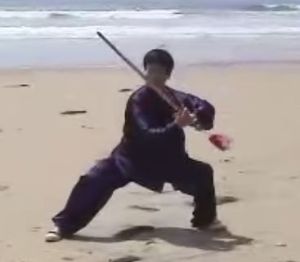
I’ve posted on this form more than a dozen times. Pulling it all together now: This is a combined form with elements of both Wudang and Tai Chi sword. That is, it combines postures from the traditional Wudang sword routine with movements in the traditional Yang style Tai Chi sword form.
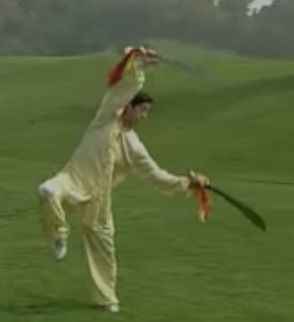
Master Liang's video is excellent.

Master Liang’s video is excellent.

Three YouTube videos were helpful to me in learning the form:

In addition, Jesse Tsao’s instructional video is invaluable for the excellent demonstration, for learning the names of the movements, getting the details right, and for multiple views of the form both front and back.

Best resource: Master Tsao's video

Best resource: Master Tsao’s video

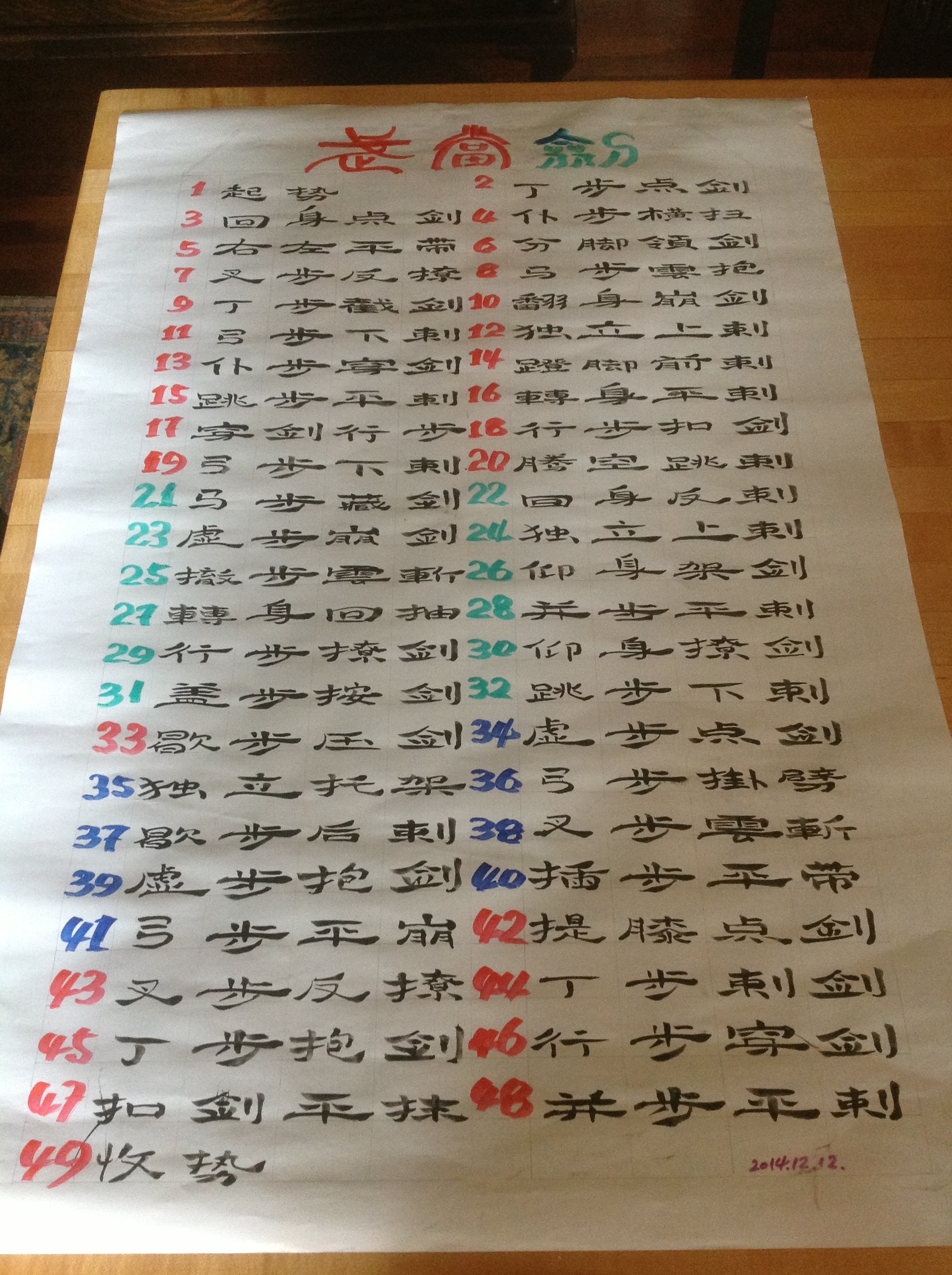
Here is the List of names in Chinese (both characters and Pinyin). My friend and teacher Long Feng, who introduced me to the form and provided the essential in-person teaching time, uses a recording of some wild, tribal-sounding music that includes the names. I haven’t found this recording anywhere in the Web–don’t even know where to look. But if you can find it, it’s fun to do the form with the names. I like it better than the music in any of the videos I’ve seen.

The 49 steps in Standardized Wudang Sword form, handwritten

The 49 steps in Wudang Tai Chi Sword form, handwritten

I worked my way through Master Tsao’s instructions and posted notes on each of the eight lessons. I don’t know if these notes help anyone but me, but they are here:

Wudang Sword Notes: 1 | 2 | 3 | 4 | 5 | 6 | 7 | 8

All posts on this form are tagged Wudang Sword. And finally, below, click to see the traditional Wudang sword form for comparison. Exciting form, that! looks hard.

Yi Jian Mei Lyrics

No end of artists have recorded this song! I found a YouTube video with the lyrics in Pinyin (the singer is Timi Zhou), which makes it easier to keep my place in the music while learning the form. I also found a video with English subtitles:

Click to go to English version.

Click on image to go to English version.

I actually like the vocals in these two recordings better than the one that goes with the video of the form. I’ve transcribed Pinyin and English translation below. The opening movements that I wrote up the other day extend through the second line of the second verse.

Zhen qing xiang cao yuan guang huo     True love is like the wild field

Ceng ceng feng yu bu neng zu ge      Wind and rain cannot create barriers

Zong you yun kai ri chu shi hou      The cloud will break and the sun will shine

Wan zhan yang guang zhao yao ni wo      On you and me


Zhen qing xiang mei huo kai guo      True love is like the blossoming plum

Leng leng bing xue bu neng yan me     It cannot be buried by the snow

Jiu zai zui leng zhi tou zhan fang    It blossoms at the coldest time

Kan jian chun tian zou xiang ni wo     And sees spring coming towards us


Xue hua piao piao bei feng xiao xiao     The snow falls and the wind blows

Tian di yi pian cang mang     The heaven and the Earth are completely white

Yi jian han mei ao li xue zhong     One branch of plum stands proudly in the snow

Zhi wei yi ren piao xiang     Its scent is only for you


Ai wo suo ai wu yuan wu hui     My love is without complaint and regret

Ci qing chang liu xin jian     This love always stays in my heart

One stanza’s worth of instrumental music follows. Then repeat from xue hua to the end. At the end of the vocals, there is a short instrumental closing (about two lines’ worth). The form closes with the music for a grand total of about 26 lines, lasting just over three minutes in this video.

BL-3D-sm

BLUE LAKE  by Elizabeth Buhmann

Richmond, Virginia, 1968. Regina Hannon’s family was destroyed by the loss of a sister she can barely remember. When she learns that the death was once investigated as murder, Regina sets out to find the truth about tragedy reaching back to the early years of the century. Stirring up old heartache and fury, she is blindsided by unexpected danger. Read the book…

Double Saber Names

Absolute Tai Chi (an all around excellent website–look through it!) offers a list of movement names in both English and Chinese. I’ve also transcribed a list from Master Zhu’s instructional videos (which are in Chinese with English subtitles).

v_doubledao

Master Tsao also has an instructional video, too, which would be in English, with good (and sensible!) translations. All of his videos are good and well worth the moderate cost.

The immediate challenge is to figure out which name goes with which movement. The one Jesse Tsao demonstrates in the picture above is Butterfly Drinks Water. Referring to the Absolute Tai Chi list, Part I ends with the snap of the right blade, which is demonstrated in Master Gohring’s Video 6. Lone Swallow Leaves the Flock is the fajin.

What we call the Monkey Hop, and Master Zhu calls Arranging Flowers, on the Absolute Tai Chi list is left and right Stab and Flowers.  Honestly, why not just use the Chinese? Cha Hua. Short and easy. And correct! After the second set of Cha Hua, the move with the crossed swords is Subdue the Tiger, Fu Hu in Chinese.

CZjump

Zhong Kui Wields His Sword is the 180-turn with fajin right before the series of double chops (above). This is the end of Part II. To be continued!

Yi Jian Mei

One Plum Blossom is the title of a song for which a lovely and unique sword form has been choreographed. I have seen it before, a couple of years ago, but that was before studying Yang sword. Sword is an acquired taste. Here’s a video:

plum

So this is a surprise new project–I had planned to learn 56-sword next. Long Feng does this so beautifully it makes me weepy. Another woman, new to our group, knows it also. How can I pass up the opportunity to learn it? It is longish–more than 3 minutes.

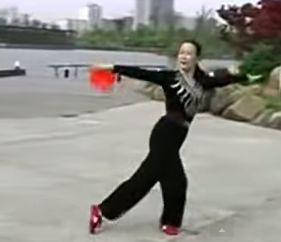
Here’s another video of the same form, Yi Jian Mei Tai Chi Sword. The performer is 80! So no excuses.

plum80

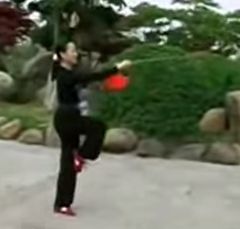
Using that first video, vocals start at :15. Opening form: she circles both arms clockwise (from the performer’s perspective) and finishes with the left arm extended, right arm raised and left knee lifted.

plum-qishi

She pulses once on the beat, then extends the right arm higher and points the left toe to touch the ground. Then she circles the right arm counterclockwise, stepping left, right and extending the left to the side. Eyes follow the right hand.

plum-qishi2

Lift into this position, which reminds me of Wu-style kua hu as shown below. Then unwind, stepping left, to point ahead as you would doing three rings around the moon. That’s the first 30 seconds.

plum-qishi3

She will not take the sword for another 15 seconds or so. From the pointing position, follow through and circle the right arm up and back, while stepping up to point the right toe. Lift the right knee, point both arms left and look left:

plum-qishi4b

What comes next is complicated–a 7-count Bagua walking with the sword spun overhead. Unwind to the right (she does a little pulsing move to start) and take seven steps R-L-R-L-R-L-R in a circle, turning out to the left on step 6, the back to the right on step 7 so the right foot faces front. Sink and step back with the left to reach the position shown below. This move lasts 5 seconds, from :35 to :40 in the video.

plum-qishi4.The sword circles all the way around overhead, from a back-carrying position to a front carrying position. The right arm is just following the body in front, then circles down and overhead at the end. Just watch the video (slow motion: use the gear symbol to select .25 speed).

She stands up in the right leg, swinging both arms in a clockwise (to her) circle, steps back with the left and then the right, dips, and swings both the right arm and the right leg across the front of her body as shown below. Finally! She takes the sword.

plum-qishi4c

She then steps right and left and pivots on her toes. While turning she slashes down in back, high in front and around behind her. She steps back with the left and stabs overhead like this:

plum-qishi5

That’s 53 seconds. What an opening. I’ll try to learn it before next week.

Chen Double Dao

In class at Master Gohring’s Tai Chi & Kung Fu, we have resumed learning the Chen double saber routine. Below, the routine is performed by Chen Zhenglei.

CZdao

Earlier this year, we had reached the two jumps that we call monkey hops, which occur at about :30-:35 in the video. The name for these hops is actually Arrange Flowers (left and right).

The next move is a combination of three-cutting, a turn, and what we call cleaning the blade. This move occurs repeatedly as a sort of punctuation between sections of the sequence. We do a lot more blade-cleaning than I see Chen Zhenglei doing–it is an optional flourish, as far as I can tell. In any case, the move finishes in the position shown above.

CZduli

Next we do a three cut on the left and stand on one leg with both knives overhead, as shown above. Afterwards, turn back to the right, leading with a right chop and turn around.

Then we do another set of monkey hops/arrange flowers, followed by 3-cut turnaround and clean.

CZcross

Then we do a turn that finishes with blades crossed and extended as pictured above–sort of. It’s hard to catch an image of this. He stomps down with the right foot, steps forward on the left, and extends the crossed blades. And Master Chen snaps the blades, thrusting forward.

Three-cut, turnaround and clean. Again, the wash is optional. With or without, we finish each new move in the Chau Yang (Sun Facing) position.

CZjump

From here, jump around from the position shown at the top of this post to the position shown above, snapping the right saber. We are doing a vertical snap. Chen Zhenglei does a horizontal snap.

CZcha

Turn to the left, slashing with the right saber, swing both sabers in a big clockwise circle and chop down in a cross stance (cha bu) as shown above. Unwind, jump around, and chop down with both sabers. This movement looks just like Fan Hua Wu Xiou (Pao Chui).

CZfan

Three-cut, turnaround and clean. Then turn back to the left and perform the same move as above but facing in the opposite direction. That’s cut right, circle sabers and chop in cha bu, then unwind and chop with both sabers, fan hua wu xiou.

CZfanleft

Then turn to the right, slashing with the left, in the mirror image of the same move–cha bu with right foot behind, unwind and fan hua wu xiou to chop with both sabers, left foot in front as shown above. From here, return to sun-facing broadsword position at the top of the page.

Recapping the sequence starting after the first set of monkey hops:

  • 3-cut turnaround and clean
  • 3-cut stand on one leg
  • 3-cut turnaround and clean
  • Second set of monkey hops
  • 3-cut turnaround and clean
  • Cross blades
  • 3-cut turnaround and clean
  • Hop around and snap
  • Cross-stance, unwind and double chop
  • 3-cut turnaround and clean
  • Cross-stance, unwind and double chop, opposite side
  • Cross-stance, unwind and double chop, opposite direction
  • 3-cut turnaround and clean

This is a lot of moves at once, some of them quite difficult. We are three quarters of the way through the form, at about 1:30 of 2:00.