Wudang Notes 5

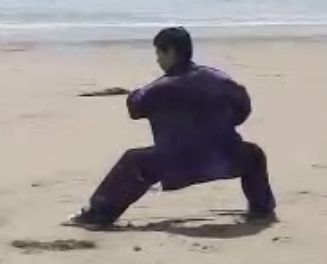
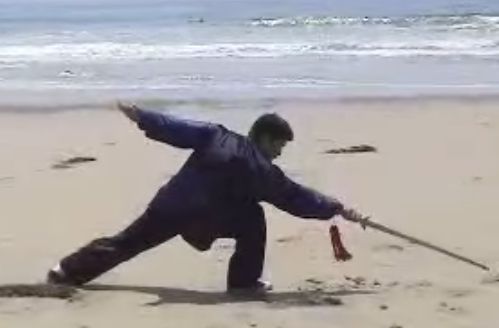
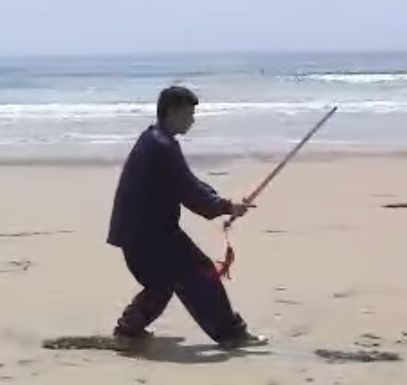
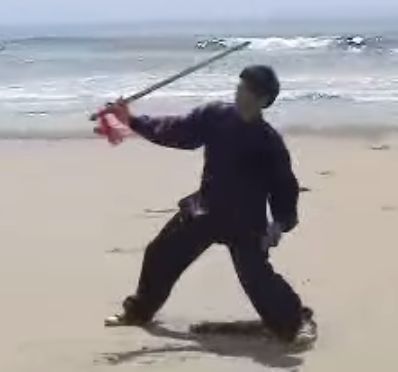
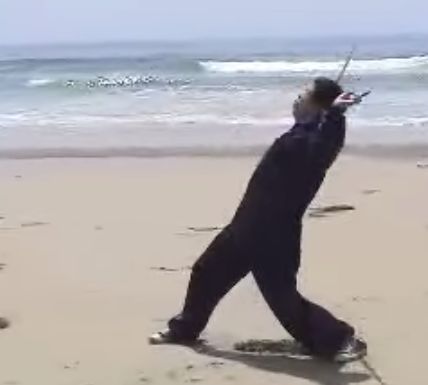
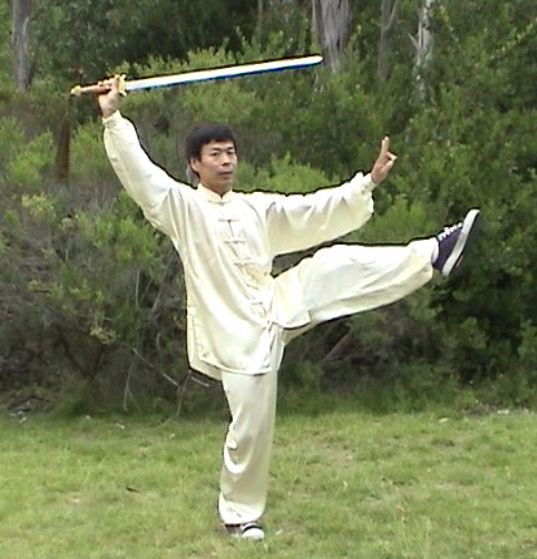
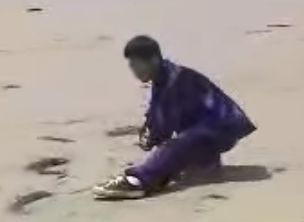
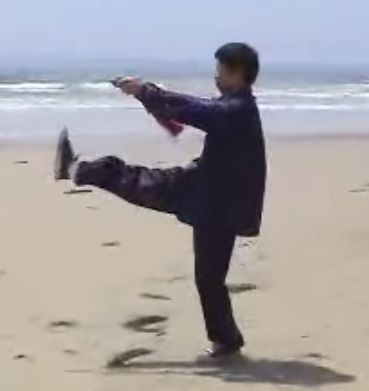
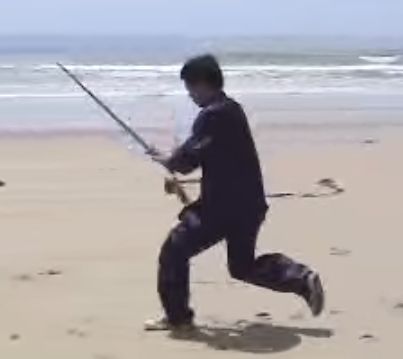
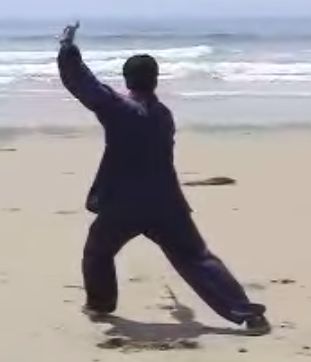
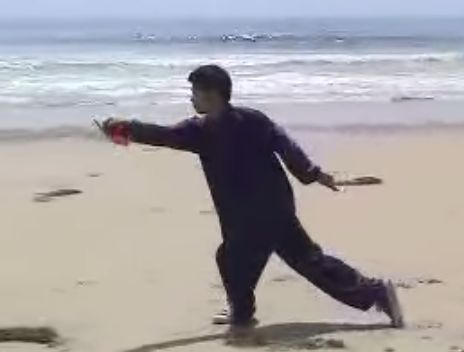
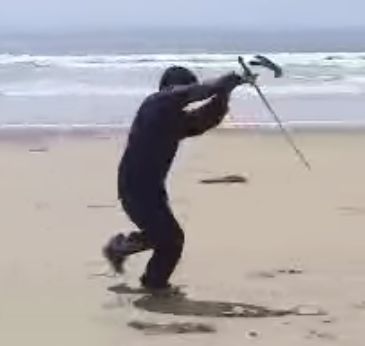
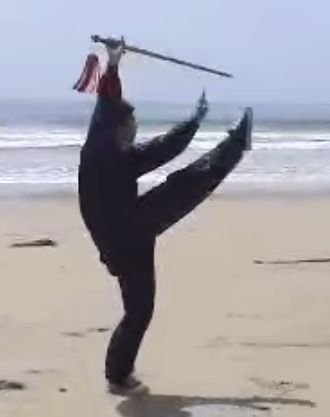
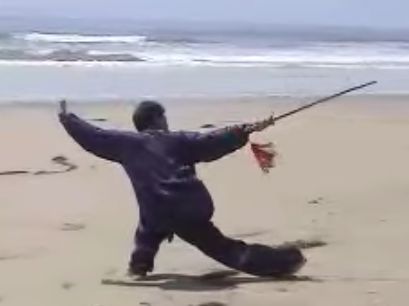
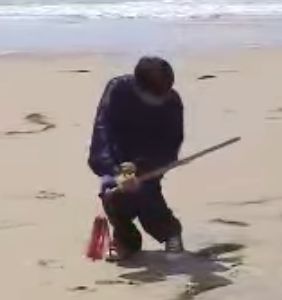
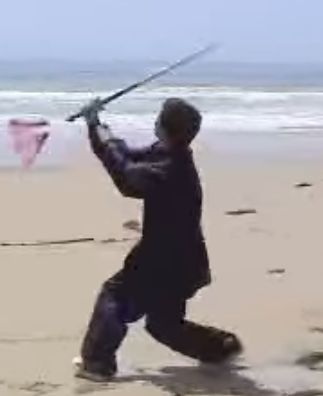
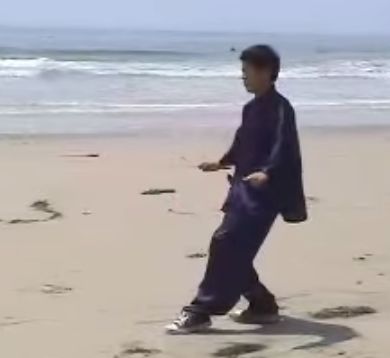
This has been the hardest section for me because of the double turn following the cutting kick shown below. Grabs are from the YouTube video, but I am studying the instructional video available from Taichihealthways by Jesse Tsao.

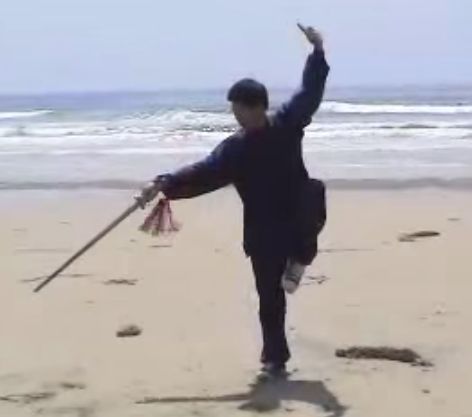
The kick with liao in lesson 5

The kick with liao in lesson 5

27. Zhuan shen hui chou: Turn Body to Pull Sword Back. This movement is familiar from 32-sword. My only new notes are that he chops out to the left front corner before withdrawing–and hiding, he says–the sword. So, four counts are turn, chop, pull back, and point. The sword finger points in that same diagonal direction.

A definite chop after zhuan shen

A definite chop after zhuan shen

28. Bing bu ping ci: Also familiar; White Ape Offers Fruit, also known as the Compass. Take a definite step to the left and point the sword slightly higher than shoulder level (although ping means level).

29. Xing bu liao jian: Dragon Walking with Slicing Sword (!). Step well back on the right, blocking up and back with the sword. Left hand to shoulder, ding bu with the left foot. The run goes left-right-left CUT, then right-left-right CUT. The cuts are up (lift sword). Start each run with a little kickback. The pattern is an S, rather than a zigzag; curve left, then right.
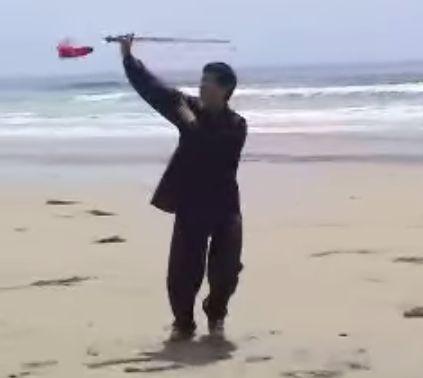
Preparing for the Dragon Walking

Preparing for the Dragon Walking

30. Yang shen liao jian: the kick is Lean Body to Cut Upward, a fen jiao, not a deng jiao as I thought. Yang shen is that body-facing-upward stance we’ve already done (as in Yang Shen Jia Jian). Flick the sword to cut up, palm facing in: liao.

31. Gai bu an jian: Cross to Cut Down. Gai means cover. Drop down from the kick onto the right foot facing front and make a small wrist circle with the sword. Then step across with the left foot facing front (release the heel of the right) while pulling down on the sword and covering with the left sword hand.

JTkick4

The hard part of this section is the transitional flourish between the covering posture and the skip-and-stab that follows. (1) From the cover position shown above, swing all the way around, sword following body in a big circle, both feet pivoting. (2) Step back with the right foot while making a small wrist-circle with the sword. (3) Pivot on the right heel to face the back while pulling the sword all the way around to a high position as shown below.

JTkick5

So it’s little circle, big circle, little circle, big circle. Then add one last (optional, but why not?) little circle as a flower before beginning the skipping move.

Finishing position for this section: gong bu xia ci

Finishing position for this section: gong bu xia ci

32. Tiao bu xia ci: Hop to Thrust Downward. Step left, skip to right gong bu and stab downward, left hand high.
Wudang Notes 4

We’re almost halfway through the form. Lesson four includes the leap.

In position for the leap.

Master Tsao in position for the leap.

20. Teng kong tiao ci: Leaping Thrust. Tiao is leap, kong is sky, and teng is soar. Leap to soar in the sky? Shift left from the xia ci, turning the right toe in and pulling the sword around with both hands. Then shift onto the right foot, pressing down with both hand, left xu bu, as shown above. Jump from the left foot, turning the right foot all the way in to land facing the back as shown below. JT4-2   21. Ma bu cang jian: Hidden Sword in Horse Stance. Note that the left foot faces forward. Both hands are palm-down, the left covering the right and the sword. The sword is flat–and sure enough, you can’t see it! JT4-3 22. Hui shen fan ci: Turn to Thrust Downward. From ma bu step around to the left, stabbing up and pivoting on the right toe. Then stab down behind you as shown above. JT4-4 23. Xu bu beng jian: Flick Sword Up in Empty Stance. Shift back to right xu bu and collapse the sword.

24. Du li shang ci: Step around to the right, pivot the left heel, rock back to swivel the right heel in, then shift forward into du li shang ci. Long Feng sometimes makes these shifts into steps, right, left, right. In any case, the du li is on the right foot. JT4-5 25. Che bu yun zhan: Che bu is a new one for me. It means to withdraw–step back with the left. I’m not sure how that’s different from tui bu, but you can see above how he is standing. Zhan is chop, or even behead. The turn of the sword inward is from the wrist; the arm hardly moves, and it stays flat. Then the cut is right to left. The left hand pulls down across the chest into a ward-off left, which gives some torque to the cut. JT4-6 26. Yang shen jia jian: Face Up to Ward Off. From both hands together and the sword in front, circle the sword flat in front of the face as shown, then cut from right to left, level, hands together in front again.

For best results, I highly recommend Jesse Tsao’s instructional video, available from taichihealthways.com.

Wudang Notes 3

Watching the video in slow motion (click on the gear), I see that after the left ping dai, the left arm makes two circles: arms open when he shifts back, left goes low, sword high, then the left threads inside the right so the sword is low and the left is high; then as the sword blocks up for the kick, and the left hand circles up to the right shoulder.

Fen Jiao - Master Tsao

Fen Jiao – Master Tsao

The grab above is from the instructional video, which I highly recommend. Available from Taichihealthways.com.

Lesson 3 begins and ends facing into the back left corner. We begin from Du Li Shang Ci, stabbing up, and end with Gong Bu Xia Ci, stabbing down. The seven movements in this lesson are (numbering for the whole 49-step routine):

13. Pu bu chuan jian: To start, we are stabbing up with palm up. Turn the wrist counterclockwise, pulling the end of the sword back and up.Then with the sword pointing down and left, thread the point in the path of a snake creeping down. Traditional name is Snake Creeps Down to Pierce. The left hand circles up, just as it does for the Yang Snake Creeps Down, then presses down over the right hand.

Pu bu chuan jian

Pu bu chuan jian

14. Deng Jiao Qian Ci: Qian means forward. Kicking Up and Thrusting Sword. Come up from snake on the left foot, opening arms to ward off. Scoop up the sword handle in both hands and lift the right knee. Thrust level forward (both hands) with the heel kick. When stepping down on the right, lower the end of the sword (point rocks up a bit). Reach to thrust forward with both hands.

JTdeng

This whole movement (and the next) goes toward the back right corner; it travels diagonally.

15. Tiao Bu Ping Ci: Wild Horse Leaping Over Creek (that is the traditional name; the Chinese descriptive name means “jump step level stab”). From the reaching thrust after the kick, hop forward onto the left foot, opening the arms. Hands drop to the sides with the landing. Stab level, left arm high.

Leaping Across the Stream!

Leaping Across the Stream!

16. Zhuan Shen Ping Ci: Turn body level stab. Circle the sword to the left, and turn the wrist counterclockwise to palm down. Do this while shifting left and turning the right toes in. Sword fingers go to the right wrist. Then lead a full turn to the left with the sword fingers, finish in zuo gong bu ping ci (palm up) facing the back. Below:

JTpingci

17. Chuan Jian Xing Bu: Bagua Walking. Block back and up to the right while shifting back. Turn left, pivoting on left heel, and thread the sword across the body to stab to the left. Curl under the right hand to go palm-down on the pull-back; spiral to palm-up on the stab. It’s a little hard to see, below, that his shoulders are facing us but his hips face away. Left arm is behind him (toward the camera).

JTtwisted

18. Xing Bu Kou Jian: The right steps across the left and beng jian–flip the wrist to snap the sword up. Here’s where you walk in a big circle and a half. Starting with the left foot, four steps. Then on five, lift the hilt; on six, stab out to the right; on seven open the arms; on eight, bring them together overhead; on nine, circle down and pull the hilt up to the right, pressing down with the left.

Count nine of Bagua Walking

Count nine of Bagua Walking

19. Gong Bu Xia Ci: Traditional name is Cat Catches Rat. Head for the back corner. On what would be the tenth step, open out the arms. On eleven, step toward the back corner. On twelve (we’re on the right foot now) stab down with both hands on the sword handle. You gong bu xia ci = right bow stance stab down. Master Tsao notes that with enough space, you can make it fourteen steps, and that’s what he does on the YouTube video — watch :55-1:05 in slow motion.

Wudang notes 2

Lesson two begins from Zuo Ping Dai, a left bow stance with left hand high and sword stabbing level. These first two lessons cover about the first 35 seconds of the YouTube video, a low-quality excerpt from the instructional video.

Fen jiao ling jian

Fen jiao ling jian

6. Fen jiao ling jian: Shift back and turn the left toe out. Step in and block high with the left, drop the sword handle into a counterclockwise circle outside the left hand. Block up with the sword, circle in with the left across the chest. The kick is a toe kick (not a heel kick as I once imagined). Ling means lead. The descriptive name he gives is Point Toe and Lead with Sword. After the kick, step down (onto left) and pull down on the handle to circle behind clockwise. Make a figure-eight, circling the sword counterclockwise in front.

Cha bu is the back cross stance

Cha bu is the back cross stance

7. Cha bu fan liao: Cha bu is the crossing stance pictured above. Fan liao means the sword is raised backwards. He gives the name as Back Slash in Cross Stance.

JTmabu

8. Ma bu yun bao: From cha bu, the left foot pivots on the toe, the right foot pivots on the heel, to reach ma bu (horse stance) as pictured above. The sword swings from pointing backwards to the right all the way around over the head to the position shown. Yun is cloud (the circle over the head), bao is embrace (note the rounded arms above). This horse stance is shifted to the left.

Ding bu jie jian

Ding bu jie jian

9. Ding bu jie jian: Jie is cut. Cut Down in T-Stance. Flip the sword over and cut down on the left. For me, this movement is improved with the knowledge that the ma bu is shifted left. That way, the step up to ding bu is more pronounced. Also, that flip is accomplished by leading the hilt in a tight counterclockwise circle. The cut is along the left thigh.

Fan shen beng jian

Fan shen beng jian

10. Fan shen beng jian: Beng jian is a new concept for me. Master Tsao in this lesson gives a good look at how the wrist flips to snap the sword around. His sword visibly flexes with this sharp movement. Beng means collapse (outside of its use in describing sword play); the sword snaps back to rest more or less upright in the hand, which is like a collapse or a folding up or cocking movement. The wrist rotates from palm down to palm up. Master Tsao uses the word “flick”–Turn Body to Flick Sword.

11. Gong bu xia ci: Both hands are on the sword handle for the downward stab. Between the fan shen and the gong bu, there’s a little pivot on the left foot so the posture faces stage-left. The traditional name is Cat Catches rat.

12. Du li shang ci: The arms open up (this is a ward-off) and then circle into the shang ci. A correction for me: don’t try to keep the left hand on the sword handle; it slides back on the right forearm, which allows the sword to extend more. The footwork is to step left, then right. The traditional name is Birds Return to the Tree at Dusk.

Wudang Notes 1

I’m working my way through the instructional video by Master Jesse Tsao–eight lessons in all for the 49 steps.

Master Tsao: ding bu dian jian

Master Tsao: ding bu dian jian

I know the form already from working through Master Liang’s demonstration video and from following Long Feng and Mr. Cao on weekends, but there is so much more to learn from Master Tsao! A low-quality video of Jesse Tsao demonstrating the whole form is free on YouTube, however the instructional video, available from his website, Taichihealthways.com, is excellent, detailed, high quality video, and well worth $35.

Lesson 1 covers the first five movements. The following are my notes on this section.

1. Qi shi: When circling the left arm across, the left heel leaves the ground and the right sword fingers cross the chest to protect the ribs. When the right sword fingers point ahead, they should pass by the ear and point at nose level, centered. To draw back the right hand, turn palm-up and pull down and back before releasing the arm to the back. Reach for the sword handle with “tiger mouth” (Hu Kou) again at ear level.

2. Ding bu dian jian: Pictured above. Master Tsao describes the pointing of the sword as a pecking movement, like a bird pecking with its beak. The traditional name for this is Dragonfly Dipping Water.

Master Tsao- hui shen dian jian

Master Tsao- hui shen dian jian

3. Hui shen dian jian: Pictured above. From ding bu, block up with the sword, leading a clockwise circle with the hilt. Left hand circles low. Then again the movement is a pecking action, while the left hand wards off high. Du li. Look at the point of the sword.

Pu bu heng sao

Pu bu heng sao

4. Pu bu heng sao: Heng means horizontal; this is a horizontal sweep from a low squat, cutting at ankle height. The traditional name for this move is Swallow Skimming Across the Water.

5. You Zuo ping dai: Carrying the sword level. On the right, Master Tsao thrusts forward palm-up, then slices right palm-down. On left ping dai, he thrusts forward palm down, then turns his sword hand palm up to sweep to the left.

Wudang Sword 49 steps

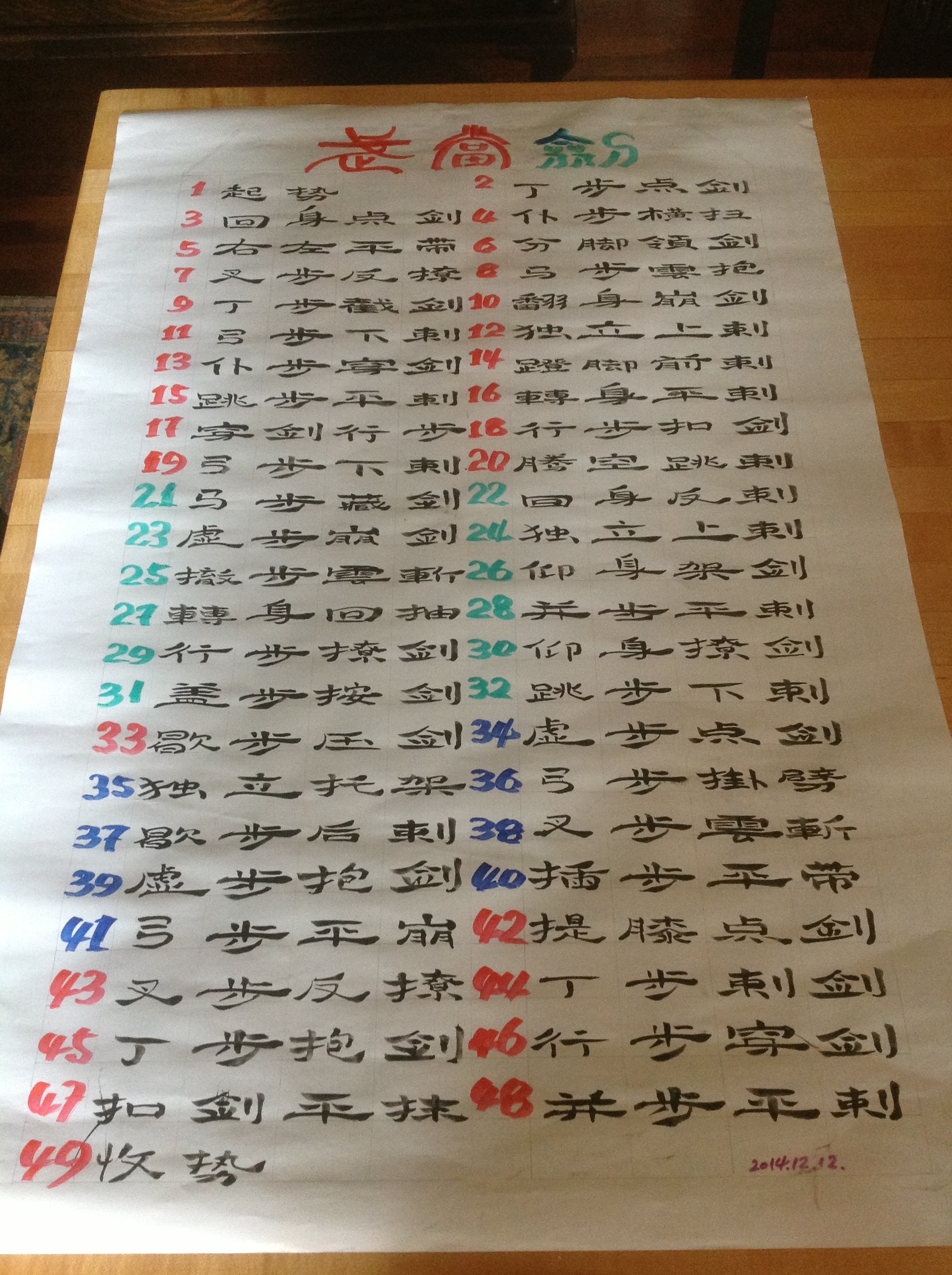
On the Tai Chi section of his website, Phil Cheung lists the 49 steps in the Wudang sword form I’ve been studying. He lists the steps in Chinese characters–it’s the same list I was given in handwritten Chinese! But as these are digital characters, I can look them up, and I did, all of them, to arrive at the list below (a few words might be wrong).

The 49 steps in Standardized Wudang Sword form, handwritten

The 49 steps in Standardized Wudang Sword form, handwritten.

The importance of this list lies in the music I have for this form: The movements are called out in Chinese. I can pick up almost nothing without Pinyin, but from the Cheung list, I now have Pinyin that corresponds to what I am hearing in the music, which, sorry, I don’t feel I can post for fear of violating a copyright. If you know where to find this Chinese Tai Chi music (I don’t), I’m sure you can find this popular accompaniment for Wudang.

I haven’t tried to translate it all–a lot of the vocabulary and descriptive moves are familiar from 32-sword, some of it is mystifying–but I have added notes connecting directions with movements for staying with the music, especially where new words occur.

  1. Qui Shi
  2. 丁 步 点 剑       Ding bu dian jian
  3. 回 身 点 剑       Hui shen dian jian
  4. 仆 步橫扫         Pu bu heng sao  (the low sweep)
  5. 右 左 平 带       You zuo ping dai
  6. 分 腳領 剑        Fen jiao ling jian (the kick)
  7. 叉 步反撩         Cha bu fan liao  (wheeling the sword)
  8. 马 步云抱         Ma bu yun bao (horse stance)
  9. 丁 步截  剑       Ding bu jie jian (the cut on the left)
  10. 翻 身崩 剑       Fan shen beng jian
  11. 弓 步下 刺        Gong bu xia ci (bow stance stab down)
  12. 独 立上 刺        Du li shang ci  (stand on one leg stab up)
  13. 仆步穿 剑         Pu bu chuan jian (squat and thread sword)
  14. 蹬腳前 刺        Deng Jiao qian ci (beginning of the run)
  15. 跳 步平刺         Tiao bu ping ci
  16. 转身平 刺         Zhuan shen ping ci (turn around level stab)
  17. 穿 刺行 步       Chuan jian xing bu
  18. 行 步扣 刺       Xing bu kou jian (begin the walk in a circle)
  19. 弓 步下 刺        Gong bu xia ci (bow stance, stab down)
  20. 騰空跳 刺        Teng kong tiao ci (the jump)
  21. 马步藏 剑         Ma bu cang jian (ma bu after jump)
  22. 回 身 反 刺       Hui shen fan ci
  23. 虛 步崩 剑       Xu bu beng jian
  24. 独立上刺          Du li shang ci (stand on one leg and stab up)
  25. 撤 步雲斬        Che bu yun zhan
  26. 仰 身架 剑       Yang shen jia jian
  27. 转 身 回抽        Zhuan shen hui chou (turn body withdraw)
  28. 并步 平 刺        Bing bu ping ci (the compass)
  29. 行步撩 剑         Xing bu liao jian (run and skip)
  30. 仰 身 撩 剑       Yang shen liao jian
  31. 蓋步按 剑        Gai bu an jian
  32. 跳 步 下 刺       Tiao bu xia ci (Skip and stab down)
  33. 歇 步壓 剑       Xie bu ya jian (first sit)
  34. 虛步 点 剑        Xu bu dian jian
  35. 独 立 托架        Du li tuo jia
  36. 弓 步 掛劈        Gong bu gua pi (bow stance wheel)
  37. 歇 步後 剑       Xie bu hou jian (second sit)
  38. 叉步雲斬         Cha bu yun zhan (feet apart circle sword)
  39. 虛 步抱 剑       Xu bu bao jian (empty stance embrace sword)
  40. 插 步 平 带       Cha bu ping dai
  41. 弓 步 平崩        Gong bu ping beng
  42. 提 膝 点 剑       Ti xi dian jian (lift knee point sword)
  43. 叉 步反 撩        Cha bu fan liao
  44. 丁 步 刺 剑       Ding bu ci jian
  45. 丁 步抱 剑        Ding bu bao jian
  46. 行 步穿 剑       Xing bu chuan jian (walk in circle)
  47. 扣 剑平抹        Kou jian ping ma
  48. 并步 平 刺        Bing bu ping ci (feet together level stab)
  49. Shou shi

49-Step Wudang Sword (6)

Look at this! One of the people in my weekend practice group has written out the 49 steps of this form for me in beautiful calligraphy. Don’t tell me: Now I have to learn to read Chinese characters.

The 49 steps in Standardized Wudang Sword form

The 49 steps in Wudang Sword

Step 1 is Qi Shi and Step 49 is Shou Shi. Beyond that I can see Du Li in three places–why not more? He also gave me a list of the steps in 32-sword, so that helps in decoding. There are many thousands of Chinese characters, so this is no mean riddle.

I’ve also found another video of 49-step Wudang. It looks like the same place, the same person (but with a different name?) and a different (somewhat less annoying) sound track: Wudang Sword by Master Leng Xian Feng.

We left off at the second sit, with the sword pointing to the left, arms closed, right foot crossed behind the left. Step back out to the right, slashing out to the right and circling the blade around in front of the face. Cross step in back with the left, pointing the sword to the right, left arm over the head. Poor quality screen grab nevertheless shows the position at the three-minute mark:

photo (14)

Footwork on the next move is step out to the left with the left, step to right cat stance, step out to the right, and step across behind with the left. Some shifting of weight happens with the slashing of the sword, as follows: slash to the left, circle in front of the face, and hold palm up with both hands in front at the cat stance. Then slash right, left, right. Finish in position as above, but sword low, left hand high.

Shift onto the left foot and lift the right knee and the hilt of the sword, step right and cut, palm up, to the right, left arm down. Pivot to the left on the left foot, chop overhead and down, right knee up. Step forward with the right (but you’re traveling to stage left) and wheel the sword back, left hand high.
Step left, sweeping to front with the sword, close with the right foot and point the sword. Step left again, sweeping the sword to the left, and close with the right, both hands on the sword.

Run in a circle, starting with the right foot, six steps and then back with the right, to left cat stance. The arms circle once during the six steps, then the sword circles, then the arms open when you step back, same position as if you were about to finish 32-sword.

To close the form (!!!) step forward left, close with the right (as in the Compass), then catch the hilt in the left hand, palm up, hand pointing back at you. Step forward left, right, then left to shoulder width. While taking these steps, circle the sword back to resting position and circle the right hand up. Straighten up and lower the right hand, as if ending the 32-sword. We’re done.

photo (12)

49-Step Wudang Sword (5)

From the sit at 2:30 (Liang Video), rise on the right leg, step left and cast overhead to right cat stance, circle sword counterclockwise and step back with the right to a low cross stance. Then stand on the right leg, sword pointed down. This sequence is also in 32-sword: Lifting the Curtain and Wheeling the Sword Left to what in Yang sword we call Minor Literary Star.

What I am calling Cut Nose Off Face

What I am calling Cut Nose Off Face

Here, it gets complicated: The sword circles clockwise, leading with the point, then figure-eights to the right, then stabs under the right arm. He spins right out of this somewhat awkward position and wheels the sword back on the right, arm up.

Finally, he leaps (left, right) to right cross in back, facing away, casting the sword overhead to the left. The sword follows through, circles up, as he spins to the right, on the left foot. He finishes by stepping out to right bow, left hand up, sword stabbing.

Step back with the right and sit. Step back out to right bow with a left-to-right slash, rock back and circle the sword in front (cutting off nose!), slash right and step across in back with the left foot.

Wheeling the Sword (Right)

Wheeling the Sword (Right)

Finishes at 3:00 facing front, right foot crossed behind the left, sword pointing back to the right, left hand over the head. Whew. This section is difficult, but there’s only half a minute left.

49-Step Wudang Sword (4)

The more I learn about the sword forms (and I have barely scratched the surface) the more I begin to recognize moves that recur, often styled differently, but nevertheless, familiar.

I’m glad I learned 32-sword first. It’s the simplest sword form (meaning the shortest), but it contains elements that are like stepping stones. Going into the third minute of the 49-step Wudang sword form, I recognize the part of 32-sword that includes the Compass.

The Compass

The Compass: sword held out with both hands

Starting from the right bow stance following the jump and squat, at 2:00 (times refer to Liang video), shift back to left, rocking onto right heel, sword point up. Then step around and back with the right, turning 180 degrees and slashing the sword around to the right. Lift into:

  • Holding the Moon
  • Circle sword and step back to right cat stance
  • Circle sword across the face and catch
  • Stab forward with two hands
  • Shift back and turn: Su Chin Carries the Sword
  • Shoot the Flying Goose
  • The Compass

The Compass comes at 2:15. That circling of the sword in front of the face is like a move we learned in Chen sword. You throw the head back. We could call this one Cut Off Nose to Spite Face. Blocking a stab to the face?

In 32-sword, the Compass is followed by left and right bow stance with sword sweeping (as in Swallow Beats the Water). This form is similar but more complicated. First, draw the sword back. Then sweep right and left, but on each side you run three steps: right, left, right, left to right cat; right, left, right, left, right to left cat.

My favorite move follows: step left and lift the right knee while flicking the foot and sword up (see below). Land on the right and step around left right, pivoting on the right to make a full circle. Then run: right left skip to right bow stance and stab just before 2:30.

flick

The sword circles four times: tight following the flick, around on the turn, tight to change direction, and then in a large circle to wind up for the stab. Withdraw the sword and sit in cross stance facing front, with the sword pointing to the front.

49-Step Wudang Sword (3)

I’m liking these Kung Fu Quest videos! Here’s another one, also 45 minutes long, YouTube, with English subtitles. This one is about Tai Chi.

kungfuquest

The emphasis is again on fighting, and the Tai Chi is mostly traditional. However, our two pilgrims do go to Beijing and touch on standardized Tai Chi, and the promotion of Tai Chi in the last century as a form of healthy exercise for most people, and especially for older people.

In the Wudang sword form, I have gotten to the 1:30 mark. In the next section, we walk in a circle and jump to a squat. Long Feng has led me through this section more than once; it’s time to learn the sequence.

Master Faye Li Yip 49-step Wudang

Another video of 49-step Wudang sword

We left off in Zuo Gong Bu — left bow stance — stabbing palm up and level, away from the direction we faced at the beginning. Left hand is up.

Rock back on the left heel, withdrawing the sword. Step across to the left with the right foot; the sword snakes across the body and turns right so you are following its point.

Walk in a complete circle to the right, counting the first step with the left, up to twelve steps. On eleven, turn to the left and step to right bow stance (twelve), stabbing down with both hands.

The movement of the sword is tricky. It leads, hilt high and point low, left hand high, for four steps. On step five, the left hand comes up to the hilt. Then both arms circle around: up, out, back, in (that’s 6, 7, 8, 9), crossing hands at nine.

On step ten open up again, sword circles like Swallow Beats the Water on eleven, and then stab on step twelve. This whole sequence, the 12 steps, starts out slow and accelerates right up to the Yo Gong Bu. That stab is with both hands, downward. All this takes only15 seconds!

We are up to the jump. Shift back, swing to the left, sit back on the right leg in left cat stance, arms open, palms down. Settle. Step left and jump to the right foot, making a 360-degree turn in the air. Set the left foot down and squat, sword pointing left.

It’s not a hard jump. Long Feng does it easily and gracefully, and it’s not too hard for me, either, except that Master Liang, I notice, lands on both feet in a squat. Landing in a squat is not so easy.

He then rocks back to the right, pivots to the left on the left foot, steps right and back with the left into right bow stance facing back the way he came. The man is beset from all sides! Very dramatic! I like it. The sword pulls back when he rocks back, the swoops and stabs down on the You Gong Bu. Left arm is up.

We are almost at the two-minute mark. That jump is right about the halfway point in the form. Next, we’ll get to the Compass, run around, and do my favorite part, a cute little flip of the sword and foot that captures the spirit of this form for me.