Tai chi Sword: Taijijian 太极剑

The Tai Chi solo sword form is the first step in learning to fight with a sword. If you have read my series on the Sword of Li Jinglin, you will be familiar with the process. After acquiring a basic competence in taijiquan (bare-hand Tai Chi), you incorporate the sword in your practice by adding the jianfa—swordfighting techniques.

me and sword: cha bu xia ci
Tai Chi 24-sword, Xia ci – Downward stab

The sword form is not a pantomime of a swordfight. It is the practice of one form of swordplay after another. The form is designed so these moves flow from one to the next. So, for example, in 32-sword, I practice the jianfa called 带 Dài, first to the right, then to the left.

Dai is a technique for countering a stab by an opponent directly in front of me. [Dai translates as “carry” but the English word is neither descriptive nor helpful.] To start, I am shifted left, so I first practice Dai to the right. Now my weight is on my right. I again practice what I could do in response to a stab from an opponent directly in front of me: I do Dai to the left.

At a comparable point in the sequence, Traditional Yang sword uses 拦扫 Lán Sǎo (block and sweep) to the right and then to the left. Lan Sao and Dai are two quite different movements, different jianfa altogether, but either one could answer a stab, and the principle is the same: you practice the move first on one side, then on the other.

demonstration of lansao (block and sweep).
Lansao (Block and sweep)

There are some basic assumptions that I make when practicing sword. One, I assume that I am facing a single opponent who is also wielding a sword. That is not to say that you cannot fight multiple attackers (good luck with that!) or that a sword cannot counter a different weapon, like a staff. These are interesting and valid variations on the basic moves. But these are advanced variations. As a default, when practicing a sword form, I assume I am fighting one other swordsman.

Another assumption: My opponent is in front of me. At a number of points in any sword form, I practice what to do in response to an attack from the side, the back, an angle, etc. That is, I practice what to do if my opponent is *not* in front of me. The answer is, in every case, that I first turn, so that he is front of me. Then I answer.

Bow stance, stabbing with a sword
Bow Stance, Level Stab; Bluegreen Dragon Emerges from the Water

For example, consider a move common to both Yang Sword (Qing Long Ch Shui—the Bluegreen Dragon Emerges from the Water) and 32-sword (Gong Bu Ping Ci—Bow Stance, Level Stab). In both forms, from the previous move, I am facing due East, and I am attacked from the left corner (NE). I first turn, then fall back and send out my own sword in front of me to contact my opponent’s weapon. Then I draw his sword to my right and counterattack.

In any case where you are attacked from anywhere but head-on, you never just throw your sword out toward your apponent. You first turn your body. Then answer.

This is corollary to a more basic principle in swordfighting, that my first priority is defense. Don’t let my opponent cut me! Then, if I can cut him, that’s good. But first and foremost, I want to stay alive.

In practice, this means that I keep my sword in front of me at all times. It could be the blade, it could be the tip, it could even be the hilt. But I need to at all times use my sword first to defend myself.

Correct position in preparation for ti xi peng jian
Can you see that the tip of the sword is on the blue line on the front of my uniform?

A good illustration of this principle is Ti Xi Peng Jian (Lift the Knee and Cup the Sword) in 32-sword. A comparable move in Yang sword is Ye Ma Tiao Jian (Wild Horse Jumps over the Stream). These two moves are quite different in the two forms, but the point here applies to both.

Sitting back in preparation to start these moves, you do not open up. Pei Yi taught me this. The tip of the sword should be in front of you, on the centerline of your body. Compare the two pictures (above and below): correct vs. incorrect position.
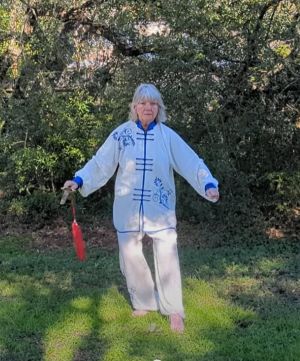
Incorrect: sword is not in front of the body.
In swinging my sword wide, I open myself to attack.

With the tip of the sword on the line from my center to that of the opponent in front of me, I am doing two things at once: I am defending myself and I am aiming my sword at my target. In the second picture, I am doing neither.

I should probably repeat my usual disclaimer: I am not a Tai Chi master! I am a diligent student who has been fortunate to study with more than one excellent Chinese master. I’m just lately doing sword quite a bit after a long-ish spell of not doing sword much at all, so I am thinking a lot about what I have learned, or at least come to think I know, over the years.

Go to Home and scroll down to the Sword section for links to previous posts on sword.
When and Where?

One of my favorite Chinese Tai Chi friends has recently returned to Austin, and I have begun practicing with her again. Wonderful! She speaks no English. No problem! I speak Taijiese.

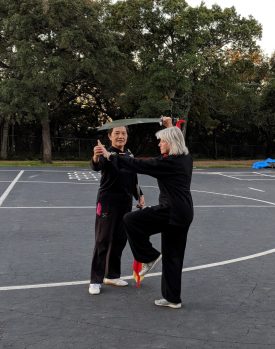
two people practicing tai chi in a park

Taijiese is not conversational Chinese, which I do not know. It is pidgin Chinese, if you will. “Pidgin” is “a simplified form of English for communication between groups that don’t share a common language.”

Except where pidgin is traditionally made up of simple English words, Taijiese is based on Chinese. Key words and minimal grammar, combined with pantomime and lots of nodding and smiling, can get simple ideas across the language barrier.

One of the things my friend and I need to communicate on any given day is when and where we will practice next. For this, it helps to know:

明天  Míngtiān Tomorrow

And the days of the week. There are several ways of naming the days of the week, but the people I know mostly use:

礼拜  Lǐbài   Week

The days of the week are numbered, starting with Monday.

礼拜一              Lǐbài Yī   Monday – literally “week [day] one”

礼拜二              Lǐbài Èr   Tuesday

礼拜三              Lǐbài Sān   Wednesday

礼拜四              Lǐbài sì   Thursday

礼拜五              Lǐbài Wǔ   Friday

礼拜六              Lǐbài Liù Saturday

Sunday is different. Again, there are several expressions for Sunday, but I know:

礼拜天      Lǐbàitiān   Sunday

Next is useful too:

下个  Xiàgè   Next

Next week

下个礼拜    Xiàgè Lǐbài   Next week

下个礼拜一 Xiàgè Lǐbài Yī     Next Monday

We need one more word:

见        Jiàn   See you

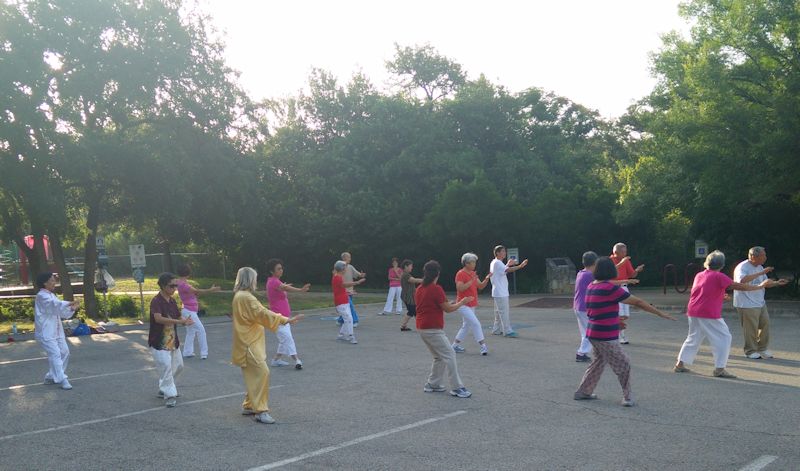
Practicing tai chi with a group in a park

For a number of years, I used to practice with a group every weekend. At the end of practice on Saturday, I would say:

明天见            Míngtiān jiàn   See you tomorrow!

At the end of practice on Sunday, I would say,

下个礼拜六见      Xiàgè Lǐbài Liù Jiàn!   See you next Saturday!

For anything more complicated than that, we might have to open our calendars.

We also need to agree about times. For this we need only the numbers and the word for hour, o’clock.

点    Diǎn  O’clock

八点  Bā diǎn   Eight o’clock

半    Bàn   Half

八点半 Bā diǎn bàn     Eight-thirty 8:30

八点一刻    Bā diǎn yī kè   Quarter past 8 (literally eight o’clock one quarter) 8:15

To say we’ll meet “here,” I just point at the ground. We both nod. That works. But there is a school where we sometimes practice:

学校  Xuéxiào    School

公园  Gōngyuán    Park

For coming to practice, we use:

来    Lái   Come

你来  Nǐ lái?  Are you coming?

This last is probably not very elegant sounding in Chinese—you come? Like Tarzan. But it works.

你来明天    Nǐ lái míngtiān?  Are you coming tomorrow?

Rising inflection and raised eyebrows make it a question.

We answer such questions with head shakes or “Yeah!”

This is helpful:

能    Néng    Indicates can

不能  Bùnéng     can’t (literally no can)

So the other day, as my friend and I were winding up after an hour, we agreed:

回家  Huí jiā    Return home (go home)

That’s enough to indicate that we are done for the day. I wasn’t going to be able to meet her the next day, so I said,

明天我不能来      Míngtiān wǒ bùnéng lái   I can’t come tomorrow

She said okay.

I then said, in an interrogative voice,

你能来礼拜四              Nǐ néng lái lǐbài sì?   Can you come Thursday?

She said, “Yeah!”

I said,

九点半      Jiǔ diǎn bàn?   Nine-thirty?

Yeah!

When I left, I said,

礼拜四见        Lǐbài sì jiàn!    See you Thursday!

New Books!

A couple of new books have just come out–one by me and the other by a good friend. From Tao to Complexity, by Laurent Carrer, is about “The Merging of Ancient Practices and Scientific Discovery.”

Laurent Carrer is a writer, translator, and long-time student of Tai Chi and Qigong. He is also widely read in both modern science and Chinese philosophy. In this new book, he explores parallels and surprising points of agreement between the most advanced aspects of traditional Eastern and modern Western thought.

The subject matter of his book is so wide-ranging and deep that I thought it might be hard to get through it, but the author’s clear and engaging style makes reading a pleasure. Complex scientific concepts are clearly explained, and the parallels and connections with the ancient wisdom of Taoism are both surprising and satisfying. We are led seamlessly from relativity theory to the benefits of tai chi, and from there to the nature of cats, all in a light-hearted and inspiring narrative. You can dip in anywhere and become engrossed. I highly recommend this book as both a serious volume and a light-hearted diversion.

The other new book is another murder mystery by me. Death at Falconfields is the first of three (so far) traditional detective novels in a series called Murder on the Gulf Coast. In this first volume, storms and flooding in the small town of Hanbury unearth the body of a young Black man shot and buried on the margins of an old plantation.

Local cops conclude that the murdered man was passing through and got into an “altercation” with some unknown person. They’d like to close the book, but the local Black community is fed up with crimes against their own being brushed aside as unimportant. The sheriff agrees, reluctantly and under pressure, to accept Gil Tillier as an outside investigator, and what looks like an isolated incident turns out to have deep roots in the history of the rich southern Alabama farmland.

In the series, Gil Tillier, the reluctant homicide detective in Accidents of Life, has retired. He’s too young for that of course, only in his thirties, but he’s inherited just enough money to scrape by in the tiny town of Mars, Alabama, population 832, far away from the mayhem of his meteoric law enforcement career.

Tillier wants nothing more to do with murder, but thanks to his former chief—and his own reputation—local cops, victims’ families, and those accused of murder drag him into unsolved crimes and injustices in small towns along the Gulf Coast, from Louisiana to the Florida Panhandle.

I’ve written the second and third volume, and I’ll be releasing them in 2026. Stay tuned!

Grandmaster Aiping Cheng

A new website, aipingcheng.com, documents the lifetime achievements of a great Tai Chi Grandmaster. It’s a wonderful resource with videos and photographs spanning decades of elite wushu and tai chi.

Master Aiping learned from an early age from some of the most illustrious masters of the twentieth century, including Fu Zhongwen, Sun Jianyun, and Li Tianji. She went on to become a many-time tournament champion and a charter and long-term member to the Chinese national team.

In the latter third of her career, she has been a beloved and influential teacher to many, many American students. I can attest that Master Aiping is a wonderful teacher—she spent the last two years of her teaching career here in Austin, amazingly just a couple of miles from my house. Here she is, teaching in slow motion one night in class at The Asian American Cultural Center.

Many professional athletes suffer long-term physical damage from their sports–football players come to mind, and ballet dancers. A lifetime of tai chi will have you moving like this in your golden years!

Master Aiping is semi-retired now, but the website brings her long and illustrious career to life. Take a look! aipingcheng.com

New Format

TaiChiNotebook is almost ten years old! I posted the first blog entry—on 32-sword—in July 2014. I was at the beginning of my journey, studying traditional Yang and Chen style Tai Chi at a local school. I was just discovering the modern forms, starting with 24 and 32-sword, and I had begun practicing with Chinese people in my neighborhood.

Over the years I have published more than two hundred posts on more than two dozen forms, spanning four of the five major styles of tai chi. The Notebook has become an iceberg! With nine-tenths of its content buried in the archives of the blog.

Saturday morning in the park. I am in yellow. My good friend and Tai Chi mentor Long Feng is in white at the far left.

I’ll continue the blog, but I have switched to the format of a website, with a static home page (still a bit sketchy!) and I am trying to build a more perspicuous structure.

Also, in 2014, smartphones were not yet ubiquitous, and TaiChiNotebook was designed primarily to be accessed from a PC or laptop. I’ll try to improve the way the Notebook renders on mobile.

These revisions will take a while… Stay tuned!

New Tai Chi Books

This year, I have acquired a couple of books that I can recommend. One is an instructional manual by Chen Zhenglei for Laojia Yilu and Erlu. I’ve been using it as a review of Laojia Yilu, in connection with a video project comparing the Yang and Chen traditional long forms.

Chen’s Tai Chi Old Frame One & Two

In this book, every movement of the form is described in careful detail, with multiple photographic demonstrations by the author (a grandmaster of such eminence that I don’t need to cite his credentials). You certainly could not learn this rather difficult routine by studying Chen’s book. But if you already know Laojia, it is an invaluable resource for refining and correcting your form. I am working it to tatters.

Another book that has recently come to my attention is Martin Mellish’s A Tai Chi Imagery Workbook: Spirit, Intent, and Motion. This beautifully illustrated volume uses sketches, photographs, and diagrams to evoke, explain, and describe the internal experience of Tai Chi.

A Tai Chi Imagery Workbook

This book is not a manual for learning specific forms or styles. Rather, it is a guide to fundamentals such as posture, stepping, balance, and breathing. It would be equally useful to beginners, more advanced students, and (especially!) instructors. It is an attractive and readable book, too.

General Qi’s House

General Qi Jiquang was one of the most famous and successful military leaders in China’s long history. He came from a military family and assumed a hereditary post in Penglai, Shandong Province, at the age of 17.

The temple overlooking the sea at Penglai

Despite his youth, Qi quickly distinguished himself as an exceptional strategist and leader. Qi is best known for eradicating the threat of Japanese Pirates along the coast, but he was also famous for defending Beijing from Mongol invaders and directing the fortification of the Great Wall.

The Great Wall

In 2018, I traveled to China with a group led by Master Jesse Tsao. In Penglai, we visited General’s Qi’s residence.

General Qi Jiguang’s House and Garden
The garden at General Qi’s house
Statues of children playing in front of the house
The general’s horse is saddled and ready to go.

Read more on General Qi’s life and accomplishments here: https://en.wikipedia.org/wiki/Qi_Jiguang. General Qi is also famous for his manuals of military strategy. Read about the Jixiao xinshu here: https://taichinotebook.com/2018/06/17/the-ji-xiao-xin-shu-of-qi-jiguang/.

Wuhan Tai Chi

I have traveled to China twice with groups led by Jesse Tsao. Both trips were wonderful. In 2017, we spent the last weekend in Wuhan. I’m not sure I’d ever even heard of the city before that trip—I certainly didn’t know anything about it. I have only the best memories of it now.

We visited the marvelous Yellow Crane Tower, which is set on a hilltop and surrounded by a beautiful public park.

We visited a huge lake, also set in a beautiful park—the Chinese do not skimp on parks!

If you look at a map, Wuhan is riddled with lakes. I don’t know which this was.
From the far end of the park, the lake looks as big as an inland sea.

But the best thing was Tai Chi in the middle of the city. On Saturday morning we walked to a nearby mid-town park which was, like all the city parks we saw in China, full of people dancing, walking, working out, playing games and—what we were looking for—doing tai chi.

We had no plan, no appointment, nothing set up in advance. We just went to the park. And there we found the lovely Master Tan, dean of martial arts for this whole city of 11 million!

Master Tan in coral on the right; I am to her left in black.

She led us through 24, the 108, Laojia, and a couple of qigong routines I wasn’t familiar with. It was thrilling. We agreed to meet again the next morning.

We thought about these lovely people this year. Jesse inquired: all were well. I like to think their tai chi protected them.

Sunday morning, in addition to everything we did on Saturday, she demonstrated Wudang Tai Chi sword for us. The whole encounter was unforgettable.

On our last night in China, several of us went walking in a long, wide pedestrian mall not far from our hotel. There is no crime in Wuhan; we were assured we would be perfectly safe, and it certainly felt that way. Safe and relaxed. Throngs of people strolled and shopped into the evening hours, and we joined them, feeling what it might be like to live in China, in Wuhan. I loved it.

32-Step Taijijian

Thirty-two-step Sword, also called the simplified sword form, is a short routine for Tai Chi straight sword that was developed in the 1950s, around the same time as the 24-step simplified taijiquan. Li Tianji was the master who created this form.

Purely Yang in style, 32 is a shortened and somewhat rearranged version of the longer traditional Yang Sword form. All of the movements in 32-sword are drawn from Yang Sword, though some of them are executed somewhat differently.

deyin32

I first learned 32-sword from my friend Long Feng, then relearned it with Hu Pei Yi, an excellent instructor from Jiangyin. I was learning yet again from Frank Lee when the pandemic intervened. Over the winter (of 2020), I studied an excellent tutorial by Li Deyin.

The tutorial is an hour and forty minutes long and it’s in Chinese, though as I have pointed out before, his demonstrations are so clear that you can understand a lot without words. Also, with a modest vocabulary for sword and the list of names, you can follow more of what he says than you might have thought. I especially like Professor Li’s back-view demonstration at 1:28.

Though simple enough to be learned easily the first time, 32 is both subtle enough and robust enough to reward frequent practice and ongoing study. It employs most of the major sword fighting techniques found in Yang sword, yet it takes only three to four minutes to perform.

wu32

Two good demonstration videos to study:

Chen Sitan: https://www.youtube.com/watch?v=TJ-sUFf2K9U

Wu Amin: https://www.youtube.com/watch?v=nrGZXgTP-ZA&t=77s

There are two lists of names, which I have combined. The modern names specify the footwork (or stance) and the sword technique employed. The traditional names indicate the movements in Yang Sword from which the 32-steps have been derived. 起势,Qǐshì (Beginning) and 收势,Shōu shì (Close form) are not included in the 32 steps. Here is my combined list: 32-sword-list (PDF)

Kung Fu Fan

Kung Fu Fan is one of two fan forms created by Li Deyin in the early two thousands. Both are popular and widely practiced, at least in China and among Chinese people living here, and both are usually performed to a piece of music also called Kung Fu Fan.

Here is Master Faye Yip performing Kung Fu Fan. She is Li Deyin’s daughter, and I think of her as the gold standard for both of his fan forms.

Fan Form

In an earlier video, Master Faye performs Kung Fu Fan with a group of students at a workshop in Madrid.

Kung Fu Fan has 52 movements, divided into six sections corresponding to six sections in the music. The first and last sections are slow and Tai Chi-like. The second section is faster, the third faster still. The fourth section repeats the second section exactly, and the fifth section starts out fast and emphatic, reaches high point, then stops and slows dramatically.

Most of the movements in Kung Fu Fan are based on traditional tai chi forms, especially sword forms, with the fan substituting for the sword. In the list I’ve got, the names of the movements are followed by the name of the traditional movement in parenthesis. Here’s the list: (PDF) kungfu fan

I’ve found a two-part, two-hour instructional video by Li himself. It’s in Chinese but as usual, he presents it so clearly, with such ample demonstration, that you can learn without understanding what he’s saying (though I wish I could!). The captions that appear on the screen match the list in the PDF above.

Instructional videos:

Just for fun, and not to be missed, check out a couple of WOW renditions of the same form in tournament play:

  1. https://www.youtube.com/watch?v=U3XRUF48z2c
  2. https://www.youtube.com/watch?v=J7cz03oIFGc&t=3s

Kung Fu Fan is an entertaining piece to watch, fun to perform, not to mention good exercise in practice.  It works very well as an ensemble piece for as many people as you can fit on the stage. It’s not that hard to learn, at least well enough to perform in the back row, so a lot of people get to be in on the act.

My weekend practice group has performed with as many as seven people, in settings as diverse as Chinese New Year parties, community centers, and nursing homes. Above, Long Feng, Hu Peiyi and I (L-R front row) perform Kung Fu Fan  for a senior lunch at the Gus Garcia Community Center in Austin in 2018.