49-Step Wudang Sword (6)

Look at this! One of the people in my weekend practice group has written out the 49 steps of this form for me in beautiful calligraphy. Don’t tell me: Now I have to learn to read Chinese characters.
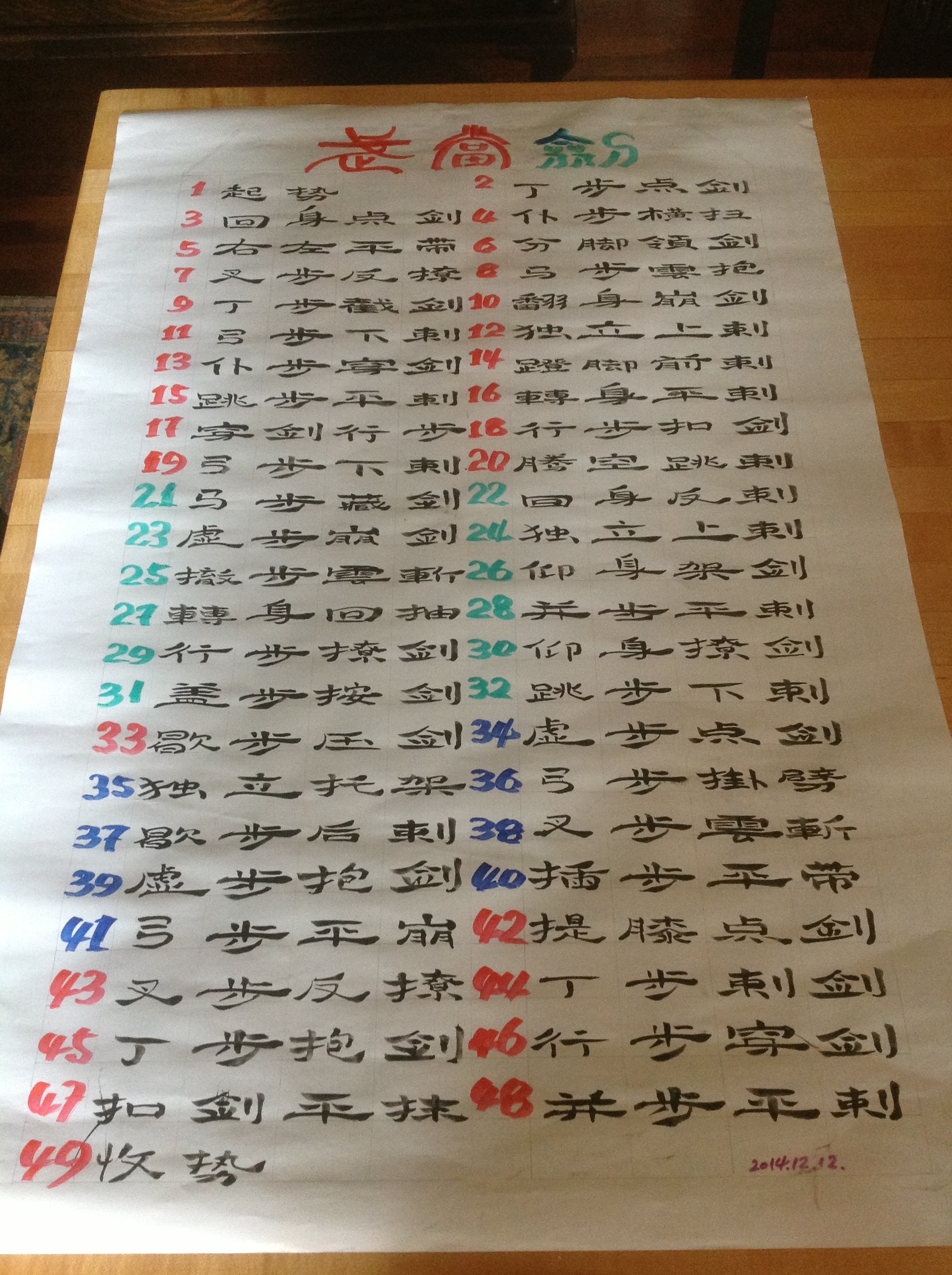
The 49 steps in Standardized Wudang Sword form

The 49 steps in Wudang Sword

Step 1 is Qi Shi and Step 49 is Shou Shi. Beyond that I can see Du Li in three places–why not more? He also gave me a list of the steps in 32-sword, so that helps in decoding. There are many thousands of Chinese characters, so this is no mean riddle.

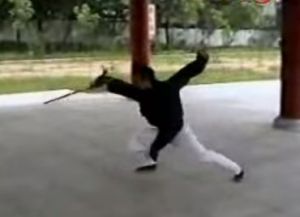
I’ve also found another video of 49-step Wudang. It looks like the same place, the same person (but with a different name?) and a different (somewhat less annoying) sound track: Wudang Sword by Master Leng Xian Feng.

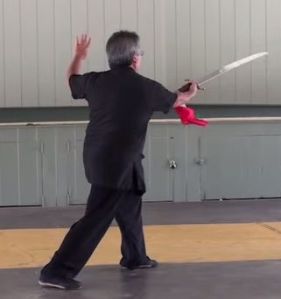
We left off at the second sit, with the sword pointing to the left, arms closed, right foot crossed behind the left. Step back out to the right, slashing out to the right and circling the blade around in front of the face. Cross step in back with the left, pointing the sword to the right, left arm over the head. Poor quality screen grab nevertheless shows the position at the three-minute mark:

photo (14)

Footwork on the next move is step out to the left with the left, step to right cat stance, step out to the right, and step across behind with the left. Some shifting of weight happens with the slashing of the sword, as follows: slash to the left, circle in front of the face, and hold palm up with both hands in front at the cat stance. Then slash right, left, right. Finish in position as above, but sword low, left hand high.

Shift onto the left foot and lift the right knee and the hilt of the sword, step right and cut, palm up, to the right, left arm down. Pivot to the left on the left foot, chop overhead and down, right knee up. Step forward with the right (but you’re traveling to stage left) and wheel the sword back, left hand high.

Step left, sweeping to front with the sword, close with the right foot and point the sword. Step left again, sweeping the sword to the left, and close with the right, both hands on the sword.

Run in a circle, starting with the right foot, six steps and then back with the right, to left cat stance. The arms circle once during the six steps, then the sword circles, then the arms open when you step back, same position as if you were about to finish 32-sword.

To close the form (!!!) step forward left, close with the right (as in the Compass), then catch the hilt in the left hand, palm up, hand pointing back at you. Step forward left, right, then left to shoulder width. While taking these steps, circle the sword back to resting position and circle the right hand up. Straighten up and lower the right hand, as if ending the 32-sword. We’re done.
photo (12)

49-Step Wudang Sword (5)

From the sit at 2:30 (Liang Video), rise on the right leg, step left and cast overhead to right cat stance, circle sword counterclockwise and step back with the right to a low cross stance. Then stand on the right leg, sword pointed down. This sequence is also in 32-sword: Lifting the Curtain and Wheeling the Sword Left to what in Yang sword we call Minor Literary Star.

What I am calling Cut Nose Off Face

What I am calling Cut Nose Off Face

Here, it gets complicated: The sword circles clockwise, leading with the point, then figure-eights to the right, then stabs under the right arm. He spins right out of this somewhat awkward position and wheels the sword back on the right, arm up.

Finally, he leaps (left, right) to right cross in back, facing away, casting the sword overhead to the left. The sword follows through, circles up, as he spins to the right, on the left foot. He finishes by stepping out to right bow, left hand up, sword stabbing.

Step back with the right and sit. Step back out to right bow with a left-to-right slash, rock back and circle the sword in front (cutting off nose!), slash right and step across in back with the left foot.

Wheeling the Sword (Right)

Wheeling the Sword (Right)

Finishes at 3:00 facing front, right foot crossed behind the left, sword pointing back to the right, left hand over the head. Whew. This section is difficult, but there’s only half a minute left.

49-Step Wudang Sword (4)

The more I learn about the sword forms (and I have barely scratched the surface) the more I begin to recognize moves that recur, often styled differently, but nevertheless, familiar.

I’m glad I learned 32-sword first. It’s the simplest sword form (meaning the shortest), but it contains elements that are like stepping stones. Going into the third minute of the 49-step Wudang sword form, I recognize the part of 32-sword that includes the Compass.

The Compass

The Compass: sword held out with both hands

Starting from the right bow stance following the jump and squat, at 2:00 (times refer to Liang video), shift back to left, rocking onto right heel, sword point up. Then step around and back with the right, turning 180 degrees and slashing the sword around to the right. Lift into:

  • Holding the Moon
  • Circle sword and step back to right cat stance
  • Circle sword across the face and catch
  • Stab forward with two hands
  • Shift back and turn: Su Chin Carries the Sword
  • Shoot the Flying Goose
  • The Compass

The Compass comes at 2:15. That circling of the sword in front of the face is like a move we learned in Chen sword. You throw the head back. We could call this one Cut Off Nose to Spite Face. Blocking a stab to the face?

In 32-sword, the Compass is followed by left and right bow stance with sword sweeping (as in Swallow Beats the Water). This form is similar but more complicated. First, draw the sword back. Then sweep right and left, but on each side you run three steps: right, left, right, left to right cat; right, left, right, left, right to left cat.

My favorite move follows: step left and lift the right knee while flicking the foot and sword up (see below). Land on the right and step around left right, pivoting on the right to make a full circle. Then run: right left skip to right bow stance and stab just before 2:30.

flick

The sword circles four times: tight following the flick, around on the turn, tight to change direction, and then in a large circle to wind up for the stab. Withdraw the sword and sit in cross stance facing front, with the sword pointing to the front.

49-Step Wudang Sword (3)

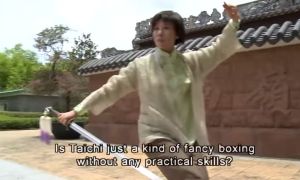
I’m liking these Kung Fu Quest videos! Here’s another one, also 45 minutes long, YouTube, with English subtitles. This one is about Tai Chi.

kungfuquest

The emphasis is again on fighting, and the Tai Chi is mostly traditional. However, our two pilgrims do go to Beijing and touch on standardized Tai Chi, and the promotion of Tai Chi in the last century as a form of healthy exercise for most people, and especially for older people.

In the Wudang sword form, I have gotten to the 1:30 mark. In the next section, we walk in a circle and jump to a squat. Long Feng has led me through this section more than once; it’s time to learn the sequence.

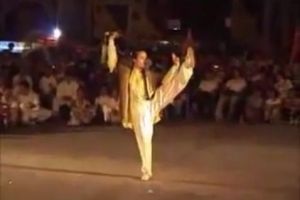
Master Faye Li Yip 49-step Wudang

Another video of 49-step Wudang sword

We left off in Zuo Gong Bu — left bow stance — stabbing palm up and level, away from the direction we faced at the beginning. Left hand is up.

Rock back on the left heel, withdrawing the sword. Step across to the left with the right foot; the sword snakes across the body and turns right so you are following its point.

Walk in a complete circle to the right, counting the first step with the left, up to twelve steps. On eleven, turn to the left and step to right bow stance (twelve), stabbing down with both hands.

The movement of the sword is tricky. It leads, hilt high and point low, left hand high, for four steps. On step five, the left hand comes up to the hilt. Then both arms circle around: up, out, back, in (that’s 6, 7, 8, 9), crossing hands at nine.

On step ten open up again, sword circles like Swallow Beats the Water on eleven, and then stab on step twelve. This whole sequence, the 12 steps, starts out slow and accelerates right up to the Yo Gong Bu. That stab is with both hands, downward. All this takes only15 seconds!

We are up to the jump. Shift back, swing to the left, sit back on the right leg in left cat stance, arms open, palms down. Settle. Step left and jump to the right foot, making a 360-degree turn in the air. Set the left foot down and squat, sword pointing left.

It’s not a hard jump. Long Feng does it easily and gracefully, and it’s not too hard for me, either, except that Master Liang, I notice, lands on both feet in a squat. Landing in a squat is not so easy.

He then rocks back to the right, pivots to the left on the left foot, steps right and back with the left into right bow stance facing back the way he came. The man is beset from all sides! Very dramatic! I like it. The sword pulls back when he rocks back, the swoops and stabs down on the You Gong Bu. Left arm is up.

We are almost at the two-minute mark. That jump is right about the halfway point in the form. Next, we’ll get to the Compass, run around, and do my favorite part, a cute little flip of the sword and foot that captures the spirit of this form for me.

49-Step Wudang Sword (2)

This long (nearly 45 minutes, with English subtitles) YouTube video about the Wudang Kung Fu Academy is fascinating. I have never seen anything like the Tai Yi Wu Xing form of Tai Chi. The Wudang Mountains are beautiful (as are the temples and the Academy).

Kung Fu Quest - Wudang (video)

Kung Fu Quest – Wudang (YouTube video)

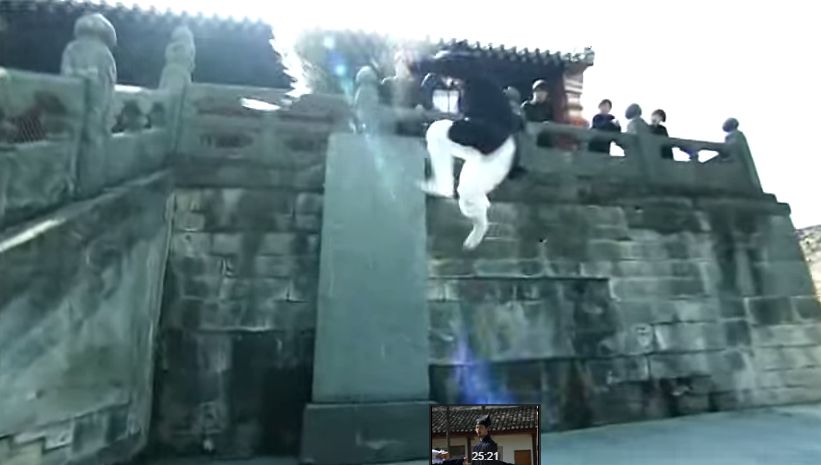
The training is fiercely difficult, and you can’t help worrying about the children who are sent there. It’s definitely all about fighting, which is not my goal in learning Tai Chi. But the sword play and light body skills (at about the 26-minute mark) are amazing.

“Light Body Skills” Master Chen Shiliu

As for the 49-step Wudang Sword that I’m trying to learn, picking up from Ma Bu, with the sword pointing to the right, the next section is as follows:

  • Step up with the left, turn sword to left
  • Step around with left (turning to the right), sword pointing right
  • Step forward right and stab downward (palm down, left hand on hilt)
  • Step left and right, sweeping sword
  • Stand on one leg, sword pointing up, palm up (Holding the Moon)
  • Step back left, turn to left and squat to lower sword (palm down)
  • Step up to right cat stance, holding sword palm up

From here, lift the right knee, extend the leg, and perform a run like that in 32-sword, consisting of Lion Shakes his Head, Tiger Holds its Head and Horse Jumps Over the Stream.

Finish by pulling the sword back to the right hip, pivot 270 degrees on the right foot, step to left bow stance and stab, palm down, level (or slightly down). This completes the next half-minute; we are at about 1:30 of 3:40.

49-Step Wudang Sword (1)

The standardized version of Wudang sword starts out much like 32-sword. I haven’t found a good list of names for this form yet, so I am borrowing the names from 32-sword, even though the moves may be slightly different. This is just an aid to learning the rough sequence of the form.

49-step Wudang Sword

Another demo: 49-step Wudang Sword

  1. Commencement (slightly different)
  2. Three rings Around the Moon
  3. [Stand on one leg]
  4. Swallow Beats the Water
  5. Block and Sweep left and right.
  6. [Stand on one leg]
  7. Sweep the Dust into the Wind on right
  8. Wheeling the Sword to the right
  9. Slash left, right, left to horse stance, sword pointing right.

In step 3 above, the sword points downward, as in Yecha Explores the Sea, and back. Step 6 resembles the Big Dipper, except the right leg extends in a heel kick. Step 8 is the one that looks back; in Chen sword we call this Rhinoceros Gazes at the Moon (after the similar Nei Kung posture).

These first nine moves comprise about the first minute of the form (which is about three and a half minutes long, give or take).

Wudang Sword

I’ve had a moratorium on new material since I decided to test for second degree, but now that the test is over, I am eager to learn another sword form. Long Feng has started teaching me Wudang sword.

Traditional Wudang Sword

Master Chen Shixing Traditional Wudang Sword

There are several versions of this form. The one in the video above is traditional; what Long Feng is teaching me is the standardized 49-step version, demonstrated in the video below.

Standardized Wudang Sword 49-step Master Liang

Wudang Sword 49-step Master Liang

I’d like to learn both eventually, if that wouldn’t be too confusing. A third form, Wudang Seven Sword, seems to be a Kung Fu version (below).

Wudang Kungfu Academy China demo

Wudang Kungfu Academy China demo

Chen 38 Breathing (1)

For the second degree test, we are expected to pace the Chen 38 so it takes no less than 12 minutes. The key to meeting this requirement is correct breathing. The untethered mind may race ahead under test conditions, but the heart and lungs will not.

breathing

The movements of this form are complicated; a single movement may have as many as a dozen components. Correct pacing and rhythm depends on correctly placed inhales and exhales.

Nearly every move involves more than one full breath (inhale and exhale) plus at least one settle and/or fajin. Settles are complete exhales with full relaxation and pause. Fajin is an explosive movement with an outburst of air. Fajin usually follows an extended inhale, and may be followed by an extended exhale and settle.

Qishi: Lift knee (in); step left and settle (ex).

Jin Gang Dao Dui: One of the most complex movements in the form, the Buddha Stamp occurs five times, and each one is somewhat different from all others except in the signature stamp itself. The opener is the most complicated, with ten full breaths (in, ex) leading up to fajin (the stamp) and a final exhale and settle.

  1. Lift arms (in); lower arms (ex).
  2. Turn right (in); return (ex).
  3. Right over left (in); sink down (ex).
  4. Lift up (in); settle (ex).
  5. Reach back left (in); block right (ex).
  6. Pull in (in); push (ex).
  7. Turn left (in); kick/step (continue); settle (ex).
  8. Reach back (in); face front (continue in); settle (ex).
  9. Flick, brush (in); hold fist (ex).
  10. Raise fist (in); fajin (pound fist) and settle (ex).

Lan Zha Yi: Five full breaths.

  1. Form an X (in); lower hands and settle (ex).
  2. Lift left knee/step left (in); settle (ex).
  3. Lift wrist (in); shift left (continue in); lift knee (quick in); step right/settle (ex).
  4. Circle hands up and right (in); press to left (ex).
  5. Open arms (in); settle (ex).

Liu Feng Si Bi: Three breaths and settle.

  1. Press R (in); press down (ex).
  2. Block up (in); press down (ex).
  3. Push (in); settle (ex).

Dan Bian: This is the first of five single whips in the form, all identical, with four full breaths.

  1. Left reach (in); right reach (continue in); press across body (ex).
  2. Form beak (in); lift left knee and step (continue in); settle (ex).
  3. Turn to left (in); reach right (ex).
  4. Open arms (in); settle (ex).

Jin Gang Dao Dui (2): Much simpler: just three full breaths.

  1. Block down to left (in); black across to right (ex).
  2. Reach (in); face front (continue in); settle (ex).
  3. Flick, brush (in); hold fist (ex).
  4. Lift fist (in); fajin (pound fist) and settle (ex).

Bai He Liang Chi: Five breaths.

  1. Circle hands to form X (in); settle (ex).
  2. Lift knee/step back (in); settle (ex).
  3. Lift wrist (in); shift back (ex).
  4. Step in (in); step back (ex).
  5. Reach out and up (in); settle (ex).

 Xie Xing: Four breaths.

  1. Turn left (in); turn right (ex).
  2. Qin na (in); push (ex).
  3. Circle arms/lift knee (in); Step (continue in); settle (ex).
  4. Brush knee (in); push with right (continue in); open arms (ex).

Lou Xi Ao Bu: Four breaths.

  1. Circle/press hands (in); hands down to left (ex).
  2. Push up (in); load up (continue in); press forward (ex).
  3. Lift knee (in); step and load (continue in); push (ex).
  4. Circle arm/step up (in); Qin na (ex).

Yan Shou Gong Quan: Two breaths.

  1. Lift knee (in); step left (ex).
  2. Load punch (in); fajin (ex).

Jin Gang Dao Dui (3): Three breaths.

  1. Lift fist (in); touch fists (ex).
  2. Pull fists back (in); sweep right leg (continue in); rest fist (ex).
  3. Raise fist (in); fajin (pound fist) and settle (ex).

Continued: Chen 38 Breathing (2)

Yang Saber

The Chinese saber, or Dao, is a single-edged long knife used for chopping and slashing. It is the weapon of the infantry, the foot soldier. For the Yang saber form, we use a saber with a rigid blade (for Chen saber, we use a flexible blade).

The form we learn at Master Gohring’s school is not the most common version; it’s a little faster, more martial and more dramatic than most other Yang saber forms I find on the Web.

Saber is one of the three forms required for the first degree black sash, so of course it will be part of the second degree test as well. The full playlist of demonstration and instructional videos can be found here:

The list of the movements below is somewhat sketchy. While some of the names seem to be real Chinese names, others are improvised descriptions. Also, the original form has been modified to accommodate space and timing issues.

  • Step Up Seven Stars Left
  • Step Up Seven Stars Right
  • White Crane Spreads Wings
  • Turn Around Hidden Knife
  • White Crane Stands on One Leg
  • Diagonal Push-Knife
  • Lift Knife Left
  • Lift Knife Right
  • Straightforward Push-Knife
  • Fair Lady Works the Shuttle
  • Center Lift
  • Middle Pull
  • Horizontal Push-Knife
  • Straightforward Push-Knife
  • Turn Around Over the Head Hidden Knife
  • Slice Up Left
  • Slice Down Right
  • Straightforward Push-Knife
  • Turn Around Over the Head Hidden Knife
  • Slice Up
  • Slice Down
  • Slice Up
  • Golden Rooster Stands on Left Leg
  • Double Jump Kick Hit the Tiger Form
  • Turn Around White Crane Spreads Wings
  • Heel Kick
  • White Crane Spreads Wings
  • Toe Kick
  • Brush Knee Push
  • Straightforward Push-Knife
  • Turn Around Over the Head Hidden Knife
  • Push Boat with Current (L, R, L)
  • Turn Around Hidden Knife
  • Slice Up
  • Slice Down
  • Slice Up
  • Heel Kick Jump Step
  • Use Strength to Axe Mountain
  • Embrace Knife Stab and Kick
  • Flip Over Change Step
  • Use Strength to Axe Mountain
  • Close Form

I haven’t found any one dominant Yang saber form. Here’s one interesting alternative, not too unlike ours:

The Yang 108

The Yang 108 is the traditional Yang-style empty-hand long form and the major component of our first degree black sash curriculum for Tai Chi at Master Gohring’s Tai Chi and Kung Fu. The form originated with Yang Luchan and was widely promulgated by his grandson, Yang Chengfu, in the first half of the 20th century.

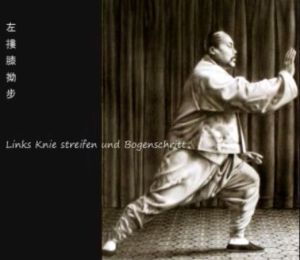
Here’s a cool video–not exactly a video; rather a succession of stills of Yang Cheng Fu performing the 108 moves:

You can see that the names of the movements are provided in Chinese and German. I’d like to study the stills and the Chinese names to see how this compares to the list I have arrived at. And I wonder if I can find a list of the names from Yang Cheng Fu himself? I wonder what the source for this video was?

The Yang family today lists 103 moves in basically the same form; here’s the Yang Family long form, which does not include a shoulder strike after Lift Hands. There are other variants of this form, some of which differ only in how the moves are counted, others making a difference in how the form is actually done. All this makes me appreciate the modern Chinese campaign to standardize.

Quibbling over the most authentic way to count the moves, or what exactly to call them, doesn’t seem very important to the practice of Tai Chi, but I am hung up on it anyway! My list below is based on the names mostly as we learn them at Master Gohring’s (but not exactly) and the Chinese as best I can gather from sources such as this list of the movements, which is close to ours but differs in a few details.

  1. Preparing Form – Yubei Shi
  2. Commencement – Qishi
  3. Ward-off Left – Zuo Peng
  4. Grasp the Bird’s Tail – Lan Que Wei
  5. Single Whip – Dan Bian
  6. Lift Hands – Ti Shou
  7. Strike with Shoulder – You Kao
  8. White Crane Spreads Wings – Bai He Liang Chi
  9. Brush Knee Push – Lou Xi Au Bu
  10. Playing the Lute – Shou Hui Pipa
  11. Left Brush Knee Push – Zuo Lou Xi Au Bu
  12. Right Brush Knee Push – You Lou Xi Au Bu
  13. Left Brush Knee Push – Zuo Lou Xi Au Bu
  14. Playing the Lute – Shou Hui Pipa
  15. Left Brush Knee Push – Zuo Lou Xi Au Bu
  16. Step Forward Block, Parry and Punch – Jin Bu Ban Lan Chui
  17. Withdraw and Push – Ru Feng Si Bi
  18. Cross Hands – Shi Zi Shou
    [Second section:]
  19. Embrace Tiger Return to Mountain – Bao Hu Gui Shan
  20. Grasp the Bird’s Tail – Lan Que Wei
  21. Diagonal Single Whip – Xie Dan Bien
  22. Fist Under Elbow – Zhou Di Chui
  23. Repulse Monkeys – Dao Nian Hou
  24. Repulse Monkeys – Dao Nian Hou
  25. Repulse Monkeys – Dao Nian Hou
  26. Slant Flying – Xie Fei Shi
  27. Lift Hands – Ti Shou
  28. Strike with Shoulder – You Kao
  29. White Crane Spreads Wings – Bai He Liang Chi
  30. Brush Knee Push – Lou Xi Ao Bu
  31. Needle at Sea Bottom – Hai Di Zhen
  32. Fan Through Back – Shan Tong Bei
  33. Turn and Strike with Backfist – Zhuan Shen Pie Shen Chui
  34. Step Forward Block, Parry and Punch – Jin Bu Ban Lan Chui
  35. Grasp the Bird’s Tail – Lan Que Wei
  36. Single Whip – Dan Bian
  37. Cloud Hands – Yun Shou
  38. Single Whip – Dan Bian
  39. High Pat on Horse – Gao Tan Ma
  40. Separate Right Foot – You Fen Jiao
  41. Separate Left Foot – Zuo Fen Jiao
  42. Turn and Strike with Heel Left – Zhuan Shen Zuo Deng Jiao
  43. Brush Knee Push – Lou Xi Au Bu
  44. Brush Knee Push – Lou Xi Au Bu
  45. Step Up and Punch Down – Jin Bu Zai Chui
  46. Turn and Strike with Backfist – Zhuan Shen Pie Shen Chui
  47. Step Forward Block, Parry and Punch – Jin Bu Ban Lan Chui
  48. Strike with Heel Right – You Deng Jiao
  49. Hit the Tiger Left – Zuo Da Hu Shi
  50. Hit the Tiger Right – You Da Hu Shi
  51. Strike with Heel Right – You Deng Jiao
  52. Box the Tiger’s Ears – Shuang Feng Guan Er
  53. Strike with Heel Left – Zuo Deng Jiao
  54. Turn and Strike with Heel Right – Zhuan Shen You Deng Jiao
  55. Step Forward Block, Parry and Punch – Jin Bu Ban Lan Chui
  56. Withdraw and push – Ru Feng Si Bi
  57. Cross Hands – Shi Zi Shou
    [Third secton:]
  58. Embrace Tiger Return to Mountain – Bao Hu Gui Shan
  59. Grasp the Bird’s Tail – Lan Que Wei
  60. Diagonal Single Whip – Xie Dan Bian
  61. Part the Wild Horse-s Mane – Ye Ma Fen Zong
  62. Part the Wild Horse-s Mane – Ye Ma Fen Zong
  63. Part the Wild Horse-s Mane – Ye Ma Fen Zong
  64. Ward-off Left – Zuo Peng
  65. Grasp the Bird’s Tail – Lan Que Wei
  66. Fair Lady Works the Shuttle – Yu Nu Chuan Shuo
  67. Fair Lady Works the Shuttle – Yu Nu Chuan Shuo
  68. Fair Lady Works the Shuttle – Yu Nu Chuan Shuo
  69. Fair Lady Works the Shuttle – Yu Nu Chuan Shuo
  70. Ward off Left – Zuo Peng
  71. Grasp the Bird’s Tail – Lan Que Wei
  72. Single Whip – Dan Bian
  73. Cloud Hands – Yun Shou
  74. Single Whip – Dan Bian
  75. Snake Creeps Down – Xia Shi
  76. Golden Rooster Stands on One Leg – Jin Ji Du Li
  77. Golden Rooster Stands on One Leg – Jin Ji Du Li
  78. Repulse Monkeys – Dao Nian Hou
  79. Repulse Monkeys – Dao Nian Hou
  80. Repulse Monkeys – Dao Nian Hou
  81. Slant Flying – Xie Fei Shi
  82. Lift Hands – Ti Shou
  83. Strike with Shoulder – You Kao
  84. White Crane Spreads Wings – Bai He Liang Chi
  85. Brush Knee Push – Lou Xi Au Bu
  86. Needle at Sea Bottom – Hai Di Zhen
  87. Fan Through Back – Shan Tong Bei
  88. Turn and White Snake Spits Out His Tongue – Zhuan Shen Bai She Tu Xin
  89. Step Forward, Block, Parry, Punch – Jin Bu Ban Lan Chui
  90. Grasp the Bird’s Tail – Lan Que Wei
  91. Single Whip – Dan Bian
  92. Cloud Hands – Yun Shou
  93. Single Whip – Dan Bian
  94. High Pat on Horse – Gao Tan Ma
  95. Pierce Palm – Chuan Zhang
  96. Cross Form Kick – Shi Zi Tui (?)
  97. Step Forward and Punch to Groin – Jin Bu Zhi Dang Chui
  98. Grasp the Bird’s Tail – Lan Que Wei
  99. Single Whip – Dan Bian
  100. Snake Creeps Down – Xia Shi
  101. Step Up Seven Stars – Shang Bu Qi Xing
  102. Step Back and Ride the Tiger – Tui Bu Kua Hu
  103. Turn and Sweep the Lotus – Zhuan Shen Bai Lian
  104. Bend Bow Shoot Tiger – Wan Gong She Hu
  105. Step Forward Block, Parry and Punch – Jin Bu Ban Lan hui
  106. Withdraw and Push – Ru Feng Si Bi
  107. Cross Hands – Shi Zi Shou
  108. Close Form – Shou Shi

Ha! I just typed that from memory! I’ll have to double-check.

I’ll post more (maybe much more) on this form, including links to video sources and applications. I love all the new material I’ve learned since I got my black sash, but this form remains my favorite and (as Master Gohring says) my core discipline.