
Tai chi Sword: Taijijian 太极剑

The Tai Chi solo sword form is the first step in learning to fight with a sword. If you have read my series on the Sword of Li Jinglin, you will be familiar with the process. After acquiring a basic competence in taijiquan (bare-hand Tai Chi), you incorporate the sword in your practice by adding the jianfa—swordfighting techniques.

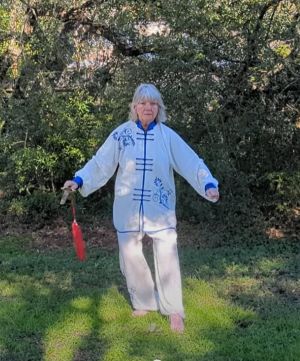
me and sword: cha bu xia ci
Tai Chi 24-sword, Xia ci – Downward stab

The sword form is not a pantomime of a swordfight. It is the practice of one form of swordplay after another. The form is designed so these moves flow from one to the next. So, for example, in 32-sword, I practice the jianfa called 带 Dài, first to the right, then to the left.

Dai is a technique for countering a stab by an opponent directly in front of me. [Dai translates as “carry” but the English word is neither descriptive nor helpful.] To start, I am shifted left, so I first practice Dai to the right. Now my weight is on my right. I again practice what I could do in response to a stab from an opponent directly in front of me: I do Dai to the left.

At a comparable point in the sequence, Traditional Yang sword uses 拦扫 Lán Sǎo (block and sweep) to the right and then to the left. Lan Sao and Dai are two quite different movements, different jianfa altogether, but either one could answer a stab, and the principle is the same: you practice the move first on one side, then on the other.

demonstration of lansao (block and sweep).
Lansao (Block and sweep)

There are some basic assumptions that I make when practicing sword. One, I assume that I am facing a single opponent who is also wielding a sword. That is not to say that you cannot fight multiple attackers (good luck with that!) or that a sword cannot counter a different weapon, like a staff. These are interesting and valid variations on the basic moves. But these are advanced variations. As a default, when practicing a sword form, I assume I am fighting one other swordsman.

Another assumption: My opponent is in front of me. At a number of points in any sword form, I practice what to do in response to an attack from the side, the back, an angle, etc. That is, I practice what to do if my opponent is *not* in front of me. The answer is, in every case, that I first turn, so that he is front of me. Then I answer.

Bow stance, stabbing with a sword
Bow Stance, Level Stab; Bluegreen Dragon Emerges from the Water

For example, consider a move common to both Yang Sword (Qing Long Ch Shui—the Bluegreen Dragon Emerges from the Water) and 32-sword (Gong Bu Ping Ci—Bow Stance, Level Stab). In both forms, from the previous move, I am facing due East, and I am attacked from the left corner (NE). I first turn, then fall back and send out my own sword in front of me to contact my opponent’s weapon. Then I draw his sword to my right and counterattack.

In any case where you are attacked from anywhere but head-on, you never just throw your sword out toward your apponent. You first turn your body. Then answer.

This is corollary to a more basic principle in swordfighting, that my first priority is defense. Don’t let my opponent cut me! Then, if I can cut him, that’s good. But first and foremost, I want to stay alive.

In practice, this means that I keep my sword in front of me at all times. It could be the blade, it could be the tip, it could even be the hilt. But I need to at all times use my sword first to defend myself.

Correct position in preparation for ti xi peng jian
Can you see that the tip of the sword is on the blue line on the front of my uniform?

A good illustration of this principle is Ti Xi Peng Jian (Lift the Knee and Cup the Sword) in 32-sword. A comparable move in Yang sword is Ye Ma Tiao Jian (Wild Horse Jumps over the Stream). These two moves are quite different in the two forms, but the point here applies to both.

Sitting back in preparation to start these moves, you do not open up. Pei Yi taught me this. The tip of the sword should be in front of you, on the centerline of your body. Compare the two pictures (above and below): correct vs. incorrect position.
Incorrect: sword is not in front of the body.
In swinging my sword wide, I open myself to attack.

With the tip of the sword on the line from my center to that of the opponent in front of me, I am doing two things at once: I am defending myself and I am aiming my sword at my target. In the second picture, I am doing neither.

I should probably repeat my usual disclaimer: I am not a Tai Chi master! I am a diligent student who has been fortunate to study with more than one excellent Chinese master. I’m just lately doing sword quite a bit after a long-ish spell of not doing sword much at all, so I am thinking a lot about what I have learned, or at least come to think I know, over the years.

Go to Home and scroll down to the Sword section for links to previous posts on sword.

Chinese Swordsmanship

I have been studying such an interesting book: Chinese Swordsmanship, by Scott Rodell.

swordsmanship

Rodell describes two systems of swordfighting, both attributed to Yang Luchan (1799-1872), the founder of Yang-style Tai Chi and of the Yang sword form. During the early years of his career (mid-nineteenth century) Yang Luchan kept his swordfighting techniques secret. That Yang system, and the sword form that demonstrates it, Rodell calls the Michuan system.

秘传 Mìchuán: “secretly transmitted, esoteric lore”

The Yang sword form most of us are familiar with, which Rodell calls the public form, was a later development.  The Michuan system has eight named swordfighting techniques (剑法 Jiànfǎ).  The public form has thirteen.

This clears up a mystery for me: I had always heard there were thirteen essential swordfighting techniques, yet the Chen masters seem to name only eight and the Wudang masters nine. So apparently, the number of Jiànfǎ  depends on what system you’re talking about; it is the Yang sword system that has thirteen.

There is still plenty of room for confusion (on my part) and further study. In some cases the same technique has different names in different systems; in other cases, the same name attaches to different techniques in different systems. Rodell does include a chapter on other swordfighting systems, though it is not exhaustive by any means.

The Yang techniques are: dian, ci, pi, beng, ya, chou, dai, ti, ge, ji, jiao, jie, and xi. Rodell describes how each is executed, and while I don’t suppose it’s possible to learn the techniques entirely from these descriptions, they are very useful.

What is also helpful is the way he categorizes the different techniques, beyond the obvious distinction between attacking and defensive maneuvers. He describes the Jiànfǎ in terms of long, medium, or short energy, the part of the sword being used, and the part of the body targeted.

Rodell also sorts Jiànfǎ  by cutting method, of which there are four: deflect or neutralize; straight thrust to pierce; what he calls a “percussion cut” (a chop with the edge of the blade without a lateral draw); and slicing cuts that draw or push the edge lateral to the cut. Hitting with the flat of the blade is in a  miscellaneous category of additional “minor movements” not really part of the system.

The book includes step-by-step illustrations and descriptions of the both the Michuan and public sword forms. It is particularly illuminating is that he provides the applications for each movement. In many, if not most cases, a single named movement involves multiple techniques.

I particularly like the way Rodell relates the sword forms to the use of the sword in actual battle, and the historical material makes very good reading. He even briefly comments on the comparison between Chinese and European swordsmanship. Between the definitions of the techniques, the applications, and the illustrations of how to do the form, history, philosophy, metallurgy, and accounts of Rodell’s own extensive training experience, this is quite a dense book, more a reference or text than a cover-to-cover read. Excellent book, a great find —highly recommended!

Yang Sword Names

I’ve compiled a list of names for the traditional Yang-style sword form, sticking pretty close to the version that I’m learning. I made reference to several lists that I found online, and chose what seemed to me the best English translations (sometimes using my own).

A few comments on the names:

Kui_Xing_bronze_statue_(late_Ming_Dynasty)It might seem odd that the movement called the Big Dipper is also called the Major Literary Star, but in Chinese, they are the same name: Kuíxīng [phonetically, kway-shing].  In English, Orion is both the mythical hunter and the constellation; in Chinese, Kuixing is like that.

[Photo of bronze Kuixing by Pratyeka – Own work, CC BY-SA 4.0, https://commons.wikimedia.org/w/index.php?curid=45370878]

Kuixing was a great scholar (hence, literary star) who was so repulsively ugly that the emperor wouldn’t give him the honors he deserved. He was so dejected that he threw himself into the ocean. A sea dragon rescued him and took him to live in the heavens. Visit the excellent Cloud Hands blog for an entertaining description of Kuixing, Yèchā the evil or malevolent spirit, and other mythical figures.

大Dà  is big or great; Da Kuixing is the Big Dipper (Major Literary Star). 小Xiǎo is small;  Xiao Kuixing is the Little Dipper (Minor Literary Star).

A couple of minor notes on translation: Língmāo, which is sometimes translated as alert cat, is an arboreal cat called a civet. Shǔ can be either a mouse or a rat. So Lingmau shu is sometimes translated as Civet Catches Rat in English.

Also, the list makes reference to both 大鹏 Dà Péng and 凤凰 Fèng Huáng. The former refers to a giant legendary bird, while the latter usually refers to the Phoenix. Sometimes one or the other is translated as Roc. I’ve translated both as Phoenix.

Often the poetic names of the sword movements turn out to be idiomatic or figurative expressions in Chinese. Qīng tíng diǎn shuǐ (Dragonfly Touches Water), for example, is an idiom for superficial contact.

Xuán yá lè mǎ (often just lè mǎ, Stop the Horse) has the sense of reining in a horse at the edge of the precipice; it is an idiom for acting in the nick of time.  I particularly like this one, because the move is an about-face, which suggests turning to face an opponent just in time to defend oneself.

Shùn shuǐ tuī zhōu (Push boat with Current) is an expression for taking advantage of a situation for one’s own benefit. Sort of like catching and riding a wave.

Liú Xīng gǎn yuè (Shooting star catches the moon), literally a meteor catching up with the moon, is an idiom for swift, decisive action.

Tiān mǎ xíng kōng (Heavenly Steed Crosses the Sky) is an idiom for bold, imaginative action. In writing and calligraphy, this expression describes an unconstrained, expressive style. Some words for sword techniques, most notably dian, ti, and hua, are also names of pen or brush strokes in calligraphy and painting.

My favorite name is Hǎi dǐ lāo yuè (Scoop the Moon from the Bottom of the Sea).  The image is that of trying to get hold of the moon by grasping at its reflection in water—an idiom for the hopeless pursuit of an illusion. What we might call a wild goose chase.

Incidentally (on the subject of names that are idioms in Chinese), 海底针 Hǎi dǐ zhēn, Needle at Sea Bottom (which is not in this form but in many others) is like our expression, needle in a haystack, for trying to find a tiny thing lost in a huge mass.

Yang Sword Videos

I am returning to Yang sword after first learning (most of) it about four years ago. Since then, I have learned several modern sword forms, which makes for some interesting comparisons. More on that in the future.

There are many variations on this traditional form; I haven’t found a video yet (outside of those made at Master Gohring’s school) that is exactly like what we do. None of the many versions are exactly like each other, either. Here is a very old video of Cheng Man Ching:


I notice that many, if not most, versions move a little more quickly than we do, with distinct jabs and stabs. An exception is this excellent Yang-style Tai Chi Sword with Chinese  names of movements on the screen:

I also particularly like the video by Peter Tam Hoy doing a version that is pretty close to ours, first on the list below. The clip by Jesse Tsao is part of a longer instructional video available on his website, taichihealthways.com.

Videos of Yang-style Tai Chi Sword:

In Chinese the form is called Yáng-shì tàijíjiàn (Yang-style Tai Chi sword). 杨 is the character for the surname Yang. It may be followed by either this character: 式 (which means style) or this one: 氏 (which means clan or family). The Pinyin (shì) is the same.