More Wu-style Tai Chi

In my last post, on the Wu 45, I didn’t include the list of movements. Here it is.

吴式太极拳45式竞赛套路 (Wu-style Tai Chi 45-step competition routine) [PDF]

The Wu 45 is the competition form, so it’s pretty demanding. For beginners, a very short routine—just 13 movements, no kicks, no low form—makes for an easy introduction to some of the most important movements. When I practice this one, I add Cloud Hands after Fair Lady Works the Shuttle, before Single Whip.

  1. Qishi (beginning)
  2. Lanquewei (grasp the bird’s tail)
  3. You zuo lou xi au bu (R/L brush knee push)
  4. Jin bu ban lan chui (step forward, block, parry, punch)
  5. You zuo ye ma fen zong (R/L part the wild horse’s mane)
  6. You zuo dao juan gong (R/L go back whirling arms)
  7. Hai di zhen (needle at sea bottom)
  8. Shan tong bei (flash the back)
  9. Zhuan shen pie shen chui (turn around strike with back fist)
  10. Jin bu zai chui (step up and punch down)
  11. You zuo yunuchuan suo (R/L fair lady works the shuttle)
  12. Danbien (single whip)
  13. Shou shi (close form)
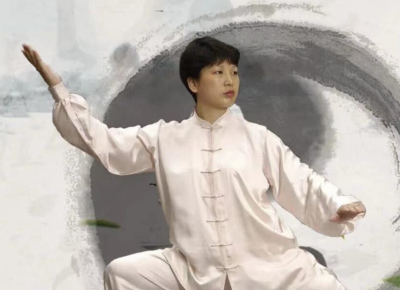
Amin Wu demonstrates the Wu-13

Master Wu also teaches Wu 24, which is very much like Wu 13 but adds opposites sides of needle at sea bottom and flash the back, plus both directions of cloud hands. She offers instructional videos on this form as well.
Wu-Style Tai Chi (3)

The modern competition form in Wu-style is the Wu 45. Like other competition routines, it incorporates the opening of the traditional form, plus many of the most important moves of the old form, but it is more left/right balanced and contains no repetition. Also like other competition routines, the Wu 45 is about six minutes long.

宗維洁 Zōng Wéi jié (1969- Beijing) is a six-time national champion in Wu-style Tai Chi competition.

Here is a list of the 45 movements (PDF).

Alas! The excellent China Wushu YouTube station no longer exists! In fall and winter of 2022-2023, I used the teaching series by Zong Wei Jie to learn the Wu 45. I have hunted down most of the videos on other YouTube stations, but I cannot find the introductory piece anywhere. In it, one of Zong’s students gives an amazing performance of the whole routine.

Here is a demo of the whole routine by Zong herself. Video quality is not the best:

Of the introductory videos on the elements of Wu style, I have located only one:

Video 4: Bufa (footwork)

I have found links to all the segments teaching the routine:

Amin Wu (吳阿敏 Wú Ā Mǐn) (About Master Wu) is another great Wu-style Tai Chi Master. Like Zong, she studied under Master Li Bingci (李秉慈 Lǐ Bǐng cí). She offers a video teaching series on Wu 45, available on Vimeo for only $20. I have used many teaching videos by Master Wu over the years (Yang, Sun, and Wu!)—they are all excellent.

Master Amin Wu teaching Wu-style 45-step Tai Chi

And here is a demonstration of the whole routine by Master Amin Wu:

Traditional Wu-style Long Form

[See my previous post introducing Wu-style Tai Chi] Each of the major styles of Tai Chi has a traditional long form, and all of the long forms follow the same deep logic. The Wu-style long form tracks the Yang 108 quite closely, so if you know the 108, the sequence of the Wu is easy to learn.

Outstanding video instruction on this form is available from Master Amin Wu. Here is a video of the whole form, demonstrated by Master Wu.

Her instructional series, very reasonably priced at just $20, consists of eighteen segments of about 12-15 minutes each. Purchase the series on Vimeo.

The instruction is in Chinese, but Master Wu’s demonstrations are so clear and detailed that you don’t need to understand what she’s saying. I have transcribed her list of the movements, totaling 93, to arrive at this list:

吴式传统93式太极拳 (Wu-shi Chuantong 93-shi Taiji – Wu-style Traditional 93-step Tai Chi) (PDF)

One note on the names: the instructional word 措 (cuò) is new to me. It’s used with 掌 (zhǎng) palm in moves 87 and 90. None of the usual definitions makes much sense–“to handle/manage/put in order/arrange/administer/execute/take action on/plan.” What you do is much like 抹 (mǒ), smear. I translated as “apply.” It’s a term of art; you just have to copy what she does. [But see George’s comment below!]

Instructional videos by Jesse Tsao are available in English from Taichihealthways.com.* I have studied these as well. Master Tsao grew up (from the age of six!) practicing Wu-style Tai Chi at the temple in Penglei. He teaches the long form in two hour-long videos priced at $24 each, also a bargain given the quality and detail of the instruction.

*At this writing, Jesse is revamping his website, but you can still get the videos here.

Here’s another demonstration of the full long form, by Master Fayi Chang:

Wu-Style Tai Chi

I started learning Wu-style Tai Chi a few years ago, but it wasn’t until this year that I really started to feel I was getting the hang of it. I love it!

The Wu name comes from 吴全佑 Wú Quán yòu (1834–1902), who trained with Yang Luchan. Wu also studied with Yang Luchan’s oldest son, 杨班侯 Yáng Ban Bān Hóu (1837–1892).

The style is characterized by a leaning posture and unique footwork. The feet are parallel, both pointing straight to front. In bow stance, with the feet in this position, you naturally lean forward so your nose is above your knee.

However, the leaning posture is not maintained throughout. It alternates with an upright posture in sitting stance. This motion, alternating between leaning and upright posture, is captured by the lovely image of a willow tree blowing in the wind—leaning with the wind and rebounding. There are useful introductory remarks about Wu-style on the Ji Hong Tai Chi & Qi Gong Website (Mississauga, Ontario).

Amin Wu studied with Li Bingci, Chief Master of the 4th Generation of Wu-Style Tai Chi. She has a video on YouTube: An Introduction to Wu-Style Tai Chi with Sifu Amin Wu. The opening and closing are long; for the most important general instruction on Wu-style, watch from about 18:00 to 33:00.

吴鉴泉 Wú Jiànquán is the son of Wu Quanyou. Here he demonstrates Wu-style postures: https://www.youtube.com/watch?v=j1YZ0vRDklI&t=32s

Also characteristic of Wu-style is the flat circle with the palm in Lanquewei (Grasp the Bird’s tail). You can see that in this demo of elements of Wu-style, with explanations (in Chinese with subtitles):