
I’ve been on a mission this year to correct my Yang-style long form to make it as authentic as possible. I’m studying Jesse Tsao’s instructional videos (available on taichihealthways.com), Yang family videos, and these two books:
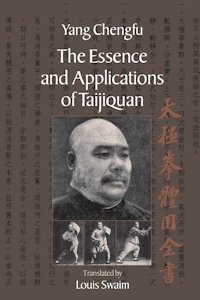
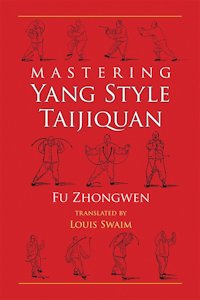
Yang Chengfu was arguably the most influential tai chi master of the 20th century, and it is his long form that defines the Yang style today. Fu Zhongwen studied with Yang Chengfu from an early age and traveled with him throughout Yang’s teaching career, demonstrating for him and representing him in push-hands contests, at which he was famously unbeatable.
Yang Chengfu explains each movement in terms of its martial arts application. Fu Zhongwen, by contrast, describes each movement in great detail, but does not make reference to the purpose of the move. I don’t know that you could learn the form from these books, but they serve very well to check the authenticity of one’s own practice.
The Yang style originated with Chengfu’s grandfather, Yang Luchan, who developed a new style of tai chi after studying for ten years with Master Chen Changxing in Chenjiagou. Yang had three sons and many disciples to preserve his teachings, but there is no concrete record of exactly what his form was like.
The historian Gu Liuxin suggests that Yang Luchan’s boxing initially shared more characteristics of Chen style, such as fajin and bursts of speed. Over time, his form took on more and more of the smooth, continuous, and gentle character that we associate with Yang style today.
Yang Chengfu learned directly from his grandfather, and according to Gu, early in his career his kicks were swift and explosive, his movements generally more physically challenging. It was only in the later years that he modified his entire form to adhere to the principle of slow, steady, and soft movements.
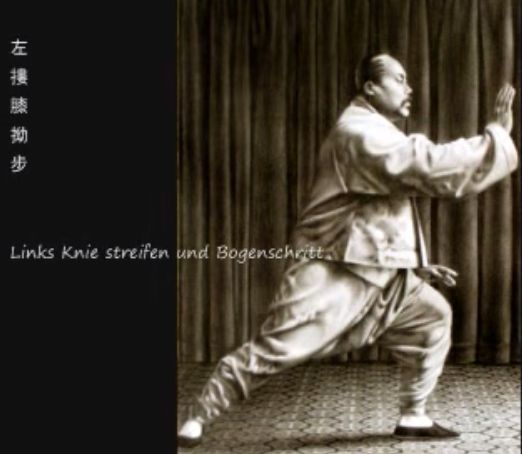
Whatever mystery may surround Yang Luchan’s practice, we can be pretty clear about Yang Chengfu’s fully developed long form. We have photographs of every posture as well as the careful descriptions in the two text books. Variations in detail are few and minor, and in the practice of Yang’s best-known disciples there is very substantial agreement and consistency.
In addition, we have the photographs and descriptions of Li Yulin, dean of studies at the Shandong Provincial Martial Arts School, who prepared teaching materials under the direction of Yang Chengfu himself. The major content of the 1931 book is reproduced in Li Deyin’s book, Taijiquan.
While we can be pretty clear about what the movements were, the naming and counting varies significantly. Some count 81, others 85, 94, 103, 105, and 108. The form doesn’t vary; it’s mostly a matter of whether you count a repeated movement one or three times (cloud hands versus cloud hands 1, cloud hands 2, cloud hands 3). My own list compiles all notable names but no repetition, and comes out to 86. I still usually call the form the 108.
See also:
- Yang Family Videos
- Chuantong 85
- My list (PDF): Yang-styleLongForm
 Qi Jiguang was known as the Tiger General. From his father, who fought for the founding Ming Emperor, Qi held a hereditary position as a military leader, which he assumed at the age of 17. Within a very few years he had distinguished himself in battle against the Mongolians who threatened Beijing from the north.
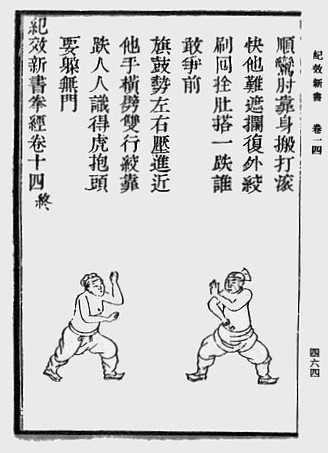 Without access to the text in Chinese (which I haven’t yet found online) I can’t take this much farther, but I’d be willing to bet that many more, if not most, postures in the quanjing can be identified in the old Chen forms.
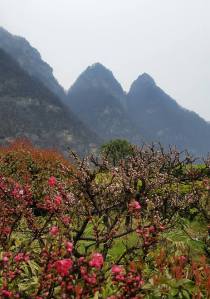 Zhang Sanfeng (张三丰), a Taoist monk, is said to have been inspired when he witnessed a snake fighting a crane in the Wudang mountains (left, Wudang mountains in spring 2017, my photo). Zhang allegedly wrote the Taijiquan Jing. Jīng (经) means classic text or canon. The Jing is the earliest of the documents called the Tai Chi Classics. Here are a couple good online translations:


 According to Li Deyin, Yang Cheng Fu, grandson of Yang Luchan, originally counted 81 movements in the long form we call the 108 (some say 103 or 105). Again according to Li, Yang Cheng Fu later separated some of the moves to arrive at 85 steps. In his book, Taijiquan, Li describes the 85 movements, which were recorded in a text and demonstrated with photographs taken in 1931 at the Shandong Provincial Martial Arts School, under the direction of Yang Cheng Fu and the deputy head of the school, Li Jinglin. The movements are demonstrated by Li Yulin, dean of studies at the school.