Unknown's avatar

About elizabethbuhmann

Author of Mystery Novels--Lay Death at Her Door, Blue Lake, Accidents of Life, and Freewheeling--plus a new detective series, Murder on the Gulf Coast.

Ba Duan Jin 4

Exercise seven is wò quán nù mù zēng lì qi. Nu mu is angry eye! Wo quan is grasp (or maybe clench?) the fist. Zeng is increase (and li, as we’ve already learned is put in order). Qi here is vital energy (as in Qi gong).

bdj-7

Start in horse stance with both fists chambered. The movement is well described by Rashka. Inhale while punching with the left. Open the hand and rotate. Inhale, clench and withdraw. Repeat on the right. Do this four times.

The movement (one English version) is Punching with an angry gaze. Or Clench the Fist and Glare Fiercely.  The benefit is increasing Qi–vital energy. Rashka calls it Punch with Fierce Glower to Build Strength.

Lastly, the eighth movement is bèi hòu qī diān bǎi bìng xiāo, Dian is jolt. Rise onto the toes, then drop down on the heels with a jolt. In the version I do, rise high, then lower about halfway before dropping the heels. Do this eight times. The benefit: Bing is illness; xiao is disappear. Make illnesses disappear.

Ba Duan Jin 3

The fifth exercise is yáo tóu bǎi wěi qù xīn huǒ. Yao here is shake or rock; tou is head; bai is move; wei is tail; qu is go away; xin is heart; huo is fire. Once again, the first part of the name describes the movement, while the second half describes the benefit. Rock the head and move the tail to get rid of “heart fire” — is this about heartburn???

bdj-5

Cloud Hands gives the name of this one as Big Bear Turns from Side to Side. Master Faye Yip, in her video, rocks from one side to the other and rolls the head. Repeat left and right four times.

Number six is liǎng shǒu pān jiǎo gù shèn yāo. Liang is two or both (hands) and pan is climb; jiao is foot or leg. Two hands climb (down) the legs. And the benefit: gu is strong; shen is kidney; this yao is waist. The two yaos have different accents.

bdj-6

Do eight repetitions of this nice gravity stretch. Doing this exercise just twice a week for the last six months has noticeably improved my flexibility. If you lay your hands along your feet, you can get a nice pull through the heels of the hands.

Ba Duan Jin 2

The third exercise is Separate Heaven and Earth in English, a pretty far cry from the Chinese: tiáo lǐ pí wèi dān jǔ shǒu.  Tiao is harmonize or reconcile; li is put in order; pi is spleen; wei is stomach; dan is single or sole; ju is yet another word for lift or hold up. Hold up one hand to harmonize spleen and stomach, in other words.

In this one, one hand is raised, palm up, and the other extends down, palm-down. Then the upper hand is spirals down and the lower hand spirals up along the centerline of the body. At about stomach level, the hands pass, the rising hand palm-up, lowering hand palm-down as in the video by Faye Yip, at about the four-minute mark.

bdj-3

Exercise four has a charming English name: the Wise Owl Gazes Backwards. The Chinese is wǔ láo qī shāng xiàng hòu qiáo, which when I look up each word comes out to something like “five work seven upwards towards behind look.” Rashka translates as “Look backward to eliminate five fatigues and seven illnesses.”

Sink down with both arms lowered, both hands facing back. Then open the arms to the left rotating the hands and arms all the way outward, so palms face up as shown.

bdj-4


Also turn the head all the way to the side. Notice that Master Yip does not turn at the waist. This is a stretch of the neck. Keep the head upright and suspended. Return to starting position. Repeat on the other side. Do both sides four times, alternating.

Ba Duan Jin 1

According to legend, the twelfth century Chinese general and folk-hero Yue Fei, also known as Pengju, created the Eight Brocades and required his soldiers to do the exercises every morning to stay fit for battle.

yuefei

Exercise 1: The short way to say this (from Wiki) is Shuang Shou Tuo Tian–two (both) hands support heaven (tian). Rashka uses Qing (raise) instead of Tuo. Li means put in order. San jiao is the “triple warmer,” a term in Chinese medicine that refers (according to Michael Garofalo) to the heart, lungs and stomach.

baduanjin

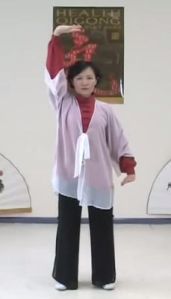
There are quite a few variations of this exercise (and of all the others). I am using the one where you sink down, join the hands palm up in front of the dantien, then lift the hands slowly while straightening up. In front of the face, the hands invert to palm-up, then extend overhead.

Faye Yip follows the hands up with the eye, then looks down before releasing the hands and allowing them to float down. In any case, inhale while the hands rise and exhale as they come down. We’re doing eight of these (the number of reps also varies with different versions).

It’s a matter of choice (and fitness and desired level of exertion) whether to remain standing straight the whole time, or whether to squat, possibly all the way to horse stance with thighs parallel to the ground. I am doing the Yang-y modified squat you see in the two videos, one by Faye Yip the other by Peter Chen:

The Mandarin word for inhale is xiru. Exhale is hu. Breathe is huxi and breath is qixi.

Exercise 2: Kai Gong Si She Diao means open the bow to shoot the eagle/hawk/vulture; diao means bird of prey. This exercise is supposed to benefit the kidney and spleen.

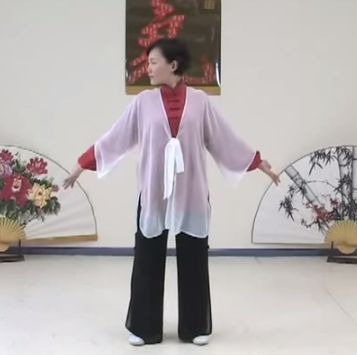
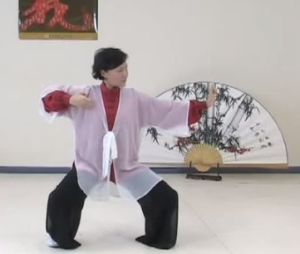
Step left, sinking to horse stance in crosshands position. Look left and point left with the left hand while drawing back the right hand to the shoulder (elbow back). Then look right, extend the right arm, lower the arms, and straighten up.

We do this four times on each side, starting with the left side and alternating. Matoko Rashka describes a rather different version in which you shift from left bow stance to right bow stance. In either case, inhale while “drawing the bow” and exhale while switching sides.

Eight Pieces of Brocade

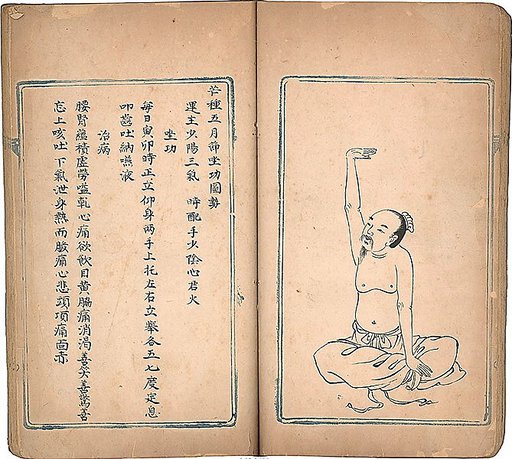
Ba Duan Jin is a Qigong routine that consists of eight exercises and takes about twelve minutes. The routine is “medical” rather than martial–practiced for its health benefits, and it is at least a thousand years old, mentioned and illustrated in Song Dynasty encyclopedias (the illustration below is not that old).

baduanjin-qigong

Sources of information:

Many videos are available on YouTube. I like the one by Master Faye Li Yip. The one by Peter Chen is good, too.

bdjfaye

The names of the eight exercises vary, especially in English, but even in Chinese to some extent. Below, I am following Matoko Rashka:

  1. Shuāng shǒu qíng tiān lǐ sān jiāo – Support the Heavens to Condition San Jiao
  2. Zuǒ yòu kāi gōng sì shè diāo – Draw the Bow to Shoot the Eagle
  3. Tiáo lǐ pí wèi dān jǔ shǒu – Raise the Hand to Condition the Spleen and Stomach
  4. Wǔ láo qī shāng xiàng hòu qiáo – Look Backward to Elimnate Five Fatigues and Seven Illnesses
  5. Yáo tóu bǎi wěi qù xīn huǒ – Swing the Head and Tail to Eliminate Xin Huo
  6. Liǎng shǒu pān jiǎo gù shèn yāo – Hold the Feet to Strengthen the Kidney and Lower Back
  7. Wò quán nù mù zēng lì qi – Punch with Fierce Glower to Build Strength
  8. Bèi hòu qī diān bǎi bìng xiāo – Shake the Back Seven Times to Prevent Illness

Additional Ba Duan Jin pages: 1 | 2 | 3 | 4

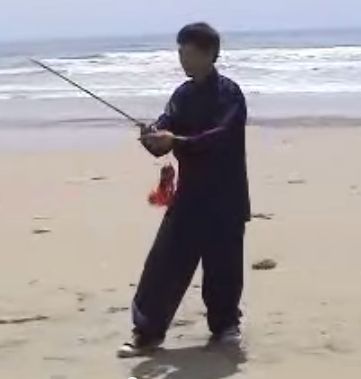
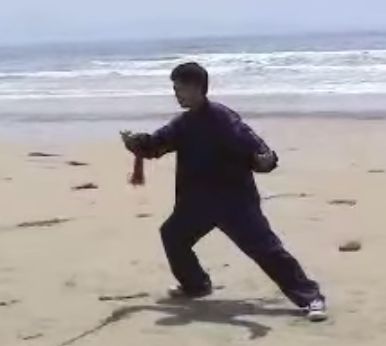
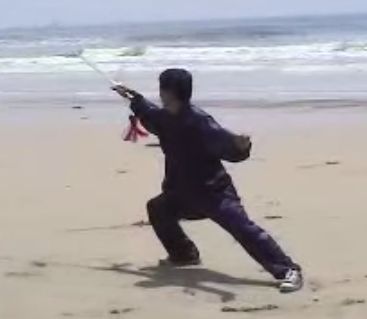
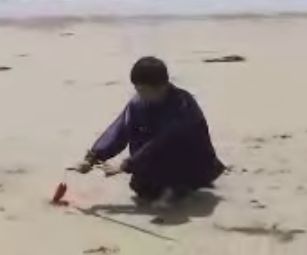
Wudang Notes 8

Last section. We ended in ding bu ci jian. As best I can tell, the blade is edgewise–that is, its edge is perpendicular to the ground, so the back of the hand faces to the right.

45. Ding bu bao jian: Hold Sword in T-Stance. Step back to the left, from left ding bu to right ding bu. At the same time, beng jian to the embracing sword position as shown below.

8-baojian

46. Xing bu chuan jian: Bagua Walking with Piercing Sword. Turn the sword over, counterclockwise from palm-up to palm-down and block away. At the same time start walking (1) right (2) left (3) right in a circle. Block away with left hand on forearm on (1). Open arms on (2) and (3). On the fourth step (which is on the left) close the arms, stabbing under the left arm, across the ribs–chuan–which is palm-up. On the fifth step, which completes the circle, open the arms, still holding the sword palm-up.

He has just stabbed across his body to the left.

He has just stabbed across his body to the left–chuan jian.

47. Kou jian ping ma: Cover Sword and Spread Flat. Kou is fasten or button, ma is wipe. On the sixth step, turn the left foot in and face front. Step back (7) on the right foot and adjust the left foot to Xu bu. On 7, also make a counterclockwise circle with the wrist to turn the sword over, pulling back and down with both hands (like before the jump, teng kong tiao ci).

8-koujian

48. Bing bu ping ci: feet together level stab. This is a repeat of White Ape Offers Fruit, aka the Compass.

8-shoushi

49. Shou Shi: Step left and reach under with the left palm up, thumb to the right. Step right, left hand high, right low. Bring up the left foot, left hand down, right high. Close form.

Wudang Notes 7

The next to last section is only six moves, and begins at the 2:05 mark on the YouTube video (which cuts away from the demo before this section is finished). From the second xie bu, we finished in cha bu, palm-down.

7-yangshen

39. Xu bu bao jian: Hold Sword in Empty Stance. Step back to the left and slash left with the sword. He changes from palm-down to palm-up just before the sword passes in front of his face. The movement in front of the face is a lot like the yang shen in an earlier move (yang shen jia jian), except he leans away to the right, as shown above. He finishes as shown below (and as described by the name of the move).

7-baojian

40. Cha bu ping dai: Cross and Carry Sword Flat. He says to diagonally fly, and that’s exactly how this move begins. I also know this from Yang sword as Phoenix Spreads Wings. But that’s just the first part of the movement. Below, he diagonally flies.

7-diagonally

Slash back, still palm-up (left crosses chest), then turn palm-down to finish in cha bu with the left leg in back. On that last slash back, lift the hilt and circle counterclockwise to finish as below.

7-chabu

41. Gong bu ping beng: Flick Sword in Bow Stance (these are the English names that Master Tsao gives–his own translation, I think). He scoops into crosshands standing up on the left leg and lifting the right knee. As he uncoils, he bends pretty deep so he’s opening up palm-down. Below, I’ve tried to catch him right before he flicks the sword–still palm-down.

7-prebeng

He flicks (beng) to palm-up (gets a pretty good snap!) and finishes in bow stance, as shown below.

7-gongbu

42. Ti xi dian jian: Lift Right Knee with Pecking Sword. Turn, as in zhuan shen, and do this:

7-tixi

43. Cha bu fan liao: Back Slash in Cross Stance. Repeat move number 7!

7-dingbu

44. Ding bu ci jian: Thrust Sword in T-Stance. Step left right to left ding bu, stabbing forward as shown above. That is Master Liang. Reviewing that video now, I see that the flourish he adds to gong bu gua pi is even more elaborate than the optional version Master Tsao demonstrates. Check it out!

Wudang Notes 6

This section (which starts at about 1:45 on the YouTube video) includes the two xie bu and, between them, three moves that are straight out of 32-sword. This section also includes an optional flourish in the middle of the wheeling movement, gong bu gua pi.

JT6-1

33. Xie bu ya jian: Press Down in Resting Stance. From the Xia Ci, shift left and slice left. The left hand circles in, then around to press down on the sword in xie bu (right foot in front).

JT6-2

34. Xu bu dian jian: The charming traditional name for this move is Heavenly Horse Flies Across Sky. Stand up on the right leg, step left to right xu bu. Just like 32-sword.

JT6-4

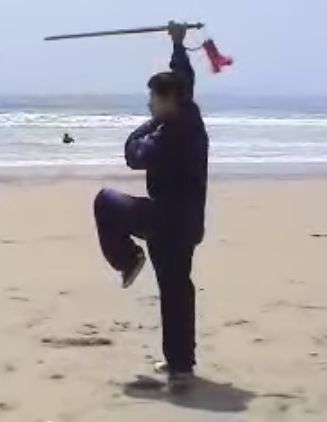
35. Du li tuo jia: Lift Curtain on One Leg. Also straight out of 32-sword. Block to the left, circle down in a squat (shown above), turn and stand up on the right leg. In du li shown below, the left hand touches the arm and the sword is parallel to the ground.

JT6-3

36. Gong bu gua pi: Cutting in Bow Stance. The simplest version of this move is to wheel the sword left and step straight into the finishing position shown below.

JT6-5

Optional flourish: Wheel the sword first left (on left foot), then right (on right foot), and leap to the position shown below.

JT6-6

The leap (which is between 1:55 and 2:00 on the video) is from right foot to left foot, and the right crosses behind the left, as shown above. From there, unwind and chop down to the finishing position.

Second xie bu with right foot crossed behind

Second xie bu with right foot crossed behind

37. Xie bu hou jian: Thrust Backward in Resting Stance.Draw the sword back to take this position. For the second xie bu the right foot crosses behind, and instead of pressing down on the sword, stab backward (hou means back) as shown.

JT6-7

38. Cha bu yun zhan: Cut Flat in Cross Stance. Step out to the right, sword following (palm up), then shift back to the left to circle the sword in front of the face (yun), as shown above, and chop to the right (zhan). Finish palm down, in cha bu (right foot crossed behind), left warding off high, sword pointing up (below).

JT6-8

Wudang Notes 5

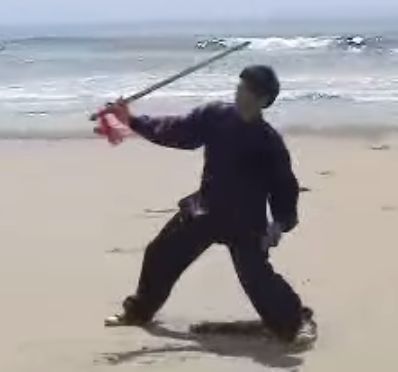
This has been the hardest section for me because of the double turn following the cutting kick shown below. Grabs are from the YouTube video, but I am studying the instructional video available from Taichihealthways by Jesse Tsao.
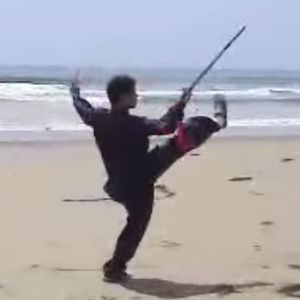
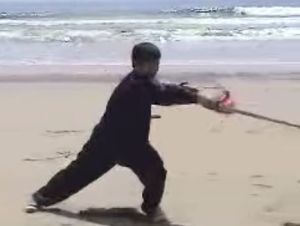
The kick with liao in lesson 5

The kick with liao in lesson 5

27. Zhuan shen hui chou: Turn Body to Pull Sword Back. This movement is familiar from 32-sword. My only new notes are that he chops out to the left front corner before withdrawing–and hiding, he says–the sword. So, four counts are turn, chop, pull back, and point. The sword finger points in that same diagonal direction.
A definite chop after zhuan shen

A definite chop after zhuan shen

28. Bing bu ping ci: Also familiar; White Ape Offers Fruit, also known as the Compass. Take a definite step to the left and point the sword slightly higher than shoulder level (although ping means level).

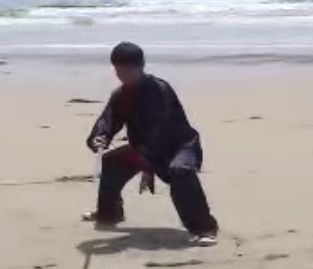
29. Xing bu liao jian: Dragon Walking with Slicing Sword (!). Step well back on the right, blocking up and back with the sword. Left hand to shoulder, ding bu with the left foot. The run goes left-right-left CUT, then right-left-right CUT. The cuts are up (lift sword). Start each run with a little kickback. The pattern is an S, rather than a zigzag; curve left, then right.

Preparing for the Dragon Walking

Preparing for the Dragon Walking

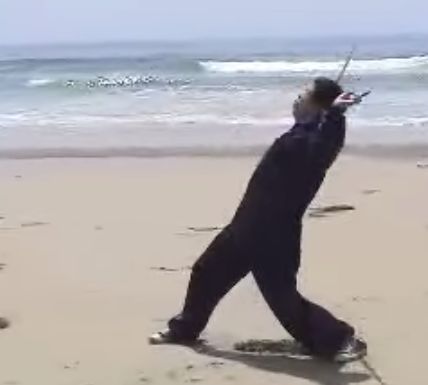
30. Yang shen liao jian: the kick is Lean Body to Cut Upward, a fen jiao, not a deng jiao as I thought. Yang shen is that body-facing-upward stance we’ve already done (as in Yang Shen Jia Jian). Flick the sword to cut up, palm facing in: liao.

31. Gai bu an jian: Cross to Cut Down. Gai means cover. Drop down from the kick onto the right foot facing front and make a small wrist circle with the sword. Then step across with the left foot facing front (release the heel of the right) while pulling down on the sword and covering with the left sword hand.
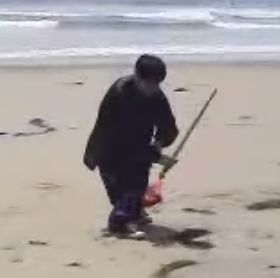
JTkick4

The hard part of this section is the transitional flourish between the covering posture and the skip-and-stab that follows. (1) From the cover position shown above, swing all the way around, sword following body in a big circle, both feet pivoting. (2) Step back with the right foot while making a small wrist-circle with the sword. (3) Pivot on the right heel to face the back while pulling the sword all the way around to a high position as shown below.

JTkick5

So it’s little circle, big circle, little circle, big circle. Then add one last (optional, but why not?) little circle as a flower before beginning the skipping move.

Finishing position for this section: gong bu xia ci

Finishing position for this section: gong bu xia ci

32. Tiao bu xia ci: Hop to Thrust Downward. Step left, skip to right gong bu and stab downward, left hand high.

Wudang Notes 4

We’re almost halfway through the form. Lesson four includes the leap.
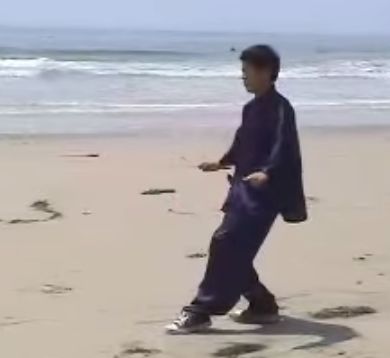
In position for the leap.

Master Tsao in position for the leap.

20. Teng kong tiao ci: Leaping Thrust. Tiao is leap, kong is sky, and teng is soar. Leap to soar in the sky? Shift left from the xia ci, turning the right toe in and pulling the sword around with both hands. Then shift onto the right foot, pressing down with both hand, left xu bu, as shown above. Jump from the left foot, turning the right foot all the way in to land facing the back as shown below. JT4-2   21. Ma bu cang jian: Hidden Sword in Horse Stance. Note that the left foot faces forward. Both hands are palm-down, the left covering the right and the sword. The sword is flat–and sure enough, you can’t see it! JT4-3 22. Hui shen fan ci: Turn to Thrust Downward. From ma bu step around to the left, stabbing up and pivoting on the right toe. Then stab down behind you as shown above. JT4-4 23. Xu bu beng jian: Flick Sword Up in Empty Stance. Shift back to right xu bu and collapse the sword.

24. Du li shang ci: Step around to the right, pivot the left heel, rock back to swivel the right heel in, then shift forward into du li shang ci. Long Feng sometimes makes these shifts into steps, right, left, right. In any case, the du li is on the right foot. JT4-5 25. Che bu yun zhan: Che bu is a new one for me. It means to withdraw–step back with the left. I’m not sure how that’s different from tui bu, but you can see above how he is standing. Zhan is chop, or even behead. The turn of the sword inward is from the wrist; the arm hardly moves, and it stays flat. Then the cut is right to left. The left hand pulls down across the chest into a ward-off left, which gives some torque to the cut. JT4-6 26. Yang shen jia jian: Face Up to Ward Off. From both hands together and the sword in front, circle the sword flat in front of the face as shown, then cut from right to left, level, hands together in front again.

For best results, I highly recommend Jesse Tsao’s instructional video, available from taichihealthways.com.