
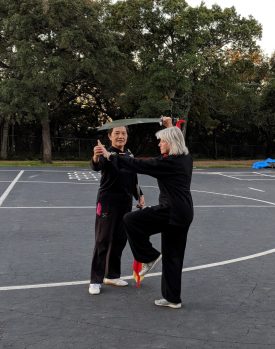
One of my favorite Chinese Tai Chi friends has recently returned to Austin, and I have begun practicing with her again. Wonderful! She speaks no English. No problem! I speak Taijiese.
Taijiese is not conversational Chinese, which I do not know. It is pidgin Chinese, if you will. “Pidgin” is “a simplified form of English for communication between groups that don’t share a common language.”
Except where pidgin is traditionally made up of simple English words, Taijiese is based on Chinese. Key words and minimal grammar, combined with pantomime and lots of nodding and smiling, can get simple ideas across the language barrier.
One of the things my friend and I need to communicate on any given day is when and where we will practice next. For this, it helps to know:
明天 Míngtiān Tomorrow
And the days of the week. There are several ways of naming the days of the week, but the people I know mostly use:
礼拜 Lǐbài Week
The days of the week are numbered, starting with Monday.
礼拜一 Lǐbài Yī Monday – literally “week [day] one”
礼拜二 Lǐbài Èr Tuesday
礼拜三 Lǐbài Sān Wednesday
礼拜四 Lǐbài sì Thursday
礼拜五 Lǐbài Wǔ Friday
礼拜六 Lǐbài Liù Saturday
Sunday is different. Again, there are several expressions for Sunday, but I know:
礼拜天 Lǐbàitiān Sunday
Next is useful too:
下个 Xiàgè Next
Next week
下个礼拜 Xiàgè Lǐbài Next week
下个礼拜一 Xiàgè Lǐbài Yī Next Monday
We need one more word:
见 Jiàn See you
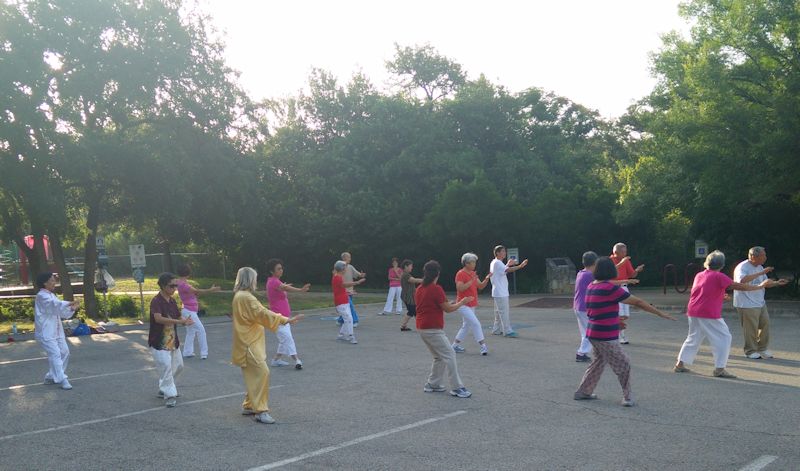
For a number of years, I used to practice with a group every weekend. At the end of practice on Saturday, I would say:
明天见 Míngtiān jiàn See you tomorrow!
At the end of practice on Sunday, I would say,
下个礼拜六见 Xiàgè Lǐbài Liù Jiàn! See you next Saturday!
For anything more complicated than that, we might have to open our calendars.
We also need to agree about times. For this we need only the numbers and the word for hour, o’clock.
点 Diǎn O’clock
八点 Bā diǎn Eight o’clock
半 Bàn Half
八点半 Bā diǎn bàn Eight-thirty 8:30
八点一刻 Bā diǎn yī kè Quarter past 8 (literally eight o’clock one quarter) 8:15
To say we’ll meet “here,” I just point at the ground. We both nod. That works. But there is a school where we sometimes practice:
学校 Xuéxiào School
公园 Gōngyuán Park
For coming to practice, we use:
来 Lái Come
你来 Nǐ lái? Are you coming?
This last is probably not very elegant sounding in Chinese—you come? Like Tarzan. But it works.
你来明天 Nǐ lái míngtiān? Are you coming tomorrow?
Rising inflection and raised eyebrows make it a question.
We answer such questions with head shakes or “Yeah!”
This is helpful:
能 Néng Indicates can
不能 Bùnéng can’t (literally no can)
So the other day, as my friend and I were winding up after an hour, we agreed:
回家 Huí jiā Return home (go home)
That’s enough to indicate that we are done for the day. I wasn’t going to be able to meet her the next day, so I said,
明天我不能来 Míngtiān wǒ bùnéng lái I can’t come tomorrow
She said okay.
I then said, in an interrogative voice,
你能来礼拜四 Nǐ néng lái lǐbài sì? Can you come Thursday?
She said, “Yeah!”
I said,
九点半 Jiǔ diǎn bàn? Nine-thirty?
Yeah!
When I left, I said,
礼拜四见 Lǐbài sì jiàn! See you Thursday!
 Tai Chi Notebook