
When and Where?

One of my favorite Chinese Tai Chi friends has recently returned to Austin, and I have begun practicing with her again. Wonderful! She speaks no English. No problem! I speak Taijiese.
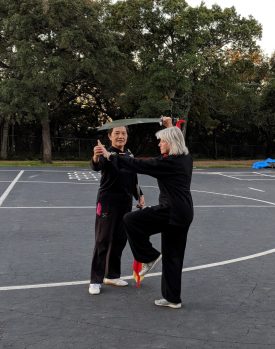
two people practicing tai chi in a park

Taijiese is not conversational Chinese, which I do not know. It is pidgin Chinese, if you will. “Pidgin” is “a simplified form of English for communication between groups that don’t share a common language.”

Except where pidgin is traditionally made up of simple English words, Taijiese is based on Chinese. Key words and minimal grammar, combined with pantomime and lots of nodding and smiling, can get simple ideas across the language barrier.

One of the things my friend and I need to communicate on any given day is when and where we will practice next. For this, it helps to know:

明天  Míngtiān Tomorrow

And the days of the week. There are several ways of naming the days of the week, but the people I know mostly use:

礼拜  Lǐbài   Week

The days of the week are numbered, starting with Monday.

礼拜一              Lǐbài Yī   Monday – literally “week [day] one”

礼拜二              Lǐbài Èr   Tuesday

礼拜三              Lǐbài Sān   Wednesday

礼拜四              Lǐbài sì   Thursday

礼拜五              Lǐbài Wǔ   Friday

礼拜六              Lǐbài Liù Saturday

Sunday is different. Again, there are several expressions for Sunday, but I know:

礼拜天      Lǐbàitiān   Sunday

Next is useful too:

下个  Xiàgè   Next

Next week

下个礼拜    Xiàgè Lǐbài   Next week

下个礼拜一 Xiàgè Lǐbài Yī     Next Monday

We need one more word:

见        Jiàn   See you
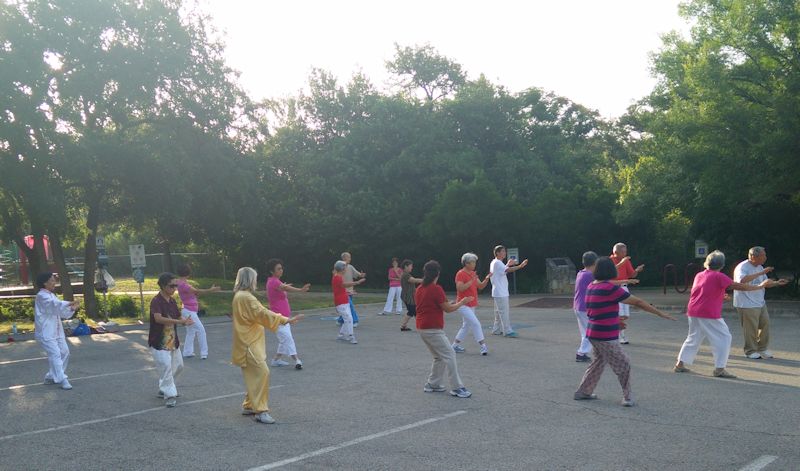
Practicing tai chi with a group in a park

For a number of years, I used to practice with a group every weekend. At the end of practice on Saturday, I would say:

明天见            Míngtiān jiàn   See you tomorrow!

At the end of practice on Sunday, I would say,

下个礼拜六见      Xiàgè Lǐbài Liù Jiàn!   See you next Saturday!

For anything more complicated than that, we might have to open our calendars.

We also need to agree about times. For this we need only the numbers and the word for hour, o’clock.

点    Diǎn  O’clock

八点  Bā diǎn   Eight o’clock

半    Bàn   Half

八点半 Bā diǎn bàn     Eight-thirty 8:30

八点一刻    Bā diǎn yī kè   Quarter past 8 (literally eight o’clock one quarter) 8:15

To say we’ll meet “here,” I just point at the ground. We both nod. That works. But there is a school where we sometimes practice:

学校  Xuéxiào    School

公园  Gōngyuán    Park

For coming to practice, we use:

来    Lái   Come

你来  Nǐ lái?  Are you coming?

This last is probably not very elegant sounding in Chinese—you come? Like Tarzan. But it works.

你来明天    Nǐ lái míngtiān?  Are you coming tomorrow?

Rising inflection and raised eyebrows make it a question.

We answer such questions with head shakes or “Yeah!”

This is helpful:

能    Néng    Indicates can

不能  Bùnéng     can’t (literally no can)

So the other day, as my friend and I were winding up after an hour, we agreed:

回家  Huí jiā    Return home (go home)

That’s enough to indicate that we are done for the day. I wasn’t going to be able to meet her the next day, so I said,

明天我不能来      Míngtiān wǒ bùnéng lái   I can’t come tomorrow

She said okay.

I then said, in an interrogative voice,

你能来礼拜四              Nǐ néng lái lǐbài sì?   Can you come Thursday?

She said, “Yeah!”

I said,

九点半      Jiǔ diǎn bàn?   Nine-thirty?

Yeah!

When I left, I said,

礼拜四见        Lǐbài sì jiàn!    See you Thursday!

Pleasantries

[An addition to the Taijiese section of TaiChiNotebook.com]

While I haven’t attempted to learn conversational Chinese, a little bit is helpful in the context of Tai Chi practice. This short section is especially tailored for the situation (in which I have found myself more or less continuously for years now) where you have the opportunity to meet and practice tai chi with a group of people who do not speak any English.

I make no effort here to provide grammatical niceties. This is pure vocabulary, which when strung together with some pantomime and good will can facilitate friendly relations across the language barrier.

Perhaps the most important phrase in any language:

谢谢     Xièxiè    Thank you

As a greeting, ni hao works in all circumstances, among both friends and strangers. Literally, “you good” I suppose it’s like “How do you do?” But it’s not really a question. If you add me, it becomes an actual question, “Are you good?” to which you could reply, “Hen hao!” Very good! We also say Zao shang hao for good morning.

你好                    Nǐ hǎo                 General greeting

吗                       Ma                      Suffix forms interrogative

你好吗       Nǐ hǎo ma?              How are you?

早上好                Zǎoshang hǎo              Good morning

It is very useful to know the personal pronouns. They are not declined. Relax: You don’t even have to know what declension is! I say no more.

我          Wǒ        I, me

你          Nǐ           You

他          Tā          He/she/it

Form the plurals by adding the suffix, men.

们     Men                    Indicates plurality

我们      Wǒ men              We, us

你们   Nǐ men                You (plural) (Y’all!)

他们      Tā men                They, them

Good to know the possessive form as well, which is also formed with a suffix: de.

的          De          Suffix to indicate possession

我的      Wǒ de   My, mine

你的      Nǐ de     Your, yours

他的      Tā de     His/hers/its

Plural possessive is just as you would suspect:

我们的 Wǒ men de              Our/ours

你们的 Nǐ men de              Your/yours

他们的 Tā men de              Their/theirs

Exchanging names:

名字      Míngzi                 Name

是          Shì                       is

什么      Shénme              What

Now you can say:

我的名字是                     Wǒ de míngzì shì           My name is

你的名字是什么?          Nǐ de [your] míngzì [name] shì [is] shénme? [what?]            What is your name?

他的名字是什么?          Tā de [his/her] míngzì shì shénme? [what?] What is his/her name?

My name, Elizabeth, has been quite difficult for the Chinese people I’ve met. Apparently it is very long and strange-sounding to a Chinese person who speaks no English. Fortunately, there is a Chinese  equivalent for a number of English names. Mine is Yi Li Sha Bai, which everyone finds easy to say. You might check whether your name has a Chinese equivalent. Google Translate works:

伊丽莎白     Yīlìshābái              Elizabeth

托马斯       Tuōmǎsī              Thomas

苏珊          Sū shān               Susan

大卫          Dà wèi                David

莉莉                    Lìlì                        Lily

Since we’ve got the possessive, it might be good to know this and that:

这个   Zhège    This, this one

那个      Nàge     That, that one

Zhege shi ni de? This is yours? Add me to make a question:

这个是你的么 Zhege shi ni de me? Is this yours?

不是   bù shì    Is not

Bu shi wo de. It’s not mine.

扇     Shàn      Fan

Zhege shan bu shi wo de. That fan isn’t mine.

And I like knowing this word:

朋友   Péngyou             Friend

Zhege shi wode Taiji pengyou. This is my Tai Chi friend.

For good-bye, bye and bye-bye work, but this is good to know:

再          Zài         Again

见          Jiàn        See you

The informal zai jian works as a friendly good-bye:

再见   Zàijiàn   See you again